
Google's New Patent Makes Private AI Training Far Less Expensive to Run
Training an AI model while keeping individual people's data genuinely private is expensive, and Google thinks it's found a way to make it significantly cheaper. This patent describes a training approach that caps the total computation at a level that scales linearly with the size of the dataset, rather than ballooning out of control.
What Google's privacy-safe AI training actually does
Imagine a hospital wants to train an AI to detect disease, but it can't let the AI memorize any individual patient's records. The standard fix, called differential privacy, works by injecting carefully calibrated random noise into the training process so no single person's data leaves a detectable fingerprint. The catch is that this protection usually requires enormous amounts of computation.
Google's patent describes a way to train that same AI with a hard upper limit on how much work the computer has to do. Specifically, the total number of calculations can't exceed the square of the number of training examples, which sounds like a lot but is actually a meaningful ceiling that previous methods couldn't reliably stay under.
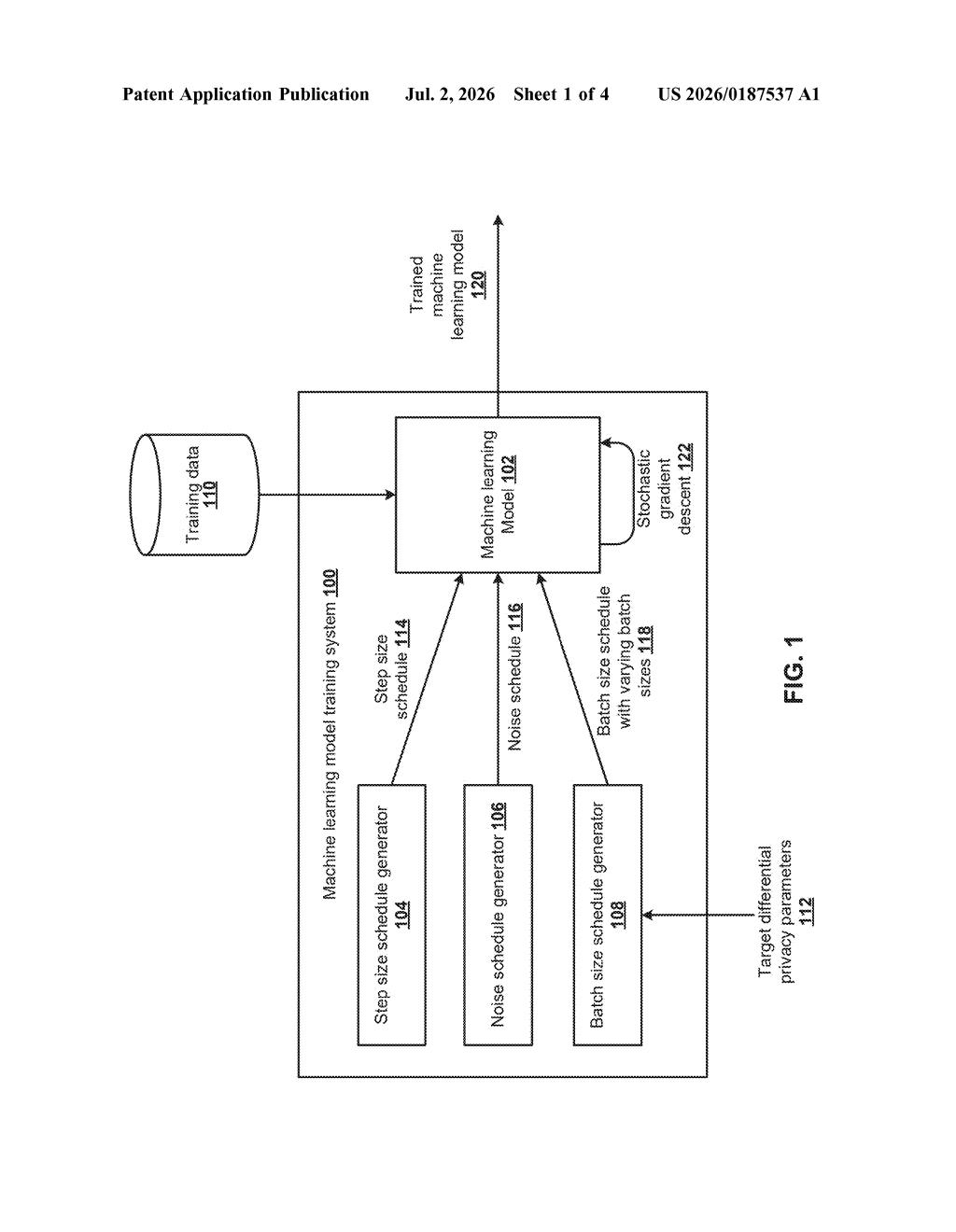
The key insight is that Google controls three dials at once: how big each learning step is, how much noise gets added, and how many examples get sampled per step. By carefully coordinating those three things, the system can hit the privacy target without the computation spiraling upward.
How the noise schedules and batch sizes keep data private
The patent describes a training algorithm built around differentially private stochastic gradient descent (DP-SGD), the standard way to train AI models without memorizing individual data points. In plain terms: each training step looks at a small random batch of examples, computes which direction to nudge the model, then deliberately blurs that direction with random noise before applying it. The noise prevents the model from encoding anyone's specific data.
What's new here is the precise coordination of three schedules that run simultaneously:
- Step size schedule: how aggressively the model updates its parameters at each iteration
- Noise schedule: how much random interference gets injected, calibrated to the privacy target
- Batch size schedule: how many training examples are sampled per step, and crucially, this number varies across training rather than staying fixed
The mathematical claim is that the total number of gradient computations (the core unit of training cost) stays at or below n², where n is the number of training examples. For prior DP-SGD approaches, the computation could grow much faster. The patent frames this as a linear time algorithm in a specific theoretical sense: the complexity scales in a controlled, predictable way relative to the dataset size.
The target privacy level is specified upfront using differential privacy parameters (technically epsilon and delta, which bound how much any single example can influence the final model). The algorithm then works backward to set the three schedules so training satisfies that guarantee at minimum cost.
What this means for AI trained on sensitive data
Differential privacy is the gold standard for training AI on sensitive data, including medical records, financial history, and personal communications. The reason it isn't used more widely is cost: the noise injection requires more training steps or larger models to compensate, and the computation adds up fast. If Google's approach genuinely holds the computation to n² gradient steps, it makes private AI training viable at scales where it currently isn't.
For you as a user, this matters because it affects which AI products can realistically be built with strong privacy guarantees. Models trained on health data, search history, or private messages could become more accurate without requiring engineers to choose between privacy and performance. Google's own products, from Search to health-adjacent features in Android, are obvious candidates where this tradeoff comes up constantly.
This is a important piece of theoretical ML infrastructure. Differential privacy has been a stated Google priority for years, but the practical cost has always been a real constraint. A patent that frames a tighter computational bound as the central claim is betting that this algorithm will actually ship in training pipelines, not just appear in a research paper. Whether the bound holds in messy real-world training runs is the real question.
Get our take in your Top Stories
Liked this breakdown? Add Patentlyze as a preferred source on Google, and our plain-English take shows up more often in your Top Stories the next time Google patent news breaks.
There are more where this came from
We read every patent application Big Tech publishes and send you the ones worth knowing. Plain English, free, every week.
Want this weekly breakdown for a company we don't cover? Patentlyze Pro →