
Google Files Patent for an AI Production Crew That Makes Ads for Each Audience
Getting an AI to draw a person walking without melting a leg into a railing is harder than it sounds, and Google's patent application tackles it with a team of AI helpers plus a critic that sends bad images back.
What Google's AI ad-making crew actually does
An advertiser types in a product, a brand, a city and an age range. Out comes a short ad: a 21-year-old in white sneakers striding down a sunny park path, with music picked to match. Behind that ad is a whole crew of AI helpers, each with its own job.
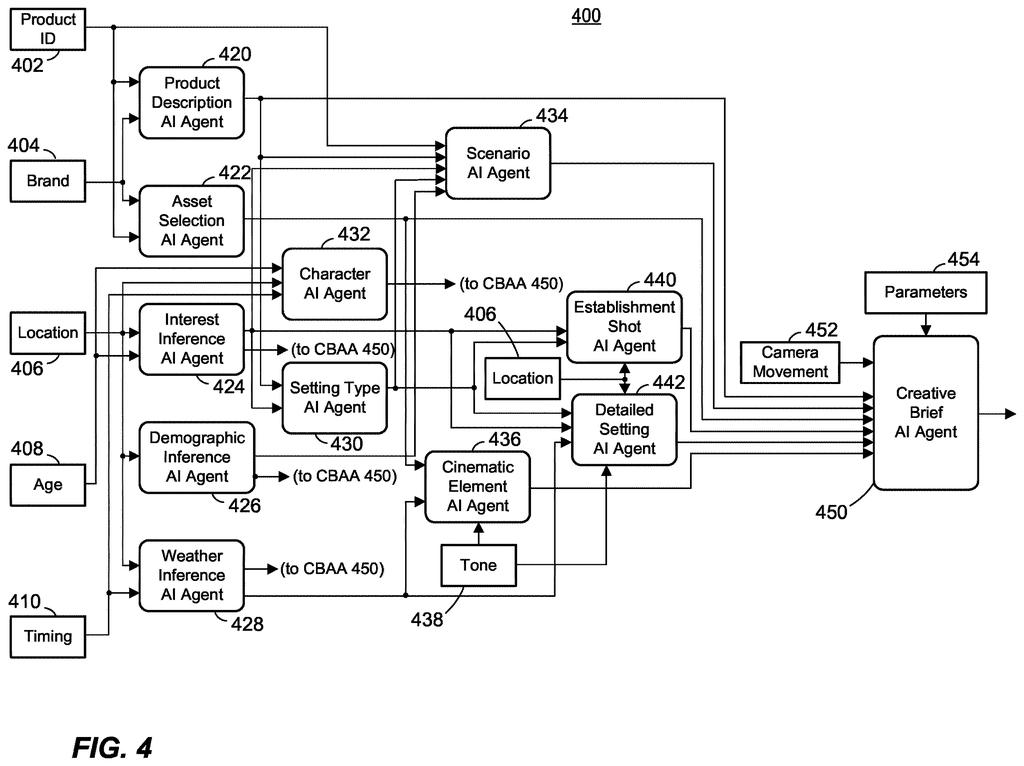
In Google's patent application, one AI guesses what people of that age in that place probably care about. Others choose the setting, the storyline and how the characters look. A final one combines it all into a written plan, called a creative brief, and hands it to an AI image or video maker.
Then a second AI plays critic. It spots flaws, like an arm that melts into a railing, and sends notes back so the picture gets redone. So the next ad that seems to know your age and your town may have been planned by a committee of machines.
inferring, by an audience inference AI agent and based on at least one of the one or more audience parameters, one or more characteristics of the audience; generating, by a setting AI agent and based on (i) at least one of the one or more product parameters and (ii) the inferred one or more characteristics of the audience, a setting descriptor; …
Translation: Specialized AI tools analyze the buyer group and figure out the ideal background setting for the advertisement.
How the AI critic sends bad images back
The main claim covers a relay of specialized AI agents (separate AI models, each handed one narrow job). You supply product details (a name, a brand) and audience details (such as location and age). Then:
- An audience inference agent guesses traits you didn't supply, like interests or income level.
- A setting agent and a scenario agent each describe where the scene happens and what unfolds.
- A creative brief agent merges everything into one written plan, which becomes the prompt for an image or video model.
Optional helpers handle characters, lighting and camera shots, voiceover and music genre. Age can map to a tone: 18 to 24 gets 'energetic, trendy,' while 60 and up gets 'cinematic, warm.' Number codes like 1857 (shot, angle, motion, lighting) also nudge each agent toward a different look, so thousands of ads don't blur together.
A separate claim covers an actor-critic loop. The 'actor' model makes the image, a 'critic' model flags flaws, and a third model rewrites the prompt so the actor can retry. Short lessons from past rounds get saved and fed into future prompts. The filing says this cuts the images needed for one good result from over 100 to roughly 30 or fewer.
… using a setting AI agent to generate a setting descriptor based on at least one product parameter and the inferred audience characteristic(s), using a scenario agent to generate a scenario descriptor based on at least one product parameter and the inferred audience characteristic(s), and using a creative brief AI agent to generate the creative brief …
Translation: Different artificial intelligence roles collaborate to design the environment and storyline for the promotional video.
What this means for the ads aimed at you
If you run a small business, the pitch is simple: type in a product and an audience, and get a polished ad without a film crew. For everyone else, it means more ads built around people like you, with the weather, setting and music chosen to match your age and where you live. The filing says the aim is better click-through and conversion rates.
The filing also tries to keep AI ads from going off the rails. It describes feeding in brand safety rules and industry regulations, and checking recent news so a scenario doesn't echo a bad headline. Keep in mind this is a patent application, not a product announcement, and it doesn't say if or when anything ships.
Google files its 26th application we've tracked since May on our AI models working in teams watchlist, following its two-model search ranker and software-monitoring agent network.
Anyone who has asked an AI for a picture of a person walking has seen the trouble: extra fingers, melted legs, a shoe fused to the pavement. Google's own filing puts the yield at one usable image out of well over 100 tries, which makes cheap AI ads a lot less cheap.
The answer fits the size of that problem. A critic that inspects each result and writes notes is a sensible way to cut waste, and about 30 tries is a big step down from 100. Thirty tries for one keeper remains a hefty bill, and that figure comes from Google's own tests.
The audience side of the plan is thinner. Guessing the lifestyle of everyone aged 21 in a given city from two facts produces a stereotype with good lighting. The filing claims higher click rates but offers no numbers for that.
Get our take in your Top Stories
Liked this breakdown? Add Patentlyze as a preferred source on Google, and our plain-English take shows up more often in your Top Stories the next time Google patent news breaks.
There are more where this came from
We read every patent application Big Tech publishes and send you the ones worth knowing. Plain English, free, every week.
The drawings
9 drawing sheets from US 2026/0311384 A1 · click any drawing to enlarge


Want this weekly breakdown for a company we don't cover? Patentlyze Pro →
Be the first to weigh in