
Google Patents Technology to Keep Video and Call Quality Consistent Across Shared Cell Towers
Modern cell towers are often split into two separate processing units, and keeping them in sync on what traffic matters most turns out to be surprisingly hard. Google is filing patents around exactly that coordination problem.
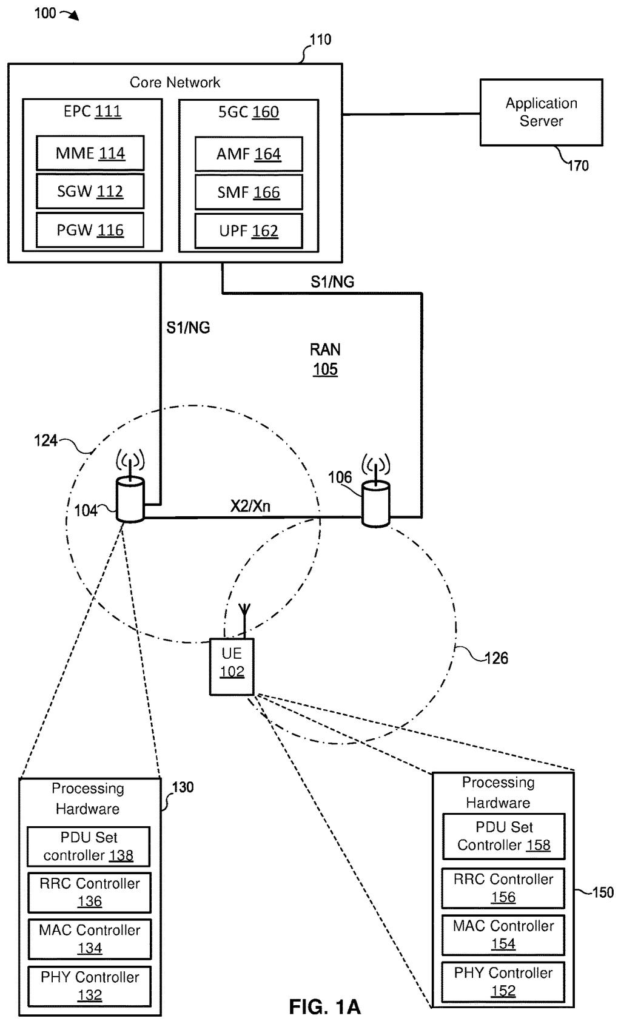
How Google's split-tower patent handles video vs. Data priority
Every time your phone streams a video or joins a voice call, the cell tower handling your connection has to decide what kind of traffic you're sending and how urgently to push it through. That decision has to happen fast and correctly, or your call drops or your video buffers.
The tricky part: many modern towers aren't one box anymore. They're split into two separate units, a central one that handles the heavy thinking and a local one closer to you that handles the actual radio signals. These two halves have to agree on the same priority rules for your data, or things break down.
Google's patent describes a method where the central unit sends a formal request to the local unit, including specific priority settings for a particular type of data flow. The local unit replies to confirm, and only then does data start moving. It's a simple handshake idea, but getting it formally specified matters for building equipment that all works together.
transmitting, to the DU, a request related to a context of a UE that communicates with a core network (CN) via the DU and the CU, the request including a packet data unit (PDU) Set quality of service (QoS) parameter for a QoS flow; …
Translation: The central network controller sends instructions to the local cell tower about the required video quality.
How the CU and DU negotiate QoS flow parameters
The patent covers a coordination method inside what's called a distributed base station, the type of cell tower architecture common in 5G deployments. Instead of one monolithic tower, the station is split into a Centralized Unit (CU), which handles higher-level logic like connecting to the core network, and a Distributed Unit (DU), which sits closer to antennas and handles radio-layer details.
The specific problem being solved involves PDU Set QoS parameters. A PDU Set is a group of data packets that belong together and need to be treated as a unit (think one video frame made up of many packets). QoS, or Quality of Service, is the system that tells the network how urgently to deliver different types of traffic. A live video call needs low delay; a background file sync can wait.
The method works like this:
- The CU sends a request to the DU that includes QoS settings tied to a specific data flow for a specific user device.
- The DU receives those settings and sends back a response confirming it understands them.
- Data then flows between the user's device and the core network, with both halves of the tower applying the same priority rules.
The claim is narrow and procedural, focused on the signaling exchange itself rather than any particular algorithm for deciding which traffic is most important.
What this means for 5G network reliability at scale
In 5G networks, the split-tower architecture is becoming standard because it lets operators centralize expensive computing while keeping antennas distributed and cheap. But splitting a tower means splitting responsibility, and any gap between what the two halves understand about a user's data flow can cause dropped calls, buffering, or dropped connections during hand-offs.
For everyday users, this kind of patent is invisible infrastructure. If it works, your video call stays smooth as you move around a venue covered by multiple antennas feeding the same central unit. If coordination like this isn't standardized, different hardware vendors' equipment may not interoperate cleanly, which is a real problem for carriers mixing and matching gear from different suppliers.
Google's 742nd filing we've tracked since May in our Google coverage continues its network focus, building on the XR video quality patent and the on-demand device linking application.
The engineering tradeoff here is deliberate: adding a formal request-response handshake between the CU and DU before any data flows means guaranteed alignment on priority rules, but it also adds a round-trip of latency to session setup. For a 5G system advertising sub-millisecond response times, that setup cost is worth scrutinizing.
The bet reads as reasonable for the cases that matter most, like voice calls or XR streaming, where getting priority wrong is far more expensive than a slightly slower connection start. For bulk data transfers, the overhead barely matters. So the tradeoff is asymmetric in a good way: the cost is small and one-time, the benefit is continuous.
That said, this patent is narrow. It specifies a handshake, not a new way of deciding priorities. Whether the priority values being exchanged are themselves well-chosen is a separate problem entirely, and this filing doesn't touch it.
There are more where this came from
We read every patent application Big Tech publishes and send you the ones worth knowing. Plain English, free, every week.
The drawings
16 drawing sheets from US 2026/0292585 A1 · click any drawing to enlarge


Want this weekly breakdown for a company we don't cover? Patentlyze Pro →
Be the first to weigh in