
Google's New Patent Teaches Devices to Recognize Objects Using Only Radar Echoes
Google is working on a way for devices to recognize objects — like your hand, a cup, or a person — using only the echoes from radar pulses, no camera involved. The system could then use that recognition to trigger actions automatically.
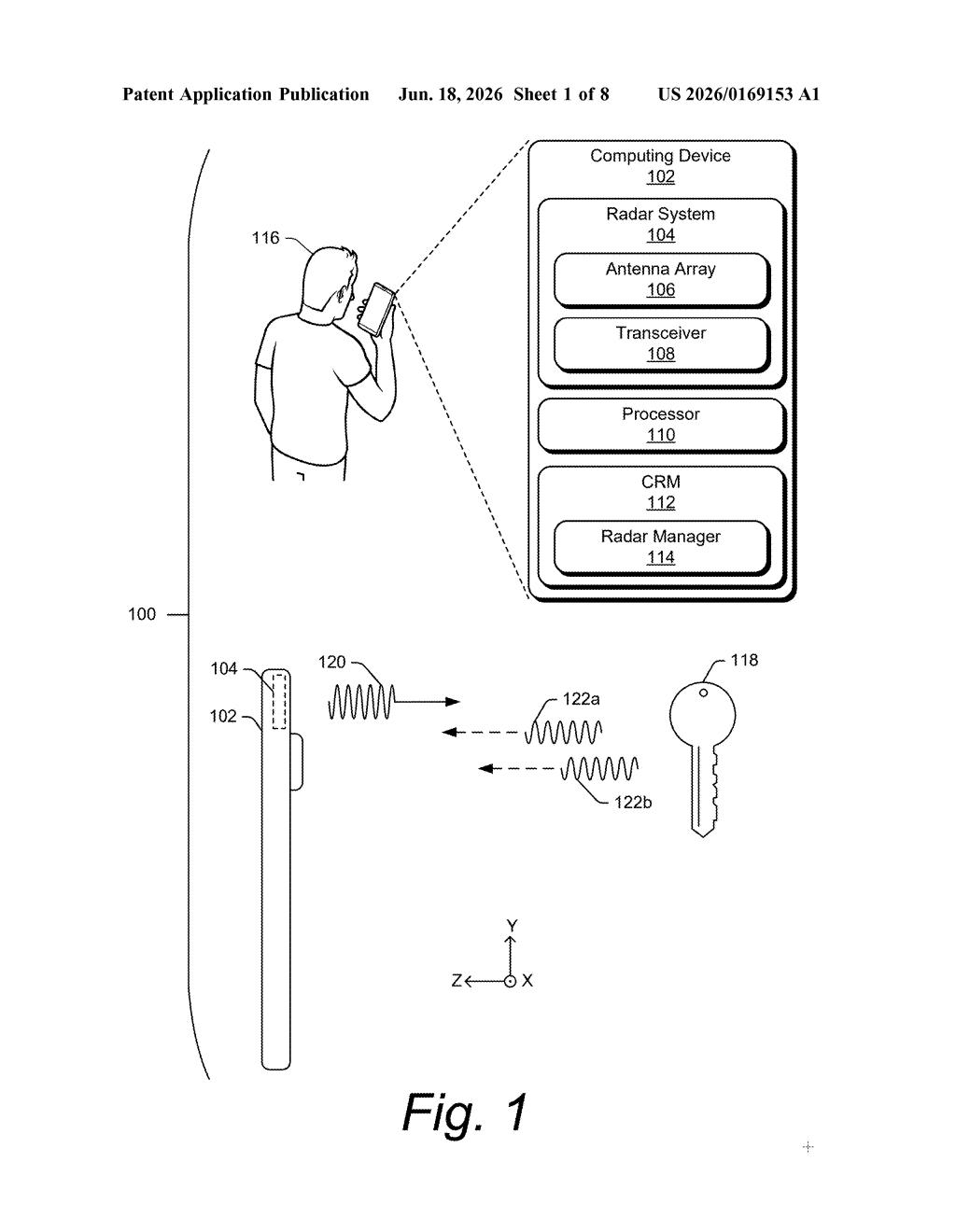
How Google's radar spots objects without seeing them
Imagine your phone or smart speaker sensing that you've walked into the room and automatically adjusting your music or screen brightness — without any camera watching you. That's the general idea behind this Google patent.
The system sends out a silent radio pulse and listens for how it bounces back off nearby objects. A neural network (an AI model) studies the shape of that echo and creates a kind of fingerprint for whatever it detected. If that fingerprint matches something the system has seen before, it knows it's the same object — and can trigger a response.
The key distinction here is privacy: radar doesn't capture images the way a camera does. You're not being photographed or filmed — the device is just reading how radio waves bounce around you, the way a bat navigates in the dark.
How the neural network maps reflections to object identities
The patent describes a device with a built-in radar system that continuously sends out radio-frequency pulses and listens for the signals that bounce back. When an object — a hand, a body, a mug — reflects that signal, the shape of the returning waveform carries information about that object's size, material, and movement.
A neural network then converts that reflected signal into an object embedding vector — think of it as a compact numerical fingerprint that lives in a mathematical space where similar objects cluster together. The system compares each new fingerprint to a stored library of previous ones.
If the new fingerprint is close enough to a stored one (meaning the reflection pattern strongly resembles a previously seen object), the system concludes they're the same object. That conclusion then fires off a contextual trigger — an automatic action like waking a screen, changing a setting, or adjusting device behavior.
The whole pipeline runs on-device, with no images stored or transmitted. It's similar in concept to Google's earlier Soli radar work on the Pixel 4 and Nest Hub, but this patent specifically focuses on object-level recognition and persistent identity tracking across encounters.
What this means for always-on, camera-free device triggers
Most always-on sensing today relies on microphones or cameras, both of which carry real privacy concerns. A radar-based system that can identify objects and trigger actions without capturing any visual data is a meaningful alternative — and it works in the dark, through thin materials, and without requiring line-of-sight. For smart home devices or wearables, that's a practical advantage over cameras.
The "contextual trigger" framing is worth paying attention to. Google isn't just describing object detection — it's describing a system that remembers objects and reacts differently depending on what it recognizes. That's the foundation of a device that adapts to your environment automatically, without you touching anything or saying a word.
This is a real and interesting extension of Google's Soli radar lineage. The move from gesture detection (what Soli did) to object-identity recognition is a meaningful step up in capability, and the privacy angle gives it a genuine use case that cameras can't easily match. Whether it ships in a product anytime soon is another question, but the technical direction is clear and coherent.
There are more where this came from
We read every patent application Big Tech publishes and send you the ones worth knowing. Plain English, free, every week.
Want this weekly breakdown for a company we don't cover? Patentlyze Pro →