
Google Files Patent for Turning One Sweep of Your Camera Into a Panoramic Video
Sweep your camera across a river full of kayakers and Google's patent describes an AI that invents the parts the lens never saw, paddle strokes included. The hard part is making those invented bits move believably.
What Google's panoramic video patent actually does
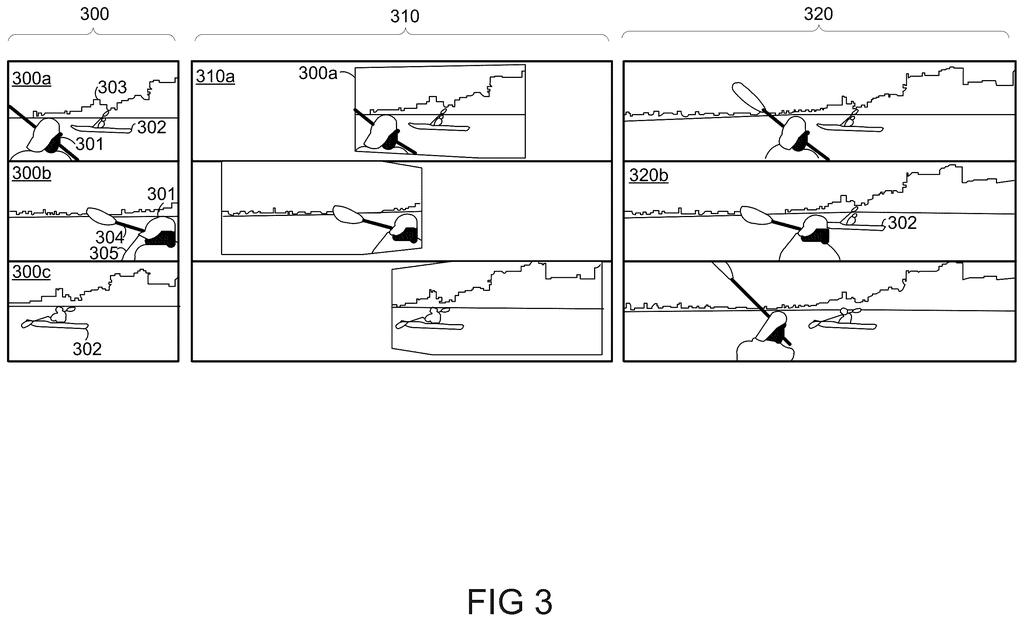
Two kayakers glide past each other on a river while someone slowly sweeps a phone across the view. At any instant the camera sees only a slice of the scene, so whatever happens just outside the frame goes unrecorded.
Google's patent describes a way to turn that single sweep into a panoramic video, a wide moving picture that shows the whole scene at once. Your frames get laid out on a wide blank canvas, and an AI paints in the empty areas, including the motion, like a paddle dipping into the water. If you sweep back and forth more than once, the AI has more real footage to work from.
The hard part is making the invented areas move naturally, so a paddle doesn't jerk or glitch. Google's answer is to work out the rough motion first, then add detail in stages.
… reprojecting the input panning video onto a panoramic canvas, wherein the panoramic canvas includes the image frames and missing regions; and outputting, with a generative machine-learning model, a panoramic video that includes synthesized pixels for the missing regions …
Translation: The system maps your camera sweep onto a wide canvas and uses AI to fill in the blank areas.
How the AI paints in a panorama's missing edges
The method starts with a video in which the camera pans at least once from one side to the other. Each frame is reprojected (repositioned according to where the camera was pointing) onto a panoramic canvas, a wide frame with room for the whole scene. Your real footage fills part of the canvas. The rest stays blank, and those blanks are the "missing regions."
A generative machine-learning model (an AI that creates new image content) then fills the blanks with synthesized pixels, working in stages:
- It first makes a base video at a coarse temporal scale, meaning very few frames (11 in one example), which settles the broad motion.
- It then temporally upsamples that base video (adds frames in steps, such as 11 to 22 to 44 in one example) and lines it up with the real footage, matching position and color.
- Finally it merges the real pixels back on top and resynthesizes (regenerates) the invented areas so their details fit the new frames.
The filing says the model could be a token-based one or a diffusion model (an AI trained to turn random noise into clean images). Overlapping windows let it handle panoramas of different widths. An optional super-resolution pass sharpens the final video, and you could pull a single panoramic still out of it.
generating a base video at a coarse temporal scale that includes the synthesized pixels for the missing regions and refining the base video by performing temporal upsampling, merging the temporally upsampled base video with the panoramic canvas …
Translation: It first creates a rough, low-detail version of the missing parts and then smooths and polishes them.
Why moving scenes are the hard part of panoramas
Conventional panorama stitching struggles when things move, and a panoramic video has to get motion right in every frame. This patent aims to give you a wide moving shot from one casual sweep of your camera, with the AI imagining what happened outside the frame. The filing's examples include people kayaking, scuba diving, skating and walking around a landmark.
There is a catch the filing itself admits: a panoramic video can end up with more synthesized pixels than original ones. What you watch would be partly a recording and partly the AI's best guess. That makes it a fun way to capture a scene, and a poor fit for anything where accuracy counts.
Google's 66th filing we've tracked since May in the AI photo editing race builds on earlier ideas like makeup filters trained on AI faces and editable sketches before AI draws.
Software does nearly all the work here. The input is an ordinary video from an ordinary camera, and the filing says the processing can run on your device, on a server, or split between the two. No new hardware is needed.
What has to exist first is the trained AI model, which the filing describes teaching with real videos paired with masked copies. The example frame sizes are small (128 by 128 pixels for the diffusion model, 160 by 96 for the token-based one) and get sharpened in later passes. That suggests a full-quality result takes several rounds of computing.
The shortest route to something you could use is a server-side feature: you upload a sweep, wait a little, and get back a wide clip. Whether people want a panorama containing scenes the camera never saw is a product decision for Google, and it will decide how far this goes.
Get our take in your Top Stories
Liked this breakdown? Add Patentlyze as a preferred source on Google, and our plain-English take shows up more often in your Top Stories the next time Google patent news breaks.
There are more where this came from
We read every patent application Big Tech publishes and send you the ones worth knowing. Plain English, free, every week.
The drawings
12 drawing sheets from US 2026/0320868 A1 · click any drawing to enlarge


Show the other 4 sheets


Want this weekly breakdown for a company we don't cover? Patentlyze Pro →
Be the first to weigh in