
A New Google Patent Covers How AI Software Handles Sentences of Any Length
Every sentence you dictate has a different length, and the AI listening has to cope with that. A new Google patent covers a resizable list built for exactly that job.
What Google's resizable AI data list does
Ever tried to pack a suitcase without knowing how long the trip will last? AI software has the same problem with a sentence. One voice command might be three words and the next might be thirty, and the software has to handle each word in turn.
Google's filing describes an expandable shelf for the AI's working data. Each slot holds one piece of information, and the shelf can grow as the input gets longer. A built-in order-keeper makes sure an item is placed on the shelf before anything reaches for it. Once a slot is filled, its contents stay put.
The same shelf also works while the AI is learning, which involves running its steps backward to see what to adjust. The filing's examples include speech-to-text and handwriting recognition.
… generating a directed computational graph representing the machine learning model that specifies the dynamic, iterative computation as one or more operations using a tensor array object, wherein the tensor array object is an object containing a dynamically-sized array of tensors that ensures sequential execution of its operations; …
Translation: The system builds a map of the AI's tasks using a flexible data structure that handles steps in order.
How Google keeps reads and writes in order
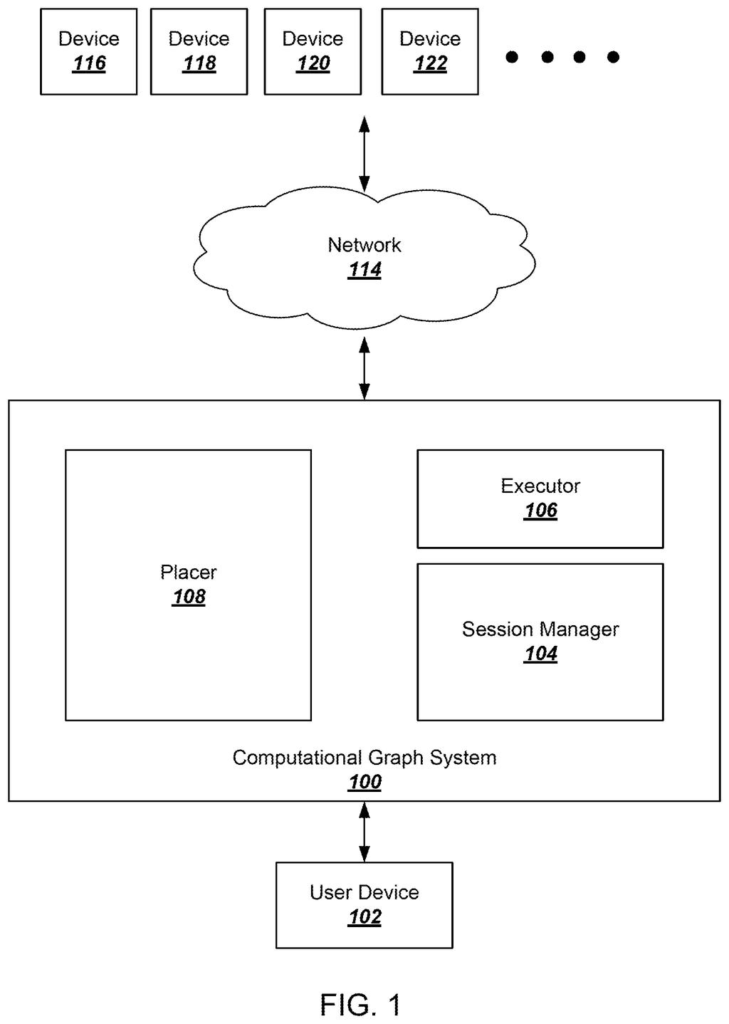
The claims cover a method in which a program containing a loop of unknown length (say, "do this for every word in the sentence") is turned into a computational graph, a map of operations and the data flowing between them. The loop is expressed through a tensor array object: a dynamically sized list of tensors (blocks of numbers, such as a vector or a table) that guarantees its operations happen in sequence.
That ordering comes from a hidden flow tensor, a small marker value passed along from step to step:
- Every write hands a new marker to the next write, so a write only runs after all earlier writes.
- Every read needs the latest marker, so it cannot run before the data it wants has been written.
- Each slot can be written only once, though it can be read many times.
For training, the system builds a backward path through the graph to compute gradients (measurements of how much each model setting should change). A write on the way forward becomes a read on the way back, and a read becomes a write. When several reads of one slot turn into several writes going backward, the results are added together.
The claims also name operations such as read, write, pack, unpack, gather and scatter, and list recurrent neural networks (models that process sequences) as one use. The filing says it continues earlier applications dating to 2017 and that tensor arrays are part of the open source TensorFlow library.
Methods, systems, and apparatus, including computer programs encoded on computer storage media, for efficiently processing dynamic length tensors of a machine learning model represented by a computational graph.
Translation: This technology helps AI models quickly process data inputs of changing sizes.
Why long and short sentences both matter to AI
If you dictate a text message or scan handwritten notes, the software behind it has to cope with inputs of every length. The filing lists speech-to-text, handwriting recognition, video processing and text analysis as examples. Handling variable-length input in a way that is both efficient and correct, including while the model learns, is what this design is built for.
It is plumbing that sits underneath AI software, out of sight. Any benefit would show up as more efficient AI training and dependable results instead of a new button on your screen. The filing ties the idea to the open source TensorFlow library and continues applications first filed in 2017.
Google's 55th filing we've tracked in voice and speech AI since May builds on earlier applications like tone-aware writing AI and wake word detection fix.
You will probably never notice this patent at work. It sits beneath software that turns your voice into text or reads handwriting, and its job is to keep steps in the right order when a sentence runs long or short.
The benefit for you is indirect: fewer ordering mix-ups inside the model while it learns, and training that wastes less effort. Nothing in the filing promises a faster phone or a better answer in any product you own.
Treat it as routine housekeeping for AI developers, useful where it lives and invisible everywhere else.
Get our take in your Top Stories
Liked this breakdown? Add Patentlyze as a preferred source on Google, and our plain-English take shows up more often in your Top Stories the next time Google patent news breaks.
There are more where this came from
We read every patent application Big Tech publishes and send you the ones worth knowing. Plain English, free, every week.
The drawings
4 drawing sheets from US 2026/0329936 A1 · click any drawing to enlarge


Want this weekly breakdown for a company we don't cover? Patentlyze Pro →
Be the first to weigh in