
Samsung Files Patent for Earbuds That Pick Out Speech in Wind and Noise
Wind howling across your earbuds is one of the hardest things for them to handle. Samsung's patent application describes a way to tell speech from noise by comparing what the mic inside your ear hears with what the mics outside hear.
What Samsung's earbud voice detector actually does
Imagine you're walking down a windy street, taking a call on your wireless earbuds. Dozens of times a second, your earbuds have to decide whether the sound they're hearing is someone talking or just wind and other noise. Get it wrong and the call turns choppy, or the earbuds react to sound that isn't speech.
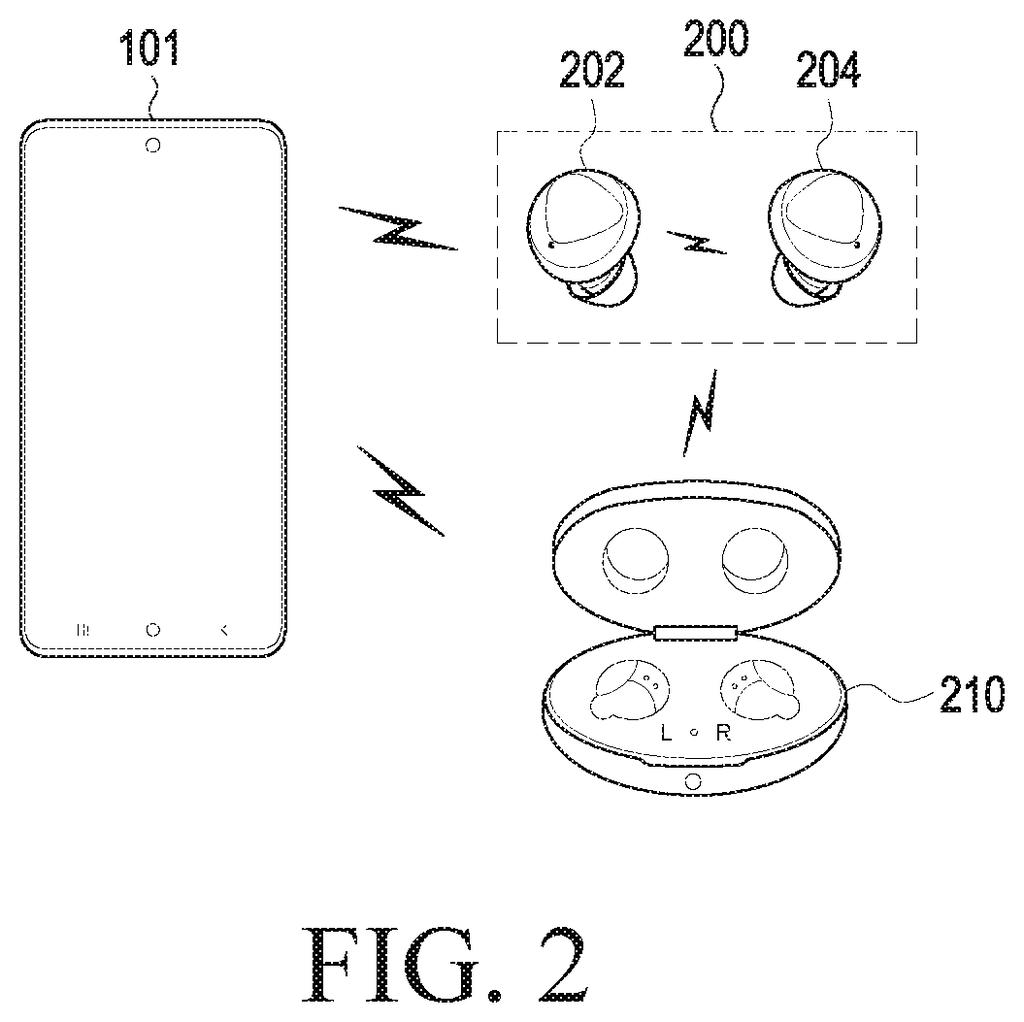
Samsung's patent application describes a way to make that decision better. Each earbud has a microphone on the inside, near your ear, plus one or more on the outside. The inner mic sits closer to your body, so it usually gets a cleaner signal, while the outer ones pick up the world around you. The earbud compares how loud the two are, and a trained AI model uses that comparison to decide whether speech is present.
It also notices when an outside mic is covered, say by part of your body, and simply ignores it.
obtain a magnitude feature of a first audio signal obtained by the first microphone, obtain an energy ratio of the first audio signal to a second audio signal obtained by the second microphone, and determine, using a trained artificial neural network, whether the first audio signal or the second audio signal includes a voice based on the magnitude feature and the energy ratio.
Translation: The earbuds compare sound levels between two microphones using artificial intelligence to find human speech.
How the earbuds compare inner and outer mics
The claims cover a wearable device with at least two microphones in different spots. It takes two measurements and feeds both to a trained artificial neural network (a software model that learned from many example recordings) to decide whether a voice is present.
The two measurements are:
- A magnitude feature from the inner microphone: a breakdown of how strong the sound is at each pitch, made with a short-time Fourier transform (math that splits sound into its pitches). The filing describes working on 20 millisecond slices and focusing on pitches under 4 kHz, where voices mostly sit.
- An energy ratio: how loud the inner mic is compared with an outer mic.
With a third microphone, the device first checks which outer mics are shielded (blocked). In the filing's example, it compares each outer mic's energy against two thresholds (50 and 30). It then uses an unblocked mic for the ratio. If every outer mic is blocked, it plugs in a preset dummy value instead.
The network outputs a number from 0 to 1. At about 0.5 or higher, it calls it speech. One variation holds off on deciding when the score lands between about 0.4 and 0.6.
The filing also describes pruning: skipping the least important parts of the network when it's quiet. It runs 100% of the computation in high noise, about 70% in medium noise and about 50% in low noise. Some of the work can also be handed to a phone or server.
What this means for calls on your wireless earbuds
If you take calls on wireless earbuds, the payoff is a device that is better at knowing when you are actually speaking, even with wind blowing across the mics. That matters because voice detection sits underneath other features. The filing calls it a preprocessing step for communication on wireless earphones, so a wrong guess hurts everything built on top of it.
The filing names Samsung Buds as an example and says the same approach could apply to smartwatches, head-mounted displays or health patches. It also points out that earbuds sit farther from your mouth than a phone does, and sit right next to their own speakers, which creates loud echo. Those are the conditions this design is meant to handle.
Samsung's 35th filing in Voice & speech AI we've tracked since May follows earlier applications like one where it fact-checks answers and one granting guests smart-home access.
This one sits close to something you could actually use. It asks for earbuds with a microphone facing the ear and at least one facing outward, plus a trained model that can run on the earbuds or hand its work to a phone.
The shortest route to a product is mostly software: sound math the industry already knows, plus a network that can skip some of its work in quiet rooms. What has to exist first is training data and testing to show it beats the simple loudness-threshold methods the filing criticizes, and the document shows no test results at all.
The verdict is routine engineering with a practical payoff. You would only notice it as calls that stay clear in the wind, which is how a good feature in this area should feel.
Get our take in your Top Stories
Liked this breakdown? Add Patentlyze as a preferred source on Google, and our plain-English take shows up more often in your Top Stories the next time Samsung patent news breaks.
There are more where this came from
We read every patent application Big Tech publishes and send you the ones worth knowing. Plain English, free, every week.
The drawings
8 drawing sheets from US 2026/0321280 A1 · click any drawing to enlarge


Want this weekly breakdown for a company we don't cover? Patentlyze Pro →
Be the first to weigh in