
Google Files Patent for Telling a Robot Dog What to Do in Plain English
Google's patent application has a chatbot write a scorecard for a robot instead of telling its motors what to do. Type 'make robot dog stand up on two feet' and separate software works out the movements.
What Google's robot scorecard patent actually does
Chatbots are good with words and surprisingly bad at moving a robot's joints. Every robot has its own motors and its own limits, and AI models have seen very little code for that kind of thing. So past attempts either needed engineers to hand-build a set of moves for each robot, or let the AI guess at raw motor commands, which can produce moves that are impossible or even damage the robot.
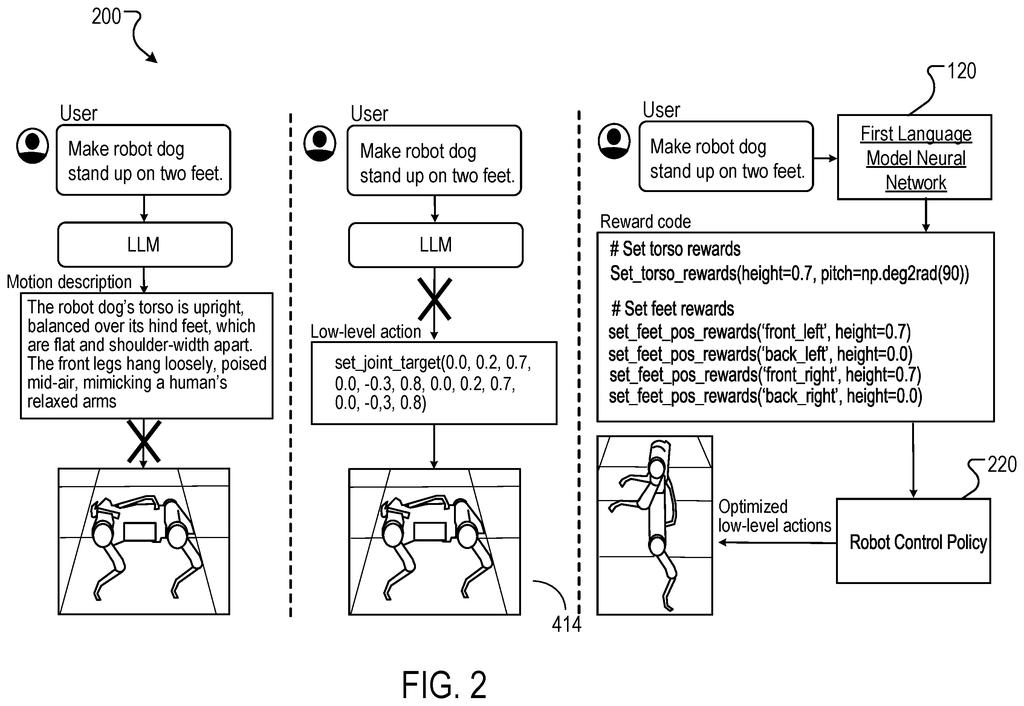
Google's filing takes a different route. You type something like 'make robot dog stand up on two feet,' and the AI writes a scorecard instead of a list of moves. The scorecard spells out what progress looks like, such as the torso tilting upward and the body reaching a certain height. A separate piece of motion-planning software then figures out the joint movements that earn the highest score.
If the robot gets it wrong, you can correct it in plain language and the AI adjusts the scorecard.
… processing the first input sequence using a first language model neural network to generate, as output, an output sequence that defines a reward function for the task …
Translation: An artificial intelligence translates your spoken or typed instructions into a scoring system for the robot.
How the AI turns a sentence into a score
The patent covers a method with four moves. A computer takes an instruction describing a task and turns it into a prompt (the written input fed to a language model, the same kind of AI behind chatbots). The model's output defines a reward function, which is a formula that checks the robot's current state at each time step and returns a score for how far along the task is. A control policy (the software that picks the robot's next move) then runs the robot using that score.
In the filing's main example, the model gets a menu of ready-made scoring tools called APIs (named functions that code can call). One scores how close an object is to a target spot. Another scores how close a robot part, such as a foot or the torso, is to a target position. The model writes code calling those tools, and the reward is a weighted sum of their results.
The filing also describes two prompts in a row:
- A 'motion descriptor' first writes a plain-language plan, like the torso pitching upward 90 degrees.
- A 'reward coder' turns that plan into the scoring code.
The policy can be model predictive control (re-planning actions in short cycles to chase the best score) or a model trained by reinforcement learning (trial-and-error practice guided by the score). Inputs can also be audio, images or video.
The sequence processing neural network is used to define a reward function for a given task to be performed by the robot and then the robot is controlled using a robot control policy that is dependent on the reward function.
Translation: The system scores the robot's progress based on AI text analysis to guide its physical movements.
What plain-English robot control could change
If this approach works as described, controlling a robot gets closer to giving instructions the way you would give them to a person. You say what you want done, watch the robot try, and correct it in everyday language. The filing says this lets non-experts shape robot behavior without piles of training data and without engineers writing low-level moves for each machine, and without retraining for each new task.
The filing also points to a comparison against an existing technique that relies on hand-designed movement building blocks for each robot. It says the scorecard-only version matched or beat that technique on most tasks, and the two-step version with a motion plan did better still. The examples cover robot arms and a four-legged robot, and the text says the method applies to any type of robot.
That makes this Google's 59th filing we've tracked since May in our AI agents acting for you watchlist, alongside one on menu-built home routines and one on sketch to cloud planning.
Claim 1 is short and wide. It needs only a task description going in, a language model writing a formula that scores the robot's progress at each moment, and a control method that depends on that score running the robot. Nothing in it names a type of robot, a type of instruction, or a type of controller.
The details that make the filing's examples concrete show up only in later claims: the ready-made scoring tools, the two language models working in sequence, and the predictive controller. So the core claim covers a general approach, and a granted version would reach any setup where a language model's output sets the robot's score, however it is built. The system and storage-media claims repeat the same wording, so they add no extra narrowness.
Claims this wide often get trimmed during examination, which makes the dependent claims the fallback positions and the place where the real engineering detail lives. For readers, the useful takeaway is the idea itself: let the AI describe success and let other software work out the motion.
Get our take in your Top Stories
Liked this breakdown? Add Patentlyze as a preferred source on Google, and our plain-English take shows up more often in your Top Stories the next time Google patent news breaks.
There are more where this came from
We read every patent application Big Tech publishes and send you the ones worth knowing. Plain English, free, every week.
The drawings
6 drawing sheets from US 2026/0336103 A1 · click any drawing to enlarge


Want this weekly breakdown for a company we don't cover? Patentlyze Pro →
Be the first to weigh in