
Google Patents a Cloud System That Keeps Private Data Locked Inside a Sealed Processing Chamber
Google is patenting a cloud architecture where your most sensitive data — health records, financial transactions, whatever — gets processed inside a mathematically sealed chamber that even Google's own infrastructure can't peek into.
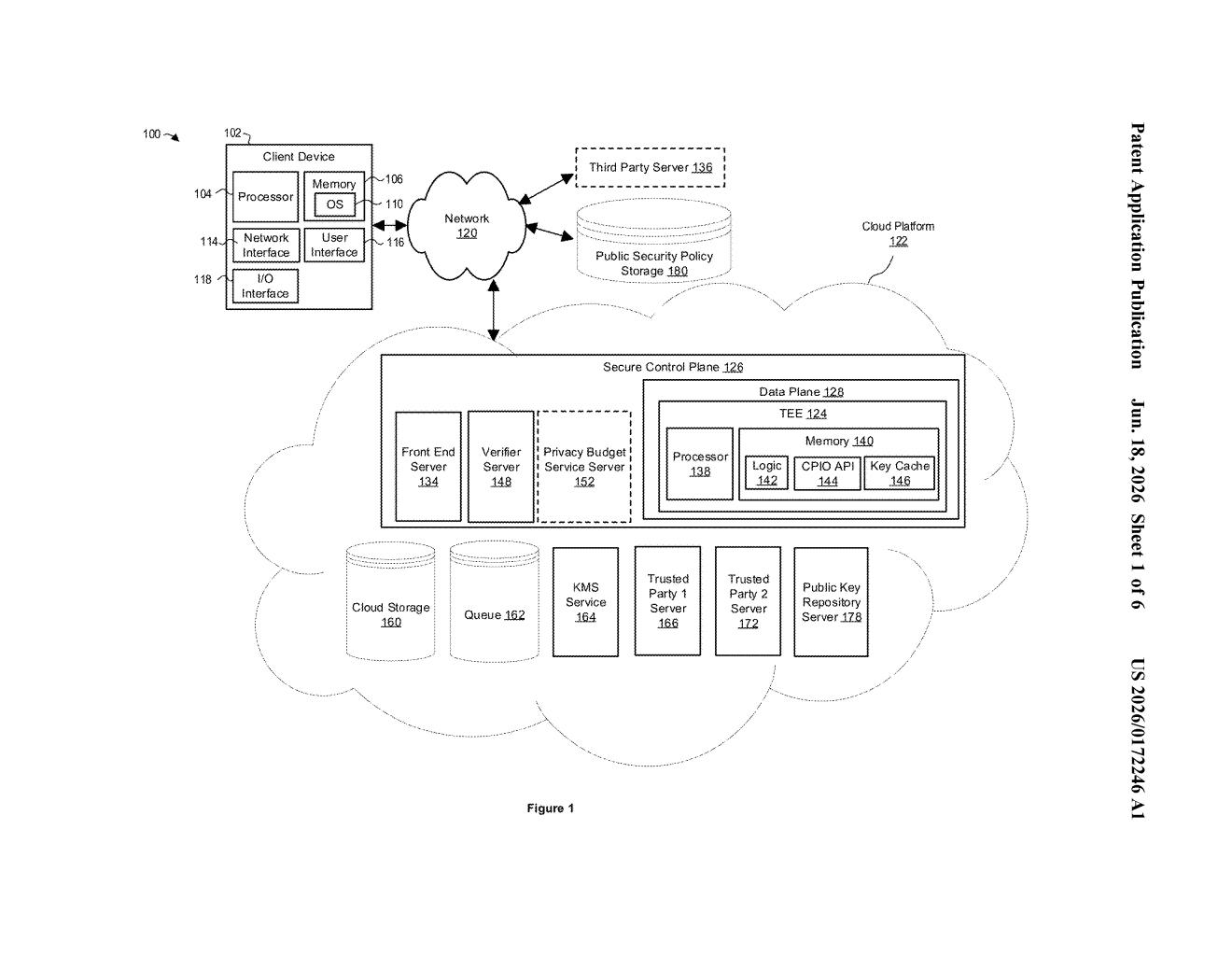
What Google's sealed cloud processing chamber actually does
Imagine you send your bank statement to an online service for analysis. Normally, somewhere along the way, a server has to open and read that document — and whoever runs the server could theoretically see it too. Google's patent describes a system designed to close that gap.
The idea is to create a locked room inside Google's cloud — called a trusted execution environment — where your encrypted data can be decrypted and processed without the surrounding infrastructure ever seeing it in plain form. The encryption key itself is split into pieces that only get reassembled inside that locked room, so there's no single moment where both your data and the key are exposed together outside it.
As a bonus, the system can also prove to outside auditors what code is running inside that locked room — so a hospital or a bank can verify that the software processing their patients' or customers' data is exactly what was promised, not something altered behind the scenes.
How the split-key decryption and trusted enclave fit together
The patent describes a two-layer cloud architecture: a secure control plane (SCP) and a data plane (DP).
The control plane acts as a gatekeeper — it receives encrypted requests from client devices and routes them inward, but it never decrypts anything itself. All the actual sensitive work happens inside the data plane, which runs in a trusted execution environment (TEE) — a hardware-level isolated zone (think of it as a vault inside the server) where code runs in a way that the host operating system and even cloud administrators cannot inspect.
- Encrypted requests arrive at the control plane and are passed to the data plane unchanged.
- The data plane retrieves a split key — a decryption key that was deliberately divided into fragments generated outside the environment and only reassembled inside the TEE, so no single party ever holds the complete key in an exposed state.
- The data is decrypted and processed entirely within the TEE.
- Only the result — not the raw sensitive data — exits the sealed environment.
The system also includes an attestation mechanism (a cryptographic proof of what code is running) so third parties can verify the deployed logic matches what was publicly disclosed. For proprietary code that can't be published, the patent covers alternative verification that the logic still follows agreed-upon security policies.
What this means for businesses handling sensitive customer data
For businesses in regulated industries — healthcare, finance, legal — the ability to hand data to a cloud provider without simply trusting that provider is a significant shift. Right now, most cloud processing requires some degree of faith that the vendor won't misuse access. A verified, hardware-enforced enclave changes that calculus by making the guarantee architectural rather than contractual.
For you as an end user, this is the kind of plumbing that underpins services that handle your most sensitive information. If your health app or tax software runs on infrastructure like this, your data would be processed by code you could theoretically verify — not just a privacy policy you'd have to take on faith.
This is infrastructure-level work, not a flashy consumer feature — but it's the kind of patent that matters a lot if Google is pitching cloud services to hospitals, banks, or government agencies that need provable data isolation. The split-key assembly and attestation combination is genuinely well-thought-out. Whether it ships as a discrete Google Cloud product or quietly underpins something like Confidential Computing is the interesting open question.
There are more where this came from
We read every patent application Big Tech publishes and send you the ones worth knowing. Plain English, free, every week.
Want this weekly breakdown for a company we don't cover? Patentlyze Pro →