
Google Patents a System That Tests New Phone Features Before They Reach Users
Before Google ships an AI update to millions of phones, it wants to run a controlled head-to-head race on a sample of real devices — and only promote the winner.
How Google picks which AI model lands on your phone
Imagine a sports team that never sends a player onto the field without first watching them practice against a real opponent. Google's patent describes something similar for AI software updates.
Right now, when a company wants to update the AI running on your phone — say, the model that powers autocomplete or voice recognition — it typically tests that update in a lab. This patent describes a different approach: pick a small group of real phones that share similar specs, run the new model on some of them and the old model on others, then measure which one actually performs better on those devices.
If the new model wins the head-to-head test — using real metrics like speed, memory use, and accuracy — Google can roll it out to the broader group of phones with the same specs. If it loses, the update gets held back or tweaked. Your phone only gets the update if it's been proven to handle it well.
How the device-grouping and head-to-head test works
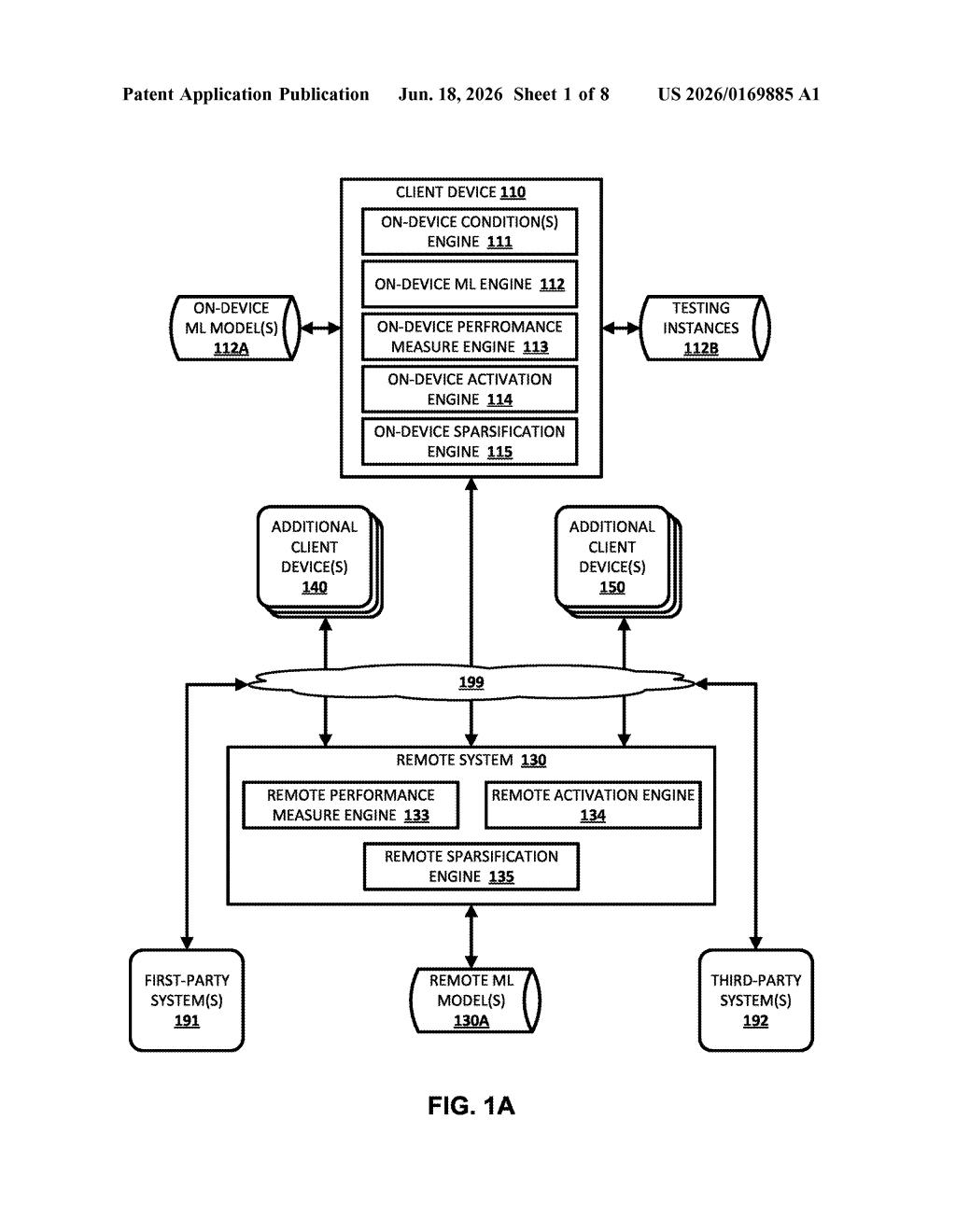
The patent describes a server-side system that coordinates a structured A/B test across two groups of real client devices (phones, tablets, etc.).
- Group selection by device profile: The system picks two subsets of devices that share the same hardware and software characteristics — same chip, same OS version, same memory tier. This keeps the comparison fair.
- Parallel benchmarking: One group runs the existing ML model; the other runs the candidate replacement. Each device generates performance measures — latency (how fast it responds), memory consumption, CPU load, and accuracy metrics like precision and recall (how often it gets the right answer and how rarely it misses).
- Winner selection and deployment: The system aggregates those measures, picks the better-performing model, and deploys it to both groups — and potentially to any other devices in the fleet that match the same hardware profile.
The patent also covers a feedback loop: if neither model clearly wins, the system can modify the candidate model and run the test again. The scope covers not just ML models but also non-ML software features and hardware-enabled functionality, making this a general-purpose quality gate for any on-device update.
What this means for on-device AI quality control
On-device AI is only getting more common — voice assistants, camera processing, keyboard prediction, and health sensors all run local models. The traditional way to evaluate those models is benchmarking in a controlled lab, which can miss real-world problems: a model that runs fine on a test rig might stutter on a three-year-old mid-range phone in someone's pocket.
This patent suggests Google wants a more systematic, data-driven gate between an AI update and your device. For Pixel phones and Android broadly, that could mean fewer cases where an update quietly degrades battery life or response speed on older hardware. It's essentially a quality-control layer that runs on the actual population of devices rather than simulated conditions.
This is infrastructure work — not a flashy consumer feature — but it's the kind of infrastructure that quietly determines whether on-device AI feels polished or janky. The fact that Google is patenting the device-characteristic-matching angle suggests they're trying to lock in a systematic approach to hardware-aware AI rollouts, which is a real problem worth solving as Android's device fragmentation only grows.
There are more where this came from
We read every patent application Big Tech publishes and send you the ones worth knowing. Plain English, free, every week.
Want this weekly breakdown for a company we don't cover? Patentlyze Pro →