
Google Patent Ensures Search Results Name the Specific Entity You Queried
When you ask Google a question, you often get a list of links instead of an answer. This patent describes a system that identifies the specific person, place, or thing your question is about and names it directly in the reply.
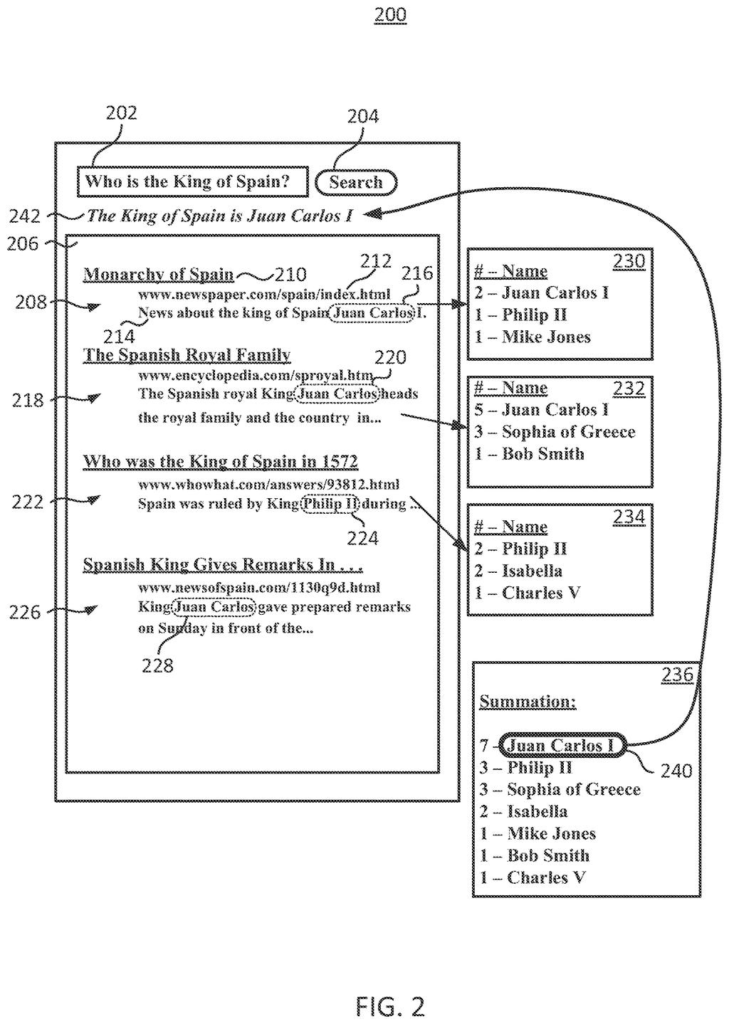
How Google wants Search to answer questions more directly
Imagine asking Google "Who invented the polio vaccine?" and instead of ten blue links, you get a clean sentence back: "Jonas Salk invented the polio vaccine." That's the kind of response this patent is designed to produce.
The system works by figuring out what type of thing your question is looking for, whether that's a person, a company, a date, or a location. It then scans the top search results, finds the specific name that fits, and builds a natural-language answer around it.
The key detail is that the answer includes text that wasn't in your original question. You asked "who" and Google fills in the name. That sounds simple, but getting a machine to reliably extract the right entity from messy web text and package it into a grammatical sentence is harder than it looks.
receiving a question query, wherein the question query is associated with a type of entity requested in the question query; generating a set of search results based on the question query, wherein each search result in the set contains unstructured text content …
Translation: The system takes a question that asks about a specific kind of thing and pulls up standard search results.
How the system pulls entity references from ranked results
The patent describes a pipeline with a few distinct steps:
- Query classification: When a question arrives, the system identifies what category of thing the question is hunting for (a named entity type, like a person, organization, or location).
- Search and ranking: Standard search results are generated and ranked by relevance.
- Pre-cached entity extraction: Here's the interesting part. Rather than parsing the top results on the fly, the system retrieves previously generated data already attached to those pages. That data contains "entity references" found inside the page's unstructured text, meaning names and labels that were extracted earlier during indexing.
- Answer generation: A natural-language answer is assembled that includes at least one term from the original question and the resolved entity name, producing a direct, readable response.
The phrase "collective reconciliation" in the abstract suggests the system may be resolving conflicts when different top results point to different candidate entities, picking the most consistent answer across sources.
An entity of the type of entity is identified in the top-ranked results and a response to the query is generated from the top-ranked results, the response including a reference to the entity that includes text distinct from the terms of the query.
Translation: Google spots the exact name of the target in the top pages and puts it directly into the final answer.
What this means for Google's AI-powered search answers
This patent sits squarely in the infrastructure behind Google's AI Overviews and the older "featured snippet" answers. The specific contribution here is using pre-indexed entity data rather than running fresh text analysis at query time, which would be faster and cheaper at the scale Google operates.
For you as a searcher, the ambition is fewer clicks and more direct answers. For the broader web, it continues a pattern where Google's search result page provides the answer itself, reducing traffic to the source sites that supplied the underlying information.
This is solidly interesting infrastructure work, not a flashy consumer feature. The pre-cached entity reference approach is a meaningful engineering choice that makes AI-generated answers faster and more consistent. It won't make headlines, but it's the kind of plumbing that makes Google's AI search answers actually reliable at scale.
There are more where this came from
We read every patent application Big Tech publishes and send you the ones worth knowing. Plain English, free, every week.
The drawings
8 drawing sheets from US 2026/0228294 A1 · click any drawing to enlarge


Want this weekly breakdown for a company we don't cover? Patentlyze Pro →
Be the first to weigh in