
IBM Files Patent for Software That Decides Which Overlapping Video Meeting You Should Join
Two meetings overlap, and your software has to decide which one deserves you. IBM's patent application scores both, then either nudges you politely or offers to switch you over mid-call.
What IBM's meeting-conflict patent actually does
Imagine you're running a team check-in that is supposed to end at 9:00, and a meeting with senior management starts at 8:50. You're stuck deciding, mid-sentence, whether to bail and how to tell everyone.
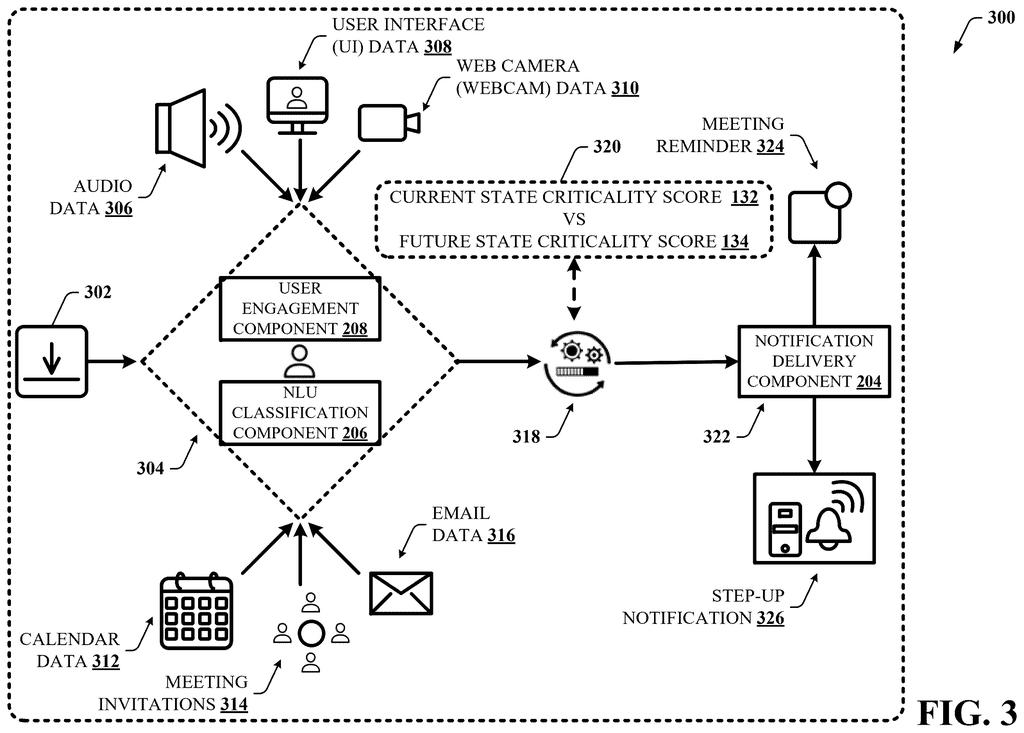
IBM's filing describes software that scores how much each meeting matters to you, then chooses how loudly to tell you about the next one. If your current meeting matters more, you get a small pop-up in the corner of your screen. If the next one matters more, you get a full-screen prompt that can move you over automatically, and the people you're leaving get told.
The scores come from your calendar, your emails, your attendance history, and how engaged you seem on the call, such as whether you're talking, sharing your screen, or looking away.
a computation component that computes a current state criticality score and a future state criticality score, wherein the current state criticality score is associated with a first virtual meeting and the future state criticality score is associated with a second virtual meeting; …
Translation: The software weighs how important your current meeting is against an overlapping one.
How IBM scores two meetings against each other
The system computes two numbers, each on a scale such as 0 to 100: a current state criticality score for the meeting you're in, and a future state criticality score for the one coming up. 'Criticality' just means how much that meeting matters to you, and a higher score means a higher priority.
The scores are built in two passes:
- Reading your records. A natural language understanding component (software that reads text to pull out meaning) goes through your calendar, email, invites and past attendance. It checks who is invited, whether your manager or a client is there, whether the meeting repeats and how often you've gone, whether you're the host, and whether emails give you action items.
- Watching your engagement. A second component looks at microphone, webcam and screen data: how often you speak, how long you've been muted, whether you're screen-sharing or working in other apps, and whether you're looking at the screen.
Then the scores are compared. If the current meeting scores higher, you get a low-key meeting reminder, like a corner pop-up or a phone buzz. If the next meeting scores higher, you get a step-up notification, such as a full-screen 'This meeting will be transferred in 3, 2, 1' prompt that you can accept or decline. Accepting tells the first meeting's attendees you've left. Declining tells the second meeting's attendees you'll be late.
Your answer feeds back in. Accepting counts as positive feedback and declining as negative, and the weights given to each factor are adjusted using standard self-tuning methods (reinforcement learning or gradient descent). The system can also ask you directly whether it got it right.
… a notification delivery component that can generate, based on the current state criticality score and the future state criticality score, a notification that can alert a user participating in the first virtual meeting about the second virtual meeting.
Translation: It pops up an alert to let you know when the other call deserves your attention.
Why back-to-back calls are IBM's target here
If a video-calling app adopted this, your meeting alerts would stop all looking the same. A reminder for a minor call would stay in the corner of your screen, while one for a meeting with senior management could take over the screen, offer to move you, and tell the other attendees you've left or will be late. The filing's stated aim is fewer awkward exits and less stress from back-to-back calls.
It also needs a lot of access: email, calendar, microphone, webcam and screen activity. The description says you would install it and opt in first. The examiner's first review rejected the claims as filed, which is routine and usually followed by amendments, so the final scope could change. The description also mentions possible partnerships with video-meeting providers such as Zoom and Microsoft.
IBM's 406th filing in our IBM coverage since May adds to a range that includes booting staff from sensitive calls and greener mobile charging.
Claim 1 is short and wide. It asks for a score for the meeting you're in, a score for a second meeting, and an alert to you, during the first meeting, about the second one based on both scores. It does not require reading your email, watching your webcam, or moving you automatically.
Those details show up in the later claims: the email and calendar reading, the engagement tracking, the two kinds of alerts, the accept-or-decline prompt and the learning loop. They read as backups if the broad first claim gets trimmed.
In everyday terms, a claim this open describes almost any tool that rates two overlapping calls and nudges you during one of them. The idea is useful, since nearly everyone has been double-booked. The practical test is how much of that breadth survives review.
Get our take in your Top Stories
Liked this breakdown? Add Patentlyze as a preferred source on Google, and our plain-English take shows up more often in your Top Stories the next time IBM patent news breaks.
There are more where this came from
We read every patent application Big Tech publishes and send you the ones worth knowing. Plain English, free, every week.
The drawings
10 drawing sheets from US 2026/0332549 A1 · click any drawing to enlarge


Show the other 2 sheets


Want this weekly breakdown for a company we don't cover? Patentlyze Pro →
Be the first to weigh in