
Intel Patents Technology to Map Sound and Sensory Cues Across AR and VR Environments
Ray tracing, the technique that makes light look photorealistic in video games, could soon do the same job for sound and other sensory information in AR and VR headsets. Intel has filed a patent describing exactly that.
What Intel's sensory ray tracing actually does for headset wearers
Today, AR and VR headsets are pretty good at making things look right, but the audio and sensory information around you is often processed separately and less precisely, which can break the feeling that you are actually there. Intel's patent describes a system that wants to fix that by treating sound and other environmental cues the same way game consoles already treat light.
The core idea is borrowed from a graphics technique called ray tracing, which maps how light travels through a virtual scene to produce realistic shadows and reflections. Intel's system applies the same math to sounds and sensory events, tracing the paths those signals would take from their source to your position before playing them back through the headset.
Multiple cameras and sensors capture what is happening around you in real life, and the system normalizes all of that information to your specific position. The result, at least in theory, is a headset experience where the audio and sensory layer matches the visual one, making the whole thing feel more convincing.
normalize the environment information to a position of an observer to generate normalized environment information for the observer; calculate, for the observer, the sound sources or sensed events vector paths …
Translation: It adjusts spatial data around a user's exact viewpoint and maps out the paths for incoming sounds and sensory triggers.
How the graphics pipeline calculates sensory vector paths
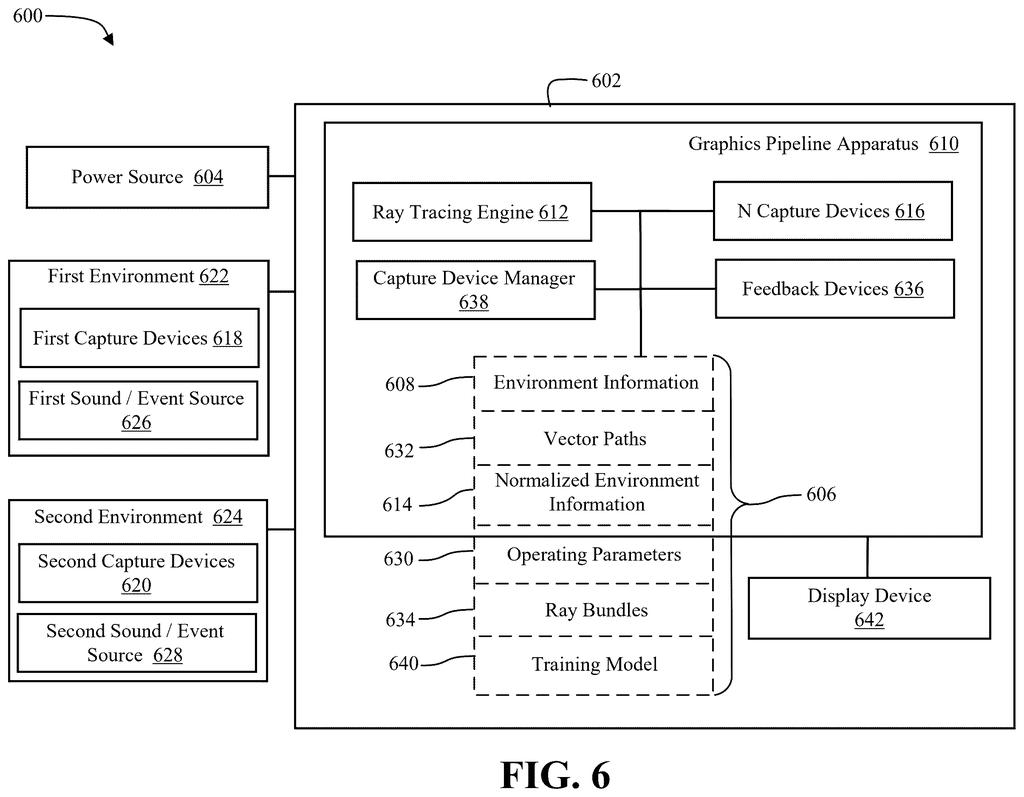
The patent describes a graphics pipeline apparatus that adds sensory processing alongside traditional image rendering. At its center is a ray tracing engine, the same class of hardware found in modern gaming GPUs, repurposed to handle non-visual information.
Here is how the pipeline works:
- Capture: Multiple external sensors or cameras collect environmental data, things like sound sources, temperature events, or other physical signals present in the real-world space around the wearer.
- Normalization: The system takes all of that raw sensor data and re-anchors it to the observer's current position in space. If you turn your head, the sensory map re-centers around where you now are.
- Vector path calculation: The ray tracing engine computes the directional paths (vectors) from each sound source or sensory event to the observer, the same way a game engine traces a light ray from a lamp to a surface.
- Playback: The normalized, path-corrected sensory information is then played back through the headset so that sounds and sensations arrive from the correct virtual or real-world direction.
The system also includes logic to detect and manage which capture devices are active and assign them based on current conditions, so it can adapt if a microphone is blocked or a sensor fails.
… detect and/or manage one or more capture devices and assign one or more the capture devices based on one or more conditions to provide observer an immersive VR/AR experience.
Translation: The system automatically handles various environmental sensors based on current conditions to keep the simulation convincing.
What this means for the next generation of AR and VR headsets
For anyone who has worn a VR headset and noticed that the audio feels like it is floating in your head rather than coming from the virtual world around you, this is the problem Intel is aiming at. Accurate spatial audio and sensory positioning is one of the bigger remaining gaps between a headset that looks impressive and one that actually feels believable.
For enterprise and industrial AR, where workers overlay digital information onto physical spaces, getting audio cues to originate from the correct physical location is a real safety and usability concern. If this approach works as described, it could also improve accessibility tools that translate visual or environmental events into audio or haptic signals for users who are deaf or hard of hearing.
That makes this Intel's 147th filing in our Intel coverage since May, adding to work like faster AI math handling and mid-task strategy switching.
The idea here is genuinely clever: the math that makes video game light look real should, in principle, work just as well on sound and sensory data. Using an existing GPU ray tracing engine rather than building separate audio processing hardware is an efficient approach on paper.
The gap between this patent and a shipping product is wide, though. The claim leans heavily on a graphics pipeline that already has ray tracing hardware built in, plus a coordinated array of environmental sensors that do not yet exist as a standard part of any consumer headset. Both of those pieces have to land before this technique can run anywhere.
The shortest path to a product would be adding this processing layer to a headset that already includes ray tracing silicon and a decent microphone array, which describes almost no current device. Intel has been filing around AR and VR graphics since at least 2023, and this patent fits that pattern, but it reads more like foundational research staking out IP than a feature on anyone's near-term roadmap.
There are more where this came from
We read every patent application Big Tech publishes and send you the ones worth knowing. Plain English, free, every week.
The drawings
36 drawing sheets from US 2026/0281652 A1 · click any drawing to enlarge


Want this weekly breakdown for a company we don't cover? Patentlyze Pro →
Be the first to weigh in