
Intel Patents an AI System That Picks the Right Chip for Every Car Screen Task
Modern cars run two kinds of graphics chips at once, and most systems don't know which one to use for a given job. Intel's new patent describes an AI that makes that call in real time, checking temperature, power draw, and processor load before routing each task.
What Intel's in-car GPU scheduler actually does
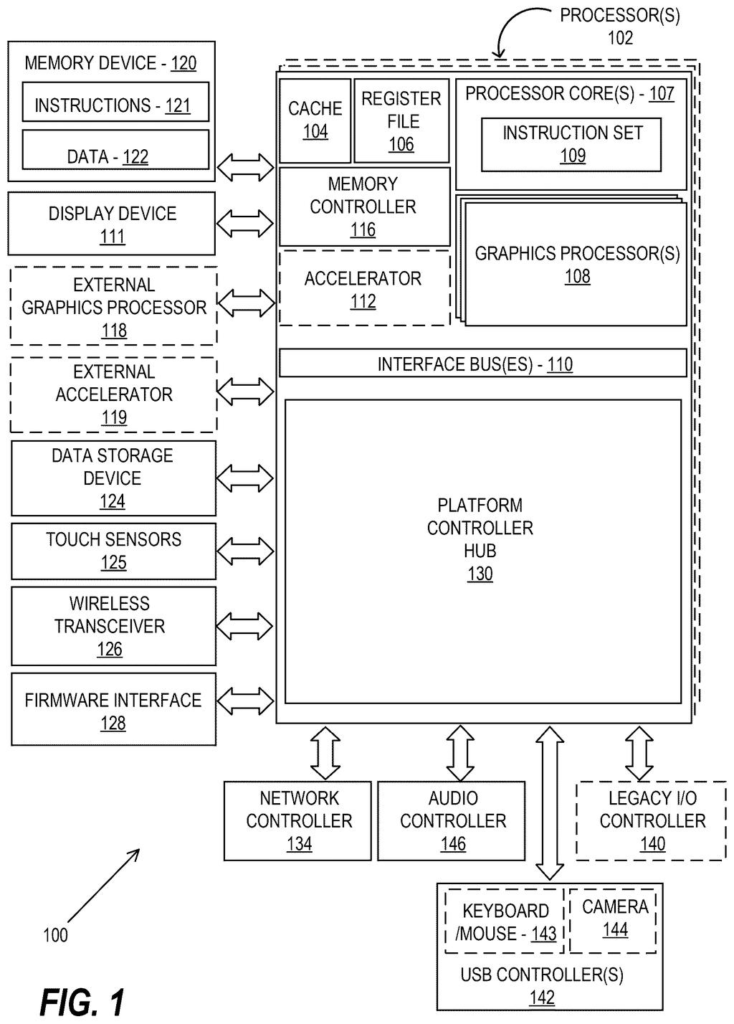
You're sitting in a car while the dashboard runs a navigation map, a rear-camera feed, and a voice assistant all at the same time. Each of those tasks has different demands, and the car's chip hardware has two options for handling them: a smaller, built-in graphics processor that sips power, and a larger, separate one that can handle heavier loads.
Intel's patent describes a scheduling system that uses a trained AI model to pick between those two chips for every incoming task. Before routing a job, it checks how hot the system currently is, how much power it's drawing, and how busy each chip already is. Then it decides which processor gets the work.
The goal is to keep the car's display system running without wasting energy or overheating, which matters a lot in a vehicle where thermal limits and battery budgets are tighter than in a desktop PC.
… select either the iGPU or dGPU to execute the AI or 3D graphics task based on at least one of: the features and the metrics associated with the current state of the apparatus.
Translation: The system chooses which graphics chip should handle a task based on the current conditions.
How the ML model reads heat, power, and workload to choose a chip
The patent covers a graphics scheduling system built for in-vehicle infotainment (IVI) platforms, the category of hardware that runs a car's touchscreen, instrument cluster, and passenger displays.
Those systems typically contain two types of graphics hardware:
- An integrated GPU (iGPU): built directly onto the main processor chip, lower power, but limited performance.
- A discrete GPU (dGPU): a separate chip with more muscle, but it draws more power and generates more heat.
The scheduler described in the patent uses a trained machine-learning model (software that has been pre-trained to recognize patterns and make decisions) to evaluate two things before each task runs. First, it looks at the features of the task itself, meaning what kind of computation is involved and how demanding it is. Second, it checks three real-time system metrics: current power consumption, current thermal conditions (how hot things are running), and current resource utilization (how busy each chip already is).
Based on that combined picture, the model selects either the iGPU or the dGPU to handle the task. The idea is that a lightweight AI inference job might go to the iGPU when the system is already warm, while a heavier 3D render gets routed to the dGPU when there's thermal and power headroom.
… determine metrics associated with a current state, the metrics to include: current power consumption conditions, current thermal conditions, and current resource utilization conditions; …
Translation: The scheduler tracks how much power, heat, and processing capacity the car is currently using.
What this means for in-car displays and power budgets
Cars are now running the kind of graphics workloads that would have lived on a gaming laptop five years ago, and they're doing it inside a sealed metal box with strict heat and power limits. Getting the chip-routing decision wrong means either a sluggish display or an overheated system that throttles itself at the worst moment.
For you as a driver or passenger, a system like this would ideally mean the screen stays responsive and the car doesn't waste battery keeping a heavy GPU running at full tilt when a lighter chip could handle the job. For automakers, it's a way to squeeze more consistent performance out of the same hardware across different driving conditions, ambient temperatures, and use cases.
This is the 36th Intel filing we've tracked in AI chip wars since May, adding to one on fitting models to chips and one on reducing wasted space.
Claim 1 is written broadly. It covers any apparatus with both an iGPU and a dGPU inside an IVI system, using any trained ML model that checks power, heat, or utilization before picking a chip. That's a wide net: the claim doesn't require a specific model architecture, a specific training method, or even all three metrics at once (the language says "at least one of").
In practice, that breadth could matter a lot. If granted as written, the claim would cover a wide range of AI-assisted scheduling approaches inside automotive display hardware, not just Intel's specific implementation. That puts this patent in the category of "broad platform claim" rather than a narrow engineering improvement.
Intel's steady investment in automotive silicon shows up in filings like this one. Whether the claim survives examination at that width is a separate question, but the scope Intel is staking out here goes well beyond a neat scheduling trick.
There are more where this came from
We read every patent application Big Tech publishes and send you the ones worth knowing. Plain English, free, every week.
The drawings
29 drawing sheets from US 2026/0267692 A1 · click any drawing to enlarge


Want this weekly breakdown for a company we don't cover? Patentlyze Pro →