
Samsung Patents a Priority-Based Display System for IoT Device Alerts
When a dozen smart home devices all trigger alerts at once, which one should your screen actually show? Samsung's new patent answers that with a location-aware priority engine that collapses competing IoT notifications into a single, ranked graphic object.
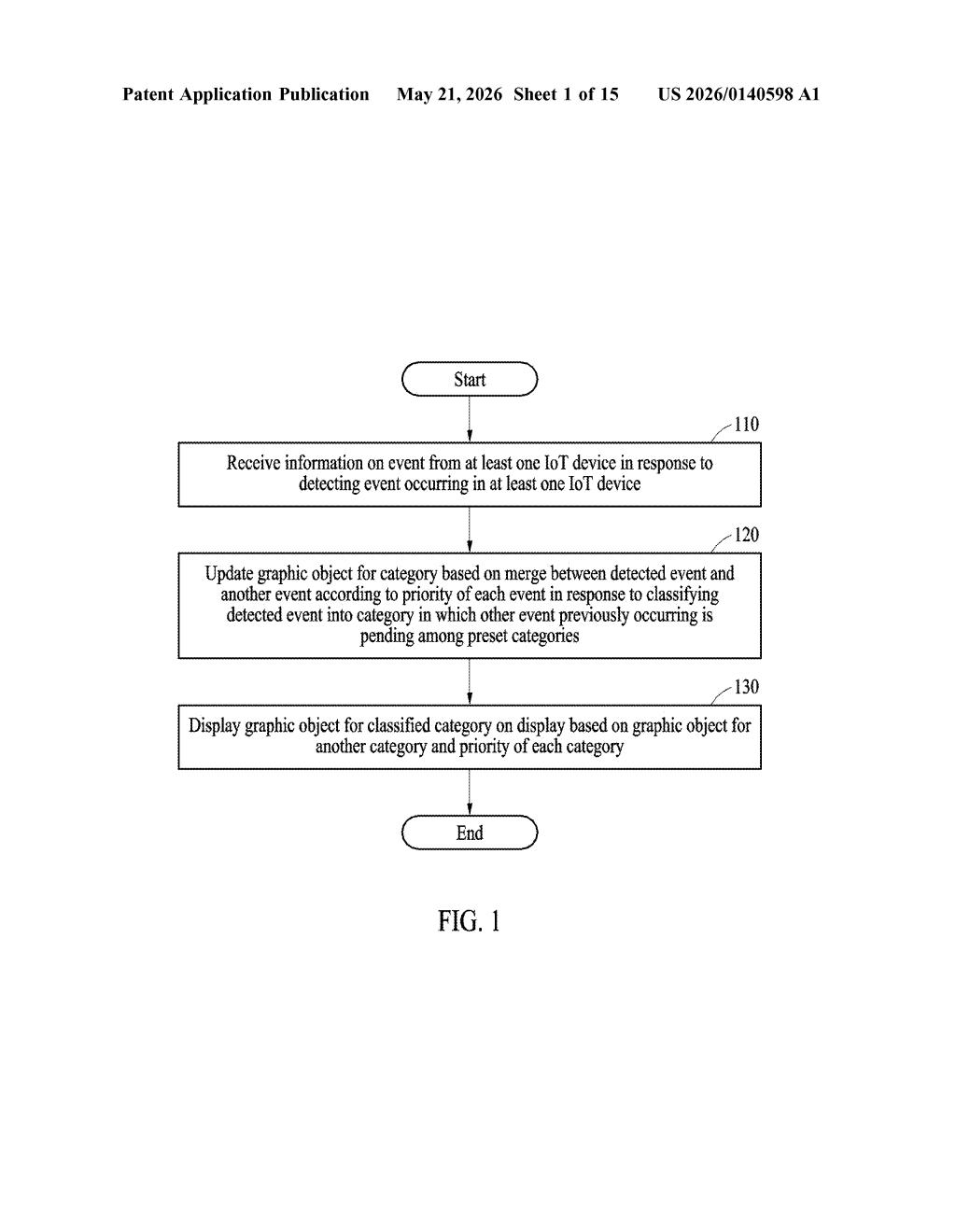
How Samsung's IoT alert merging actually works
Imagine you're home and, at the same moment, your Samsung smart fridge sends a temperature warning, your front door camera detects motion, and your robot vacuum reports it's stuck. Normally, your TV or phone screen would get slammed with overlapping notifications. Samsung's patent is trying to fix that.
The idea is that your device — say, a Samsung TV or Galaxy phone — knows where you are and uses that location context to decide which IoT alert matters most to you right now. Events get sorted into categories, and if two alerts fall into the same category, they're merged into a single graphic object rather than stacking up independently.
The result is a cleaner, ranked display: the most important alert gets shown prominently, while lower-priority events are either folded in or held back. You see what matters, not everything at once.
How the device ranks, merges, and renders IoT events
The patent describes an electronic device — likely a TV, tablet, or phone — that acts as a hub for IoT event notifications. When connected IoT devices detect events, they push that information to the hub, which then runs it through a priority and categorization pipeline.
Here's the core flow:
- Location identification: The device determines its own location (or the user's location relative to it) and uses that as a filter — events geographically relevant to the user get elevated priority.
- Event classification: Incoming events are sorted into preset categories. If a new event lands in a category where a previous event is already pending (waiting to be acknowledged), the system merges the two rather than creating duplicate alerts.
- Priority ranking: Each event and each category carries a priority value. Events above a threshold get represented as a prominent first graphic object; those below the threshold are suppressed or subordinated.
- Display logic: How and where a graphic object renders on screen depends on both its own category priority and the presence of graphic objects from other categories — essentially a layout arbitration system.
The merge behavior is the technically interesting piece: rather than a notification counter ticking up, the display object itself is updated to reflect the combined state of multiple events in one category.
What this means for Samsung's smart home ecosystem
Samsung operates one of the largest consumer IoT ecosystems on the planet — SmartThings connects everything from refrigerators to air purifiers to door locks. As households add more connected devices, the notification problem gets genuinely worse, and a fragmented alert experience is a real friction point for smart home adoption.
This patent suggests Samsung is working on a more coherent ambient notification layer across its devices — one that could surface on a Galaxy phone lock screen, a Samsung TV ambient mode, or a smart display. If this makes it into SmartThings or One UI, it could meaningfully reduce the chaos of managing a multi-device home without requiring users to manually configure notification rules.
This is unglamorous but genuinely useful infrastructure work. Notification overload is one of the most-complained-about aspects of smart home setups, and a system that merges and location-weights IoT events is a practical step toward making those systems less annoying. It's not a flashy AI demo — it's the kind of polish that actually moves consumer adoption.
There are more where this came from
We read every patent application Big Tech publishes and send you the ones worth knowing. Plain English, free, every week.
Want this weekly breakdown for a company we don't cover? Patentlyze Pro →