
Salesforce Patents a System That Flags Rule Violations Across Linked Database Records
When related records in a database break a business rule, someone usually finds out too late. Salesforce's new patent describes a system that catches those violations automatically and puts a visible warning right on the record.
What Salesforce's virtual container warnings actually do
Imagine your sales team has a rule that the total value of all deals linked to one account can't exceed a certain budget. Right now, if someone adds a deal that pushes the total over the limit, there's a good chance nobody notices until a manager runs a report. Salesforce's patent describes a way to catch that kind of problem the moment it happens.
The idea is to group related records into what the patent calls a virtual container, then watch those records as a set. When any change to one record breaks a rule that applies to the whole group, the system flags the offending record immediately and shows a visible warning inside the app you're already using.
The practical result is that the person editing records sees the problem in real time, right on screen, instead of hunting for it later. It's a quality-control layer built into the database itself, not bolted on as a separate audit process.
detecting a violation of a first constraint associated with the virtual container based at least in part on a relationship between a first value of a respective field of the first record and one or more respective values associated with the one or more additional records …
Translation: It spots when linked database entries break a rule together.
How the constraint check finds and surfaces violations
The patent describes a three-step process that runs inside the database layer of a Salesforce-style system.
- Grouping: The system identifies a virtual container for a given record based on one or more of that record's field values (think: same account ID, same project code). It then links that record to other records that share the same container.
- Watching: Whenever a create, update, or delete operation touches any record inside the container, the system compares the relevant field values across all the linked records against a predefined rule called a constraint (for example, "the sum of line-item amounts must not exceed the order budget").
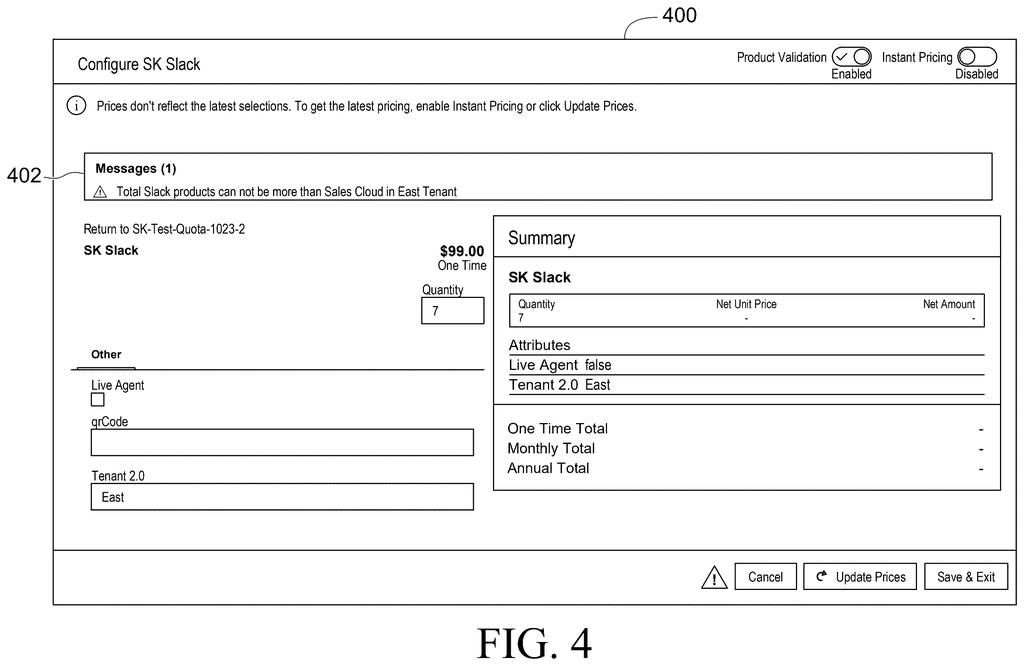
- Flagging: If a violation is detected, the system writes an indication of which constraint was broken directly into a dedicated field on the first record. The client application then reads that field and renders a graphical indication, meaning a badge, icon, or warning, on the record's screen.
The key architectural choice here is storing the violation flag in the record itself rather than in a separate log table. That means any interface that displays the record automatically inherits the warning without needing extra queries or custom UI code.
… generates a graphical representation of the first record that includes a graphical indication of the first constraint based at least in part on the second field of the first record …
Translation: It creates a visual warning on the screen showing that the rule was broken.
What this means for Salesforce CRM users and admins
For Salesforce admins and developers, this matters because enforcing complex cross-record rules today usually requires custom code, workflow automations, or third-party tools. A native constraint layer built into the database could replace a lot of that plumbing and reduce the chance of silent data errors slipping through.
For end users, you'd see a visible warning on a record the moment your edit causes a problem, rather than getting an angry email from finance a week later. Whether Salesforce ships this as a feature in Sales Cloud, Service Cloud, or the underlying platform is an open question, but the patent signals the company is thinking seriously about making data integrity something you see, not just something you audit.
This is genuinely useful infrastructure work, not a flashy AI play. The specific insight, storing the constraint violation inside the record rather than in a separate audit trail, is the kind of quiet architectural decision that makes enterprise software noticeably less frustrating to operate. It's worth watching if you care about where Salesforce's low-code administration story is heading.
There are more where this came from
We read every patent application Big Tech publishes and send you the ones worth knowing. Plain English, free, every week.
The drawings
7 drawing sheets from US 2026/0228224 A1 · click any drawing to enlarge


Want this weekly breakdown for a company we don't cover? Patentlyze Pro →
Be the first to weigh in