
Samsung Patents a Central LLM That Delegates Tasks to On-Device Sub-Models
Samsung is patenting an AI architecture where a large 'orchestrator' model breaks down your requests into sub-tasks, farms them out to smaller specialized models on individual devices, and then stitches the results back into a single coherent answer.
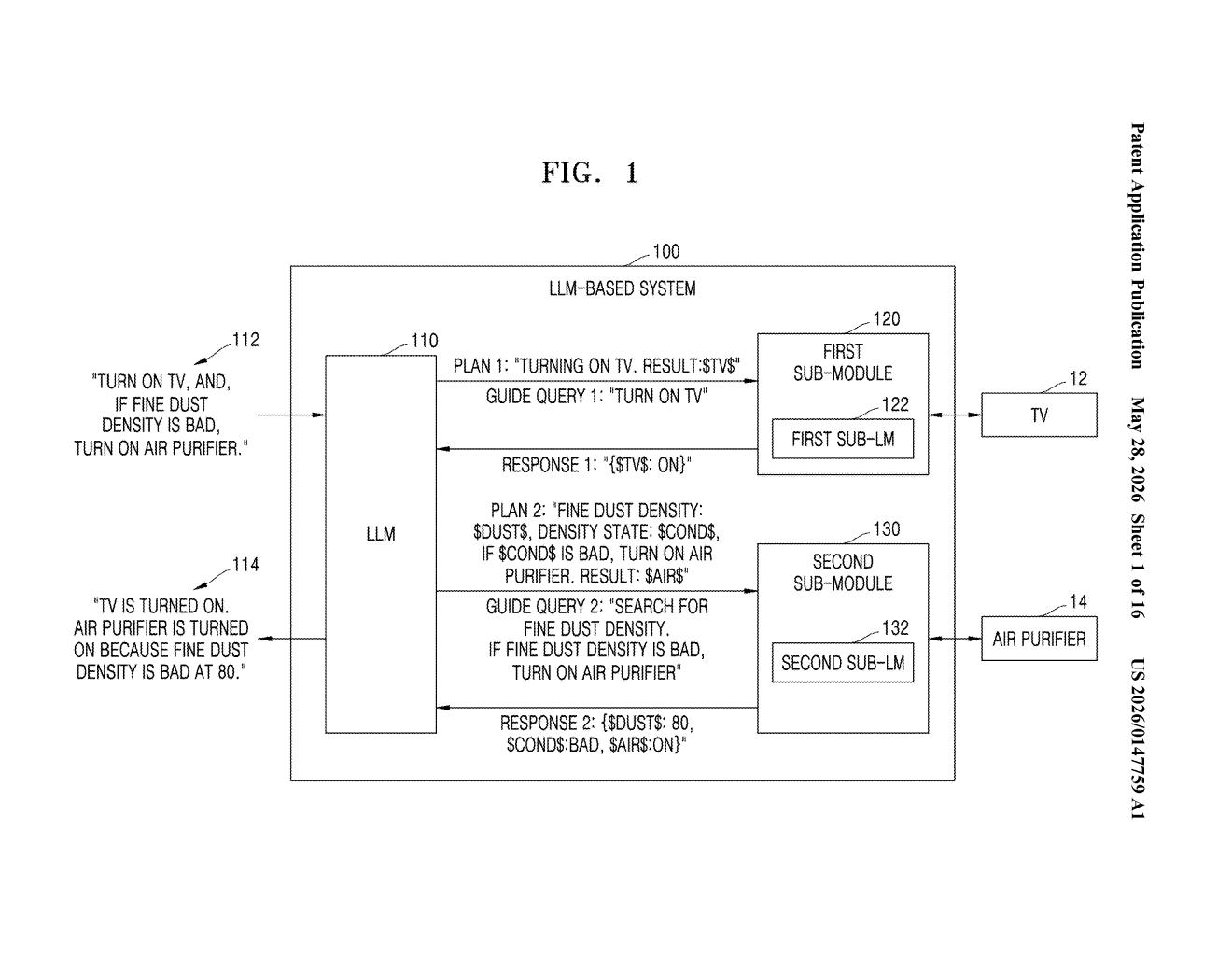
How Samsung's LLM boss-and-specialist system works
Imagine you tell your phone, "If the air quality is bad, turn on the air purifier; otherwise, turn on the TV." Today, making that kind of conditional, cross-device request work smoothly is tricky — your phone would need to understand home automation, sensor data, and natural language all at once.
Samsung's patent describes a smarter division of labor. A central large language model (LLM) acts like a project manager: it reads your request, writes a "plan" that contains blank slots for information it doesn't yet have, and sends those blanks to the right specialist models on the right devices. The TV's model fills in its blank; the air purifier's model fills in its blank.
Once all the blanks are filled in, the central LLM collects those answers and generates your final response. You ask one question, a whole ecosystem of AI models collaborates behind the scenes, and you get one clean answer back.
How the plan query and blank-filling mechanism operates
The patent describes a hierarchical query-processing pipeline with two tiers of AI models working together.
At the top sits a central LLM that receives your original input query. Rather than trying to answer everything itself, it generates what the patent calls a "plan query" — essentially a structured task plan that contains blank placeholders (e.g., $TV$, $AIR_PURIFIER$) representing values that need to be fetched from specialized sub-modules.
For each sub-module (think: a smaller, task-specific language model living on or near a particular device or service), the LLM sends three things:
- A request to fill in the blank values
- A relevant portion of the plan query so the sub-model understands the broader context
- A "guide query" — a focused re-framing of the original request scoped specifically to that sub-module's domain
Each sub-language model (sub-LM) processes its guide query in context and returns a response with the filled-in values. The central LLM then aggregates all those responses to produce the final answer. The architecture is explicitly designed to handle conditional logic ("if X, do Y; else do Z") across multiple devices or services.
What this means for Samsung's multi-device AI strategy
Samsung makes an enormous range of connected products — TVs, refrigerators, phones, air purifiers, washing machines — all under the SmartThings ecosystem. An orchestration layer like this would let a single natural-language request ripple intelligently across all of them without every device needing a full-scale LLM on board. Smaller, cheaper models on each device do the local work; one smart coordinator handles the reasoning.
This is also a direct play in the ongoing debate about on-device vs. cloud AI. By keeping sub-models local and only using the central LLM for planning and synthesis, Samsung could reduce latency, protect privacy, and cut cloud costs — all at once. Whether this shows up in Galaxy AI, SmartThings, or something new is an open question, but the architecture is clearly built with a heterogeneous device fleet in mind.
This is a genuinely interesting systems patent, not a trivial filing. The 'plan query with blank slots' idea is a clean formalization of LLM-as-orchestrator patterns that researchers have been exploring, and Samsung is one of the few companies with a hardware ecosystem diverse enough to actually need this at scale. The real test will be whether the sub-LM responses are reliable enough that the central model doesn't hallucinate when stitching them together — that's the hard unsolved problem here.
There are more where this came from
We read every patent application Big Tech publishes and send you the ones worth knowing. Plain English, free, every week.
Want this weekly breakdown for a company we don't cover? Patentlyze Pro →