

Meta
Meta · AI / ML · Filed Nov 12, 2024 · USPTO published May 14, 2026 · May 14 release
Meta Patents a Web Platform for Building Custom AI Chatbots
Meta is filing patents for a drag-and-drop-style AI chatbot creation system that uses data already sitting on its platforms to train your bot. This looks a lot like the foundation for turning every business page — or personal profile — into an always-on AI assistant.
- Publication number
- US 2026/0135825 A1(US20260135825A1)
- Applicant
- META PLATFORMS, INC.
- Filed · Published
- Nov 12, 2024 · May 14, 2026
- Inventors
- Hannah Lea Cassius, Huihui Fan, Benjamin Thomas Loulier, Demi Douglas, Gabriella Schwarz, George Orlin, Giovanni Carlo Mayuga Alcantara, Giuliano Morse, Matthew Ryan Gabor, Yash Agarwal, Wiqas Tahir, Maheen Sohail, Saeed Jahed, Marlena Lorraine Morshead, Merlyn Deng, Eric Desfosses, Zakariya Ahmad, Adam Kelsey, Alison Azera, Laycee Berkas, Sabrina Ylan Vogeley
- Status when we published
- Examiner raised objections; the company can respond
- Document
- 20 claims
- US classification
- 709/206
- Examiner
- PATEL, DHAIRYA A (Art Unit 2453)
What Meta's AI chatbot builder actually does for you
Imagine you run a small business on Facebook. Instead of hiring someone to answer customer questions at 2 a.m., you could build an AI chatbot that already knows your product catalog, your FAQs, and your brand voice — all because it was trained on data Meta already has about you.
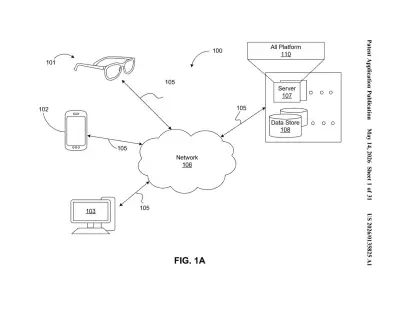
That's essentially what this patent describes. A user visits a web-based interface, picks what they want their AI chatbot to do (answer questions, recommend products, chat with followers), and Meta's system uses existing platform data associated with that user to train a machine learning model on the spot.
The finished chatbot gets deployed directly inside the same platform — no coding required, no third-party tools. It's Meta's pitch for a no-code AI agent factory baked right into its social ecosystem.
How Meta trains your chatbot from your own platform data
The patent describes a web-based creation platform that walks a user through building an AI chatbot via a guided interface. At its core, the flow works like this:
- Prompt display: The UI shows the user a menu of services and functions the chatbot can perform — think customer support, product recommendations, or conversational Q&A.
- User selection: The user picks which capabilities they want. This input acts as the configuration spec for the model.
- On-platform training: Here's the key part — the system trains a machine learning model using both the user's selections and data about the user that already exists on Meta's platform (posts, product listings, prior interactions, etc.).
- Deployment: The trained chatbot is configured and surfaced back in the same UI, ready for real-time conversation with the creator or other platform users.
The claim leans heavily on the phrase "data associated with the user available on the web-based platform" — which is doing a lot of work. It implies the training signal isn't generic; it's personalized to whoever is creating the bot, pulling from Meta's existing data graph.
The USPC 709/206 classification (information transfer, computer network) confirms this is fundamentally about networked, platform-native AI deployment rather than standalone model training.
What this means for AI agents on Facebook and Instagram
If Meta ships something like this, it fundamentally changes what a Facebook business page or Instagram creator account is. Your page stops being a static profile and becomes a live AI agent that can converse with followers, handle support queries, or sell products — 24/7, trained on your own content.
The competitive angle is obvious: this is Meta's answer to platforms like Botpress, ManyChat, or even OpenAI's GPT builder, except it's integrated into a social graph with billions of existing users and their data. For small businesses already living inside Meta's ecosystem, the switching cost to a native tool like this would be essentially zero.
Source: US 2026/0135825 A1 at the USPTO (PDF). Full patent text and figures are in the official publication.
Get our take in your Top Stories
Liked this breakdown? Add Patentlyze as a preferred source on Google, and our plain-English take shows up more often in your Top Stories the next time Meta patent news breaks.
Add Patentlyze on Google
One click.
There are more where this came from
We read the new patents from Big Tech, carmakers and more and send you the ones worth knowing. Plain English, free, every week.
More from Meta
All 192 Meta patents →
More in AI assistant & agent
All 436 AI assistant & agent patents →
Samsung
Samsung Patent Shows AI Assistant Capable of Judging When Shorter Responses Are Needed
Google
Google Patent Reveals AI That Tracks Which Words Users Actually Stop to Read
Qualcomm
Qualcomm Patents a Way to Run AI Models on Chips With Fewer Resources
IBM