
Qualcomm Patents a Way to Stop AI Text Drafts Before They Go Off the Rails
AI text generation is a two-model relay race, and Qualcomm thinks the baton is being passed way too late. A new patent describes a way to cut the draft phase short the moment a small model starts guessing blindly, handing control to the powerful model sooner and wasting less computation.
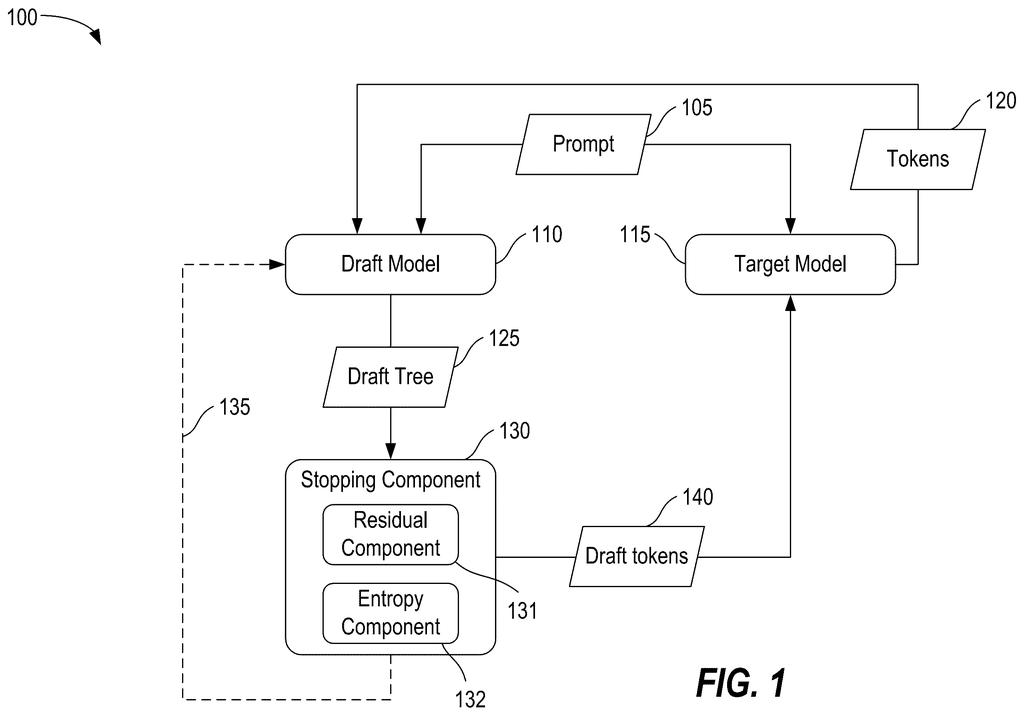
How Qualcomm's draft-stopping trick speeds up AI replies
Imagine asking your phone's AI assistant to write a message. Behind the scenes, two AI models are working together: a small, fast one sketches out candidate words, and a larger, slower one checks and approves them. The problem is that the small model sometimes keeps sketching even when it has clearly run out of good ideas, burning time and battery on word guesses that the big model will just throw away.
Qualcomm's patent describes a method for the small model to check its own confidence at each step. If it measures that its next guess is basically a coin flip, it stops drafting and hands off to the big model immediately, rather than pushing forward with noise.
The result is that the big model gets called in exactly when it's needed, not a moment later. For you, that means AI responses that arrive faster, with less wasted effort from the chip handling the work.
… compute a set of entropies comprising a respective entropy of each respective leaf token of the first set of leaf tokens based on the set of residual probability distributions; generate a set of drafting decisions comprising a respective drafting decision for each respective leaf token of the first set of leaf tokens based on the set of entropies …
Translation: It calculates uncertainty scores for the draft words to decide whether to keep going.
How entropy scores decide when to hand off to the big model
The system works within a technique called speculative decoding, where a small "draft" model generates several candidate word sequences (organized as a branching structure called a draft tree) and a large "primary" model then verifies them in one pass, accepting or rejecting branches.
Qualcomm's addition is an early-stopping check applied to the outermost branches (the leaf tokens, meaning the last proposed words at the tips of each branch). For each leaf, the system calculates something called a residual probability distribution, which is essentially the gap between what the small model guessed and what a perfectly calibrated model would have guessed.
From that gap, it computes entropy (a measure of uncertainty or disorder borrowed from information theory). High entropy means the small model is genuinely unsure. The system then applies a stopping rule: if enough leaf tokens are high-entropy, drafting stops and the primary model takes over.
- Draft tree built by the small model
- Entropy measured at leaf nodes
- Stopping criteria checked against those entropy scores
- Primary model invoked only when the draft is worth verifying
The key insight is that continuing to draft past a high-uncertainty point produces word sequences the big model will almost certainly reject, so stopping early is strictly more efficient.
The secondary generative machine learning model is exited from based on the set of drafting decisions and one or more stopping criteria for generation of a new token using the primary generative machine learning model.
Translation: The system stops the draft generation process early when the text starts going off track.
What faster AI generation means for on-device assistants
Speculative decoding is already one of the main tricks used to make large AI models run faster on limited hardware, including the chips inside phones and laptops. But its efficiency depends on the small draft model being useful, and right now most systems just let it run until a fixed length regardless of quality. Qualcomm's patent addresses that waste directly by giving the small model a way to self-assess and yield.
For people using AI assistants on Qualcomm-powered Android phones or laptops, the practical payoff would be faster first-word response times and lower battery drain during AI tasks. Qualcomm's bet on on-device AI makes this kind of efficiency work especially meaningful: the less compute each inference wastes, the more capable a phone-sized AI can be without needing a cloud connection.
Qualcomm's ninth filing we've tracked since July in AI models that work in teams, following the resolution photo picker and the disagreement-triggered recorder, adds another layer to how its models divide work.
If you use an AI assistant on a phone, the gap between tapping send and seeing the first word back is one of the most noticeable friction points in the experience. This patent addresses that gap directly, by teaching the phone's smaller background model to recognize when it's guessing poorly and hand off to the main model sooner rather than spinning on bad predictions.
Most people will never notice this running, which is exactly the point. The benefit shows up as slightly faster responses and a battery that drains a little more slowly, because the device stops doing work that wasn't going to pay off anyway.
That's a modest but honest win. It doesn't change what the AI can do, but it makes the device smarter about when to stop trying to shortcut the answer, which is the difference between a tool that feels snappy and one that feels like it's thinking too hard before it speaks.
There are more where this came from
We read every patent application Big Tech publishes and send you the ones worth knowing. Plain English, free, every week.
The drawings
7 drawing sheets from US 2026/0289328 A1 · click any drawing to enlarge


Want this weekly breakdown for a company we don't cover? Patentlyze Pro →
Be the first to weigh in