
Microsoft Patent Teaches Recommendation AI to Recognize When Backup Models Are Needed
Most recommendation systems pick an AI model and stick with it. Microsoft's new patent describes a system that checks its own confidence first, then decides which model to use mid-request.
What Microsoft's self-doubt ranking system actually does
Imagine a store employee who's great at recommending products most of the time, but on tricky days calls over a senior expert instead of guessing. That's the basic idea here.
Microsoft is patenting a recommendation engine that runs a fast, lightweight AI model by default. But before it hands you a list of results, it checks how confident that model is about its own rankings. If the confidence drops below a threshold, the system automatically routes the request to a bigger, more capable AI model to get a better answer.
The goal is to get the best of both worlds: speed and low computing cost most of the time, and accuracy when it counts. You, as a user, would just see better recommendations without any visible change in how the app behaves.
How conformal inference triggers the backup model
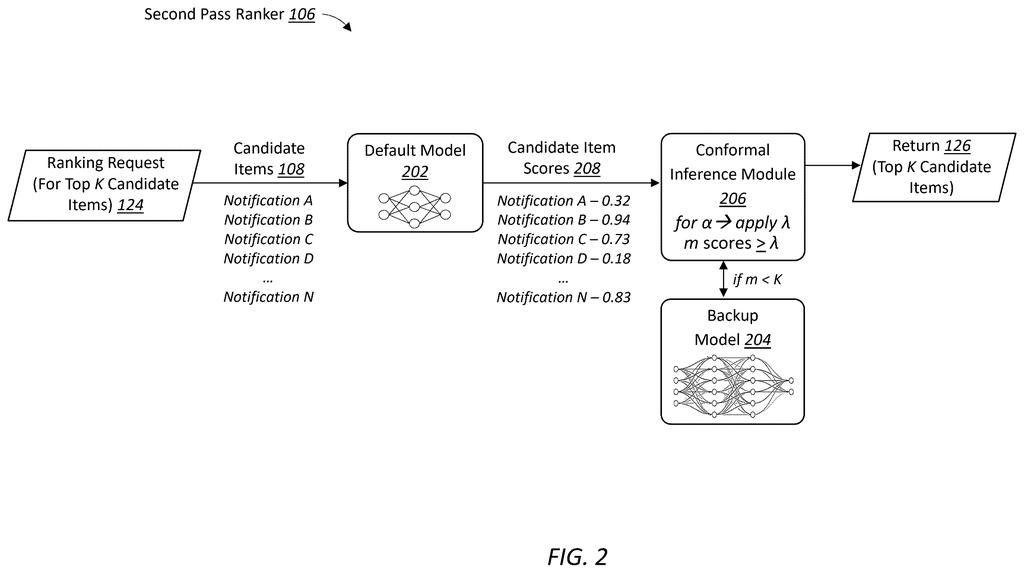
The patent describes a two-stage architecture inside a recommendation service. After an initial filtering pass narrows a large pool of content down to candidates, a component called the Second Pass Ranker (SPR) scores those candidates and picks the top results to show the user.
The SPR runs a lightweight default model first. Alongside those scores, a module applies conformal inference (a statistical technique that measures how uncertain a model's predictions are, based on how it has performed on past data) to decide whether the default model's output is trustworthy enough.
The key filtering step works like this:
- Each candidate item gets a score from the default model.
- Items scoring below a learned threshold are dropped.
- If too many items get dropped (suggesting the model is confused), the request gets escalated to a larger backup model with more parameters or more layers.
- The backup model then generates the final ranked list.
The threshold is tuned so that the false discovery rate (the share of bad recommendations that sneak through) stays below a preset limit. The system learns this threshold from historical data rather than having an engineer set it by hand.
What this means for feed-ranking at Microsoft scale
Recommendation systems at companies like Microsoft power LinkedIn feeds, Bing results, and Xbox suggestions, all serving millions of requests per second. Running a large AI model on every single request is expensive. Running a small model on everything means lower quality. This patent describes a principled way to split that workload based on actual measured uncertainty, not a fixed rule.
The practical payoff is that compute costs stay low on easy requests while accuracy improves on the harder ones where a small model would otherwise get it wrong. For users, it could mean fewer irrelevant results showing up in feeds or search pages, with no visible change in response speed.
This is solidly interesting infrastructure work. The idea of using statistical confidence to route between models dynamically is a real engineering problem at recommendation-system scale, and Microsoft is patenting a specific, testable approach to it. It won't make headlines, but it's exactly the kind of patent that ends up inside a production ranking system within two years.
There are more where this came from
We read every patent application Big Tech publishes and send you the ones worth knowing. Plain English, free, every week.
The drawings
7 drawing sheets from US 2026/0220214 A1 · click any drawing to enlarge


Want this weekly breakdown for a company we don't cover? Patentlyze Pro →
Be the first to weigh in