
Microsoft Files Patent for an AI Assistant That Finds Its Own Helper Apps
Microsoft's patent application describes an AI assistant that goes looking for helper apps on its own, instead of waiting for a developer to introduce each one. The patent examiner has already issued a final rejection.
What Microsoft's app-finding AI assistant does
A new app goes online on Tuesday, and the AI assistant on your computer has no idea it exists. Nobody told it the app is there, so it never uses it.
That is the gap Microsoft's patent application tries to close. Today, a developer usually has to write a setup file for every tool an AI can use, and list where each one lives on the network. Microsoft describes an assistant that keeps its own directory of available apps instead. It asks around, collects each app's address and a short description of what the app can do, and files that away.
Then, when you ask for something, the assistant checks the directory and picks the apps that fit. Some may sit on your own computer and some out on the internet. It gets an answer from each one and stitches them into a single reply for you.
query an Artificial Intelligence Context Protocol (AICP) endpoint registry to identify at least a locally hosted application at a local AICP endpoint server and a remotely hosted application at a remote AICP endpoint server, at least one of the locally hosted application and remotely hosted application being a generative model; …
Translation: The AI searches a registry to find other local and remote AI applications it can use for help.
How the assistant builds its app directory
The system rests on an AI context protocol, a shared set of rules that lets an AI model talk to outside apps and data sources. The filing names the Model Context Protocol as one example. Today, a developer must code a configuration file listing each tool's abilities and network location ahead of time.
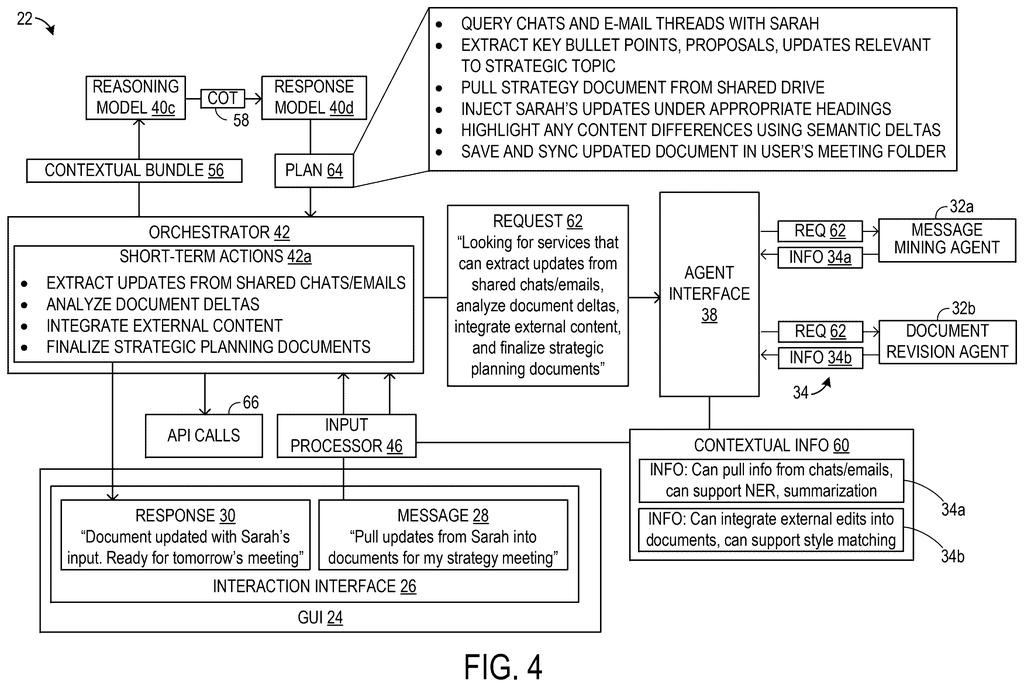
Here, a discovery module broadcasts a call to apps on the device and on remote servers. Each replies with its address, its capabilities and a text description, which are stored in a registry. When a question arrives, the AI agent plans at least two actions and looks up which registered apps can handle each one.
The first independent claim then walks through the sequence:
- Open a session with a local app (such as a word processor or spreadsheet) and send it context.
- Open a second session with a remote app, such as a language or image model.
- Pass both answers to a language model, which writes the final reply.
A third independent claim describes an orchestrator (a coordinating program) that broadcasts a request, bundles the message and actions, has a model draft a plan, and then calls a subset of the data sources to carry it out. The registry can live in long-term memory.
… establish AI context protocol sessions with the endpoint servers, transmit contexts for the context protocol sessions to the applications hosted at the endpoint servers, and receive endpoint responses from each of the applications via the protocol sessions.
Translation: It connects to those helper apps, sends them the necessary background information, and collects their answers.
What this means for assistants that juggle apps
If assistants can find tools on their own, the apps your AI can use no longer depend on a developer's setup file. For you, that could mean one chat or voice box handling jobs that now send you across several apps, including new ones that appear after the assistant was built. The filing's examples include business document tools, coding tools and research data sources.
A caution: the patent examiner has issued a final rejection of this application, so nothing here is approved or granted. Microsoft can still amend the claims or appeal. Until that plays out, the filing mainly shows how Microsoft describes an assistant that works across local and cloud apps.
Microsoft's 28th filing we've tracked since July on our AI agents that act for you watchlist follows earlier work like digital ID badges for agents and a map for clicking websites.
What you would notice is less app-hopping. Say "pull updates from Sarah into the documents for my strategy meeting," and the assistant finds the right tools and connects them without you opening a single one.
The bigger shift is what happens when a new tool joins your company's setup. Today an assistant stays blind to it until someone manually wires it in. This describes an assistant that spots it on its own and starts using it.
The open question is trust. An assistant that discovers new apps by itself is also sending your emails and documents toward them, and the filing notes that apps report back what access they need. You would want to see how that is controlled before switching it on, and with a final rejection already on record, this is an idea to follow on paper rather than a feature to plan around.
Get our take in your Top Stories
Liked this breakdown? Add Patentlyze as a preferred source on Google, and our plain-English take shows up more often in your Top Stories the next time Microsoft patent news breaks.
There are more where this came from
We read every patent application Big Tech publishes and send you the ones worth knowing. Plain English, free, every week.
The drawings
7 drawing sheets from US 2026/0349997 A1 · click any drawing to enlarge


Want this weekly breakdown for a company we don't cover? Patentlyze Pro →
Be the first to weigh in