
Microsoft Patents a Three-Layer Memory System for AI Assistants
Most AI chatbots forget you the moment you close the window. Microsoft's new patent describes a structured memory system that lets a generative model carry what it knows about you from one conversation to the next, organized in layers that mirror how human memory actually works.
How Microsoft's AI memory tiers work for you
Ever tried to find one email in a ten-year archive? The frustration isn't just about search, it's about context: you remember the gist but not the keywords. AI assistants have the same problem in reverse, they have your whole conversation right in front of them but forget everything the second you log out.
Microsoft's patent describes a way to fix that by giving an AI model three levels of memory, much like the difference between what's on your desk right now, what's in your filing cabinet, and what's in deep storage. Short-term memory holds your current chat. Working memory gathers the highlights of recent exchanges. Long-term memory keeps the stuff that actually matters, stored permanently and pulled back in when it's relevant to a new question you ask.
The result is an AI that can say, in effect, "I remember you prefer brief answers" or "last month you were working on a budget proposal" without you having to re-explain yourself every session.
… the message is appended to the short-term memory; the short-term memory is aggregated into working memory; the working memory is stored into the long-term memory based on predetermined criteria; and the contextual bundle is compiled to include one or more relevant entries of the long-term memory.
Translation: The system organizes information by moving it from immediate chat history into long-term storage based on specific rules.
How messages move from short-term to long-term storage
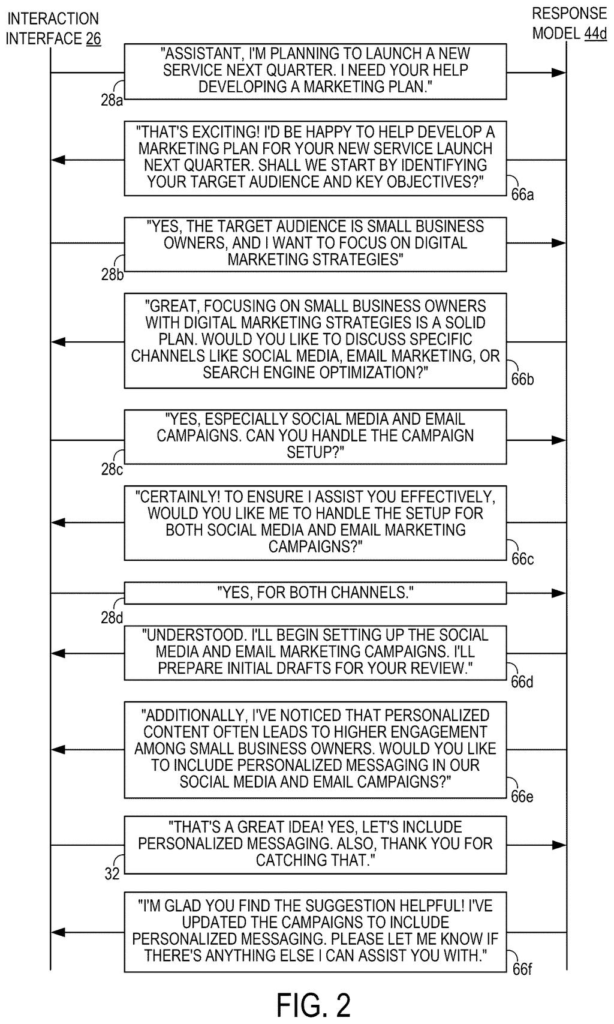
The system sits between the user's interaction interface (a chat window, voice assistant, or similar input) and the underlying generative model (an AI like a large language model). A software layer called the client coordinates all three memory tiers.
Here's how a message flows through the system:
- Short-term memory captures each message as it arrives, like a notepad for the live conversation.
- Working memory aggregates, or rolls up, the short-term messages into a condensed summary, similar to how you might jot down bullet points after a meeting.
- Long-term memory stores those summaries permanently, but only when they meet predetermined criteria, meaning the system has rules for deciding what's worth keeping.
When you send a new message, the client doesn't just hand it raw to the AI. It compiles a contextual bundle: your current message plus whichever entries from long-term memory are most relevant to what you're asking. The model then generates a response based on that enriched input.
The key design choice is the separation of tiers. Each layer has a different lifespan and a different job, which means the AI doesn't need to scan every conversation you've ever had; it only retrieves entries flagged as relevant to your current request.
The client is configured to receive a request including a message having natural language input from the interaction interface, compile the message into a contextual bundle, input the contextual bundle into the generative model to generate a response, and output the response.
Translation: The software takes your plain text question, combines it with relevant background data, and sends it to the AI for an answer.
What persistent AI memory means for Microsoft's products
For everyday users, the practical payoff is an AI assistant that actually behaves like one. Right now, if you switch sessions in Copilot or any comparable tool, you start from zero. A tiered memory system would mean the AI already knows your preferences, your ongoing projects, and your communication style, without you pasting in background context every time you open a new chat.
For Microsoft, this is a direct investment in making Copilot stickier across its Office and Windows ecosystem. The more personalized the assistant feels, the harder it is to switch to a competitor. Microsoft's AI memory work sits alongside a wave of interesting tech patents from companies trying to solve the same problem of continuity in AI, and this filing is one of the more architecturally detailed approaches to appear in public.
That makes this Microsoft's 12th filing we've tracked since June in our AI assistants that remember you watchlist, following one on building web user profiles and one on adapting chatbots to groups.
The three-tier memory design solves a real ceiling: an AI can only hold so much conversation in mind at once, so splitting storage into short-term, working, and long-term layers is a sensible way to stretch what the system can remember across time. The cost lives in the compression step. Every time recent messages get summarized and promoted upward, some detail disappears, and the patent describes the rules governing that process only as "predetermined criteria."
If those rules are calibrated wrong, the system either hoards irrelevant noise or discards exactly what you needed it to keep. That tradeoff is probably worth accepting, but it relocates the hard problem rather than solving it.
What remains open is who sets those criteria, and whether the person using the system gets any say in what the AI decides to remember about them.
Get our take in your Top Stories
Liked this breakdown? Add Patentlyze as a preferred source on Google, and our plain-English take shows up more often in your Top Stories the next time Microsoft patent news breaks.
There are more where this came from
We read every patent application Big Tech publishes and send you the ones worth knowing. Plain English, free, every week.
The drawings
5 drawing sheets from US 2026/0252594 A1 · click any drawing to enlarge


Want this weekly breakdown for a company we don't cover? Patentlyze Pro →
Be the first to weigh in