
Microsoft Patents a Way to Give AI Teammates a Visual Presence in Group Sessions
When robots and AI assistants join a mission alongside humans, how does anyone know which AI is doing what? Microsoft's latest patent takes a crack at that problem by giving AI participants their own visual identities inside a shared collaboration interface.
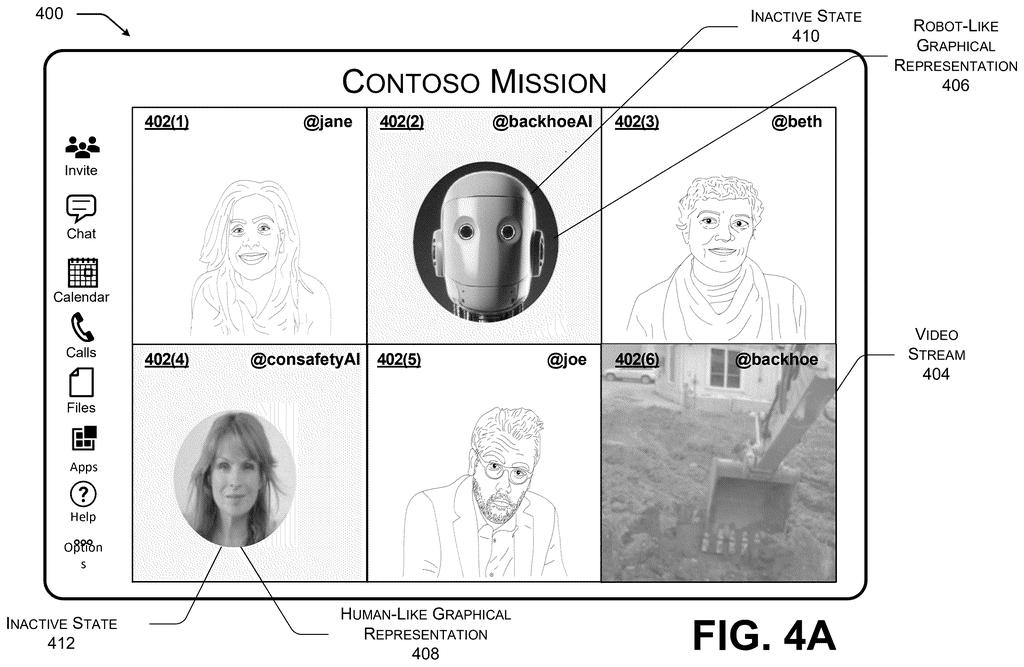
What Microsoft's AI avatar system actually does in team sessions
A fire department coordinates a search mission. Some team members are on the ground, some are drones, and a few are AI systems running in the background analyzing maps and radio traffic. Right now, you'd have no easy way to see which AI is active or what it's focused on.
Microsoft's patent describes a system that puts all three types of participants, humans, robots, and AI agents, into a single shared screen, with each AI getting its own icon or avatar. The icon changes based on what kind of AI it is: a general-purpose assistant gets one look, while a specialized AI (say, one trained only for route planning) gets a different one.
The goal is simple: anyone glancing at the interface can immediately tell which AI agents are active and what they're doing, without having to dig through menus or read system logs. It's the same idea as seeing a teammate's status light go green on a video call, applied to AI participants.
… generating, within the interaction environment for the collaboration session, a graphical representation for the artificial intelligence agent participant based on the type of the artificial intelligence agent participant …
Translation: The system creates a visual avatar for the AI based on what kind of tasks it is designed to perform.
How the system picks and displays each AI agent's icon
The system runs what the patent calls a collaboration session, a shared digital environment where humans, robotic devices, and AI agents all participate together on a defined mission inside a real geographical area (think a warehouse floor, a disaster zone, or a construction site).
When an AI agent joins the session, the system first determines its type. The patent distinguishes between at least two: a general-purpose AI (one that can handle a broad range of tasks) and a specific-purpose AI (one trained for a narrow job, like obstacle detection or translation). That type classification drives the visual.
The system then generates an interaction environment, essentially the shared interface all participants see, and places a distinct graphical representation for each AI agent inside it. The visual updates to reflect whether an agent is actively engaged and, if so, what it is currently doing within the mission context.
Human participants receive this interface on their own computing devices. The practical effect is a live dashboard where you can glance and see:
- Which AI agents are in the session
- What category of AI each one is
- Whether each agent is currently active or idle
- What task an active agent is handling at that moment
The graphical representations of artificial intelligence agent participants ensures smooth collaboration and provides an element of a visual feedback, to human participants, as to which artificial intelligence agent participants are actively engaged and/or what the actively engaged artificial intelligence agent participants are currently doing …
Translation: Seeing the AI helps people understand which digital assistants are working and what tasks they are currently handling.
What this means for human-robot-AI team software
As AI agents start showing up inside real operational software, logistics platforms, emergency response tools, industrial control rooms, the hardest UX problem isn't getting the AI to work, it's making sure the humans in the room understand what the AI is doing right now. A misread status in a time-sensitive mission can cause real errors. This patent is Microsoft's attempt to solve that with a standard visual grammar for AI participants, the same way a traffic light uses color to remove ambiguity.
The system also covers robotic devices as co-participants, which signals that Microsoft is thinking about scenarios where physical machines and software agents share a coordination layer with human operators. Those use cases, think warehouse robotics, military coordination, or disaster response, are expanding fast, and new Big Tech patents in the human-robot-AI teaming space are piling up as companies race to define how these mixed teams get managed.
That makes this Microsoft's 17th filing we've tracked since May in our AI teams working together watchlist, following applications like AI reviewers fixing chip code and dual models for content picks.
Claim 1 covers the act of generating a visual representation for an AI participant inside a shared session, where the visual form changes based on what *type* of AI agent it is. That scope is wide: it doesn't protect a specific icon or color scheme, it protects the underlying design pattern of giving AI agents type-aware visual identities in any collaborative software.
In practice, that breadth means any product that shows users a visual distinction between, say, a general-purpose AI and a task-specific AI inside a shared workspace would need to reckon with this claim. The patent is staking out a UI convention, not a technical invention.
That matters because the behavior it covers is quickly becoming standard in team software. If granted, this claim could require licensing conversations around a design choice that many collaboration tools will naturally arrive at on their own.
Get our take in your Top Stories
Liked this breakdown? Add Patentlyze as a preferred source on Google, and our plain-English take shows up more often in your Top Stories the next time Microsoft patent news breaks.
There are more where this came from
We read every patent application Big Tech publishes and send you the ones worth knowing. Plain English, free, every week.
The drawings
12 drawing sheets from US 2026/0253296 A1 · click any drawing to enlarge


Want this weekly breakdown for a company we don't cover? Patentlyze Pro →
Be the first to weigh in