
Microsoft Patents an AI System That Stops Your Virtual Hand Raise From Being Ignored
You raise your virtual hand in a meeting, the conversation barrels on, and nobody notices. Microsoft is filing a patent for software that refuses to let that happen.
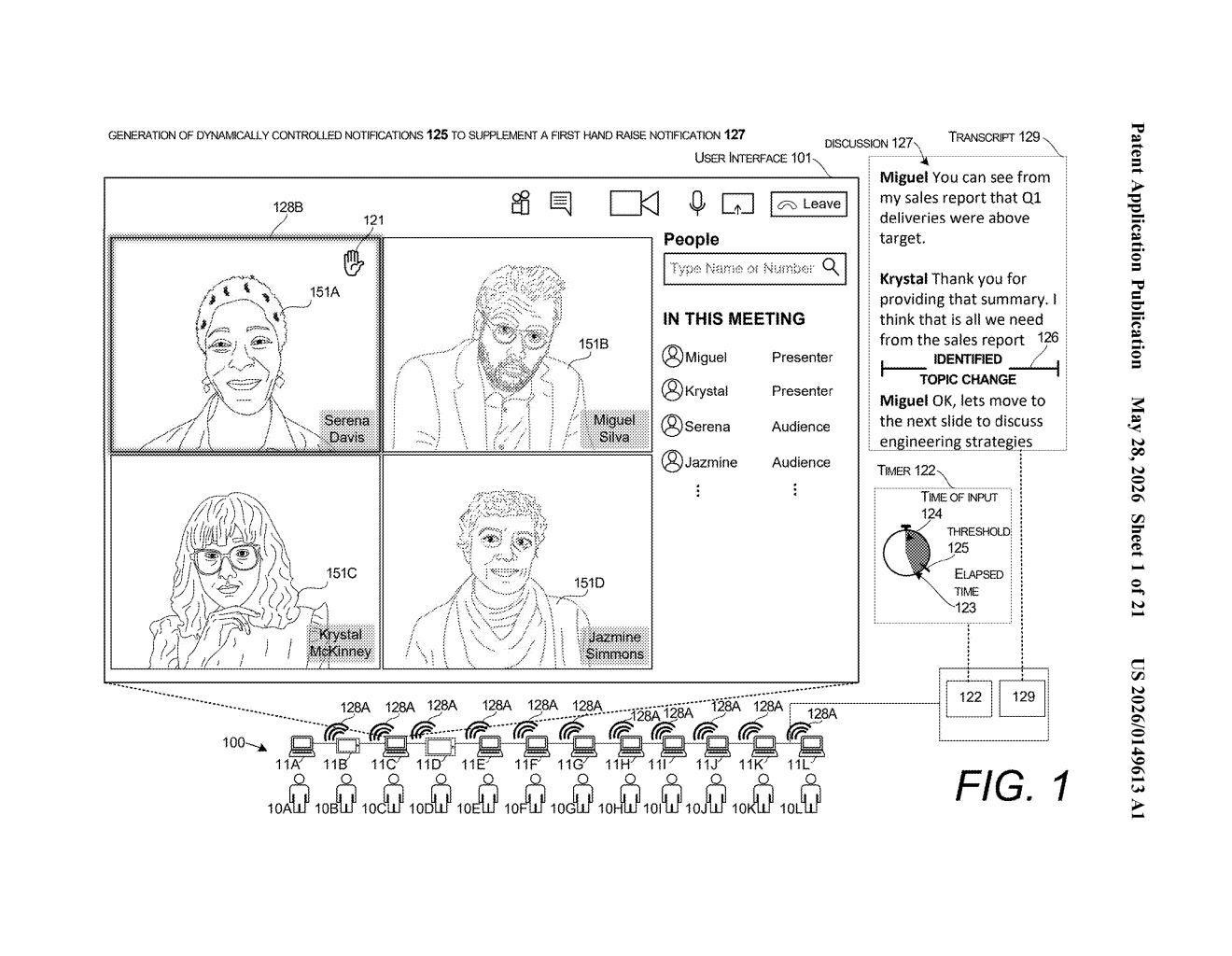
What Microsoft's persistent hand-raise alert actually does
Picture this: you're in a big Teams meeting, you click 'raise hand,' and the discussion keeps moving. By the time someone glances at the participant list, the moment has passed and the topic has already changed. That's the specific problem this patent is trying to fix.
Microsoft's system would watch for two things after you raise your hand: how long you've been waiting, and whether the conversation has drifted to a new topic. If either of those triggers fires — say, two minutes pass or the group shifts from budget talk to engineering — the meeting software escalates its notification. That might mean a sound cue, a visual highlight around your name or video tile, or some other nudge that's harder to ignore than a small icon in a sidebar.
The AI piece is a language model that listens to the audio and decides when a topic transition has actually happened. The goal is to make sure quieter participants or people in large calls don't just silently get skipped over while the meeting charges ahead.
How topic detection triggers the escalating alert
When a participant raises their virtual hand in a communication session (the patent is platform-agnostic but obviously fits Teams), the system does two things simultaneously: it displays the standard graphical hand-raise icon to all participants, and it starts a timer.
In parallel, a trained generative language model (essentially an LLM — a large language model, the same family of AI behind ChatGPT) analyzes the live audio streams of the meeting. Its job is to detect topic transitions — moments when the group's discussion meaningfully shifts from one subject to another. Think of it as the AI listening for conversational pivots, not just keywords.
The system then watches for whichever triggering event arrives first:
- Timer threshold: the participant has been waiting too long without being acknowledged.
- Topic change: the conversation has moved on, making the original hand raise potentially moot or more urgent.
When either trigger fires, the system generates a dynamically controlled notification — an escalated alert that can include an audio signal played on all participants' devices, or a supplemental visual indicator emphasizing the waiting participant's video tile or name. The patent specifically frames this as an inclusiveness tool, aimed at participants who might otherwise be talked over in large or fast-moving meetings.
What this means for inclusiveness in Teams meetings
For anyone who regularly sits through large video calls, this is a genuinely useful quality-of-life fix. The virtual hand raise in tools like Teams has always been a passive, easy-to-miss feature — a small icon that busy presenters often overlook. Tying escalated alerts to topic changes is a clever wrinkle because it captures the moment when ignoring a raised hand actually costs someone the chance to speak.
For Microsoft, this fits into a broader push to make Teams the collaboration layer for hybrid and large-org meetings. If the feature ships, it also gives Teams a concrete AI-powered inclusiveness story — something that resonates with enterprise HR and DEI conversations — rather than just more AI-generated summaries.
This is a small, focused patent that solves a real and specific problem — not a moonshot. The LLM-based topic detection is the technically interesting bit; the rest is fairly straightforward meeting UX logic. Whether it ships in Teams or quietly disappears into the backlog, the core idea is sound and the kind of thing that would actually get used if it worked well.
There are more where this came from
We read every patent application Big Tech publishes and send you the ones worth knowing. Plain English, free, every week.
Want this weekly breakdown for a company we don't cover? Patentlyze Pro →