
Microsoft Patent Uses Hybrid Loss Function to Train Smarter Compact AI Models
Most AI training techniques treat the student model as a passive recipient of the teacher's wisdom. Microsoft's new patent flips part of that around, making the student's own wrong answers part of the lesson.
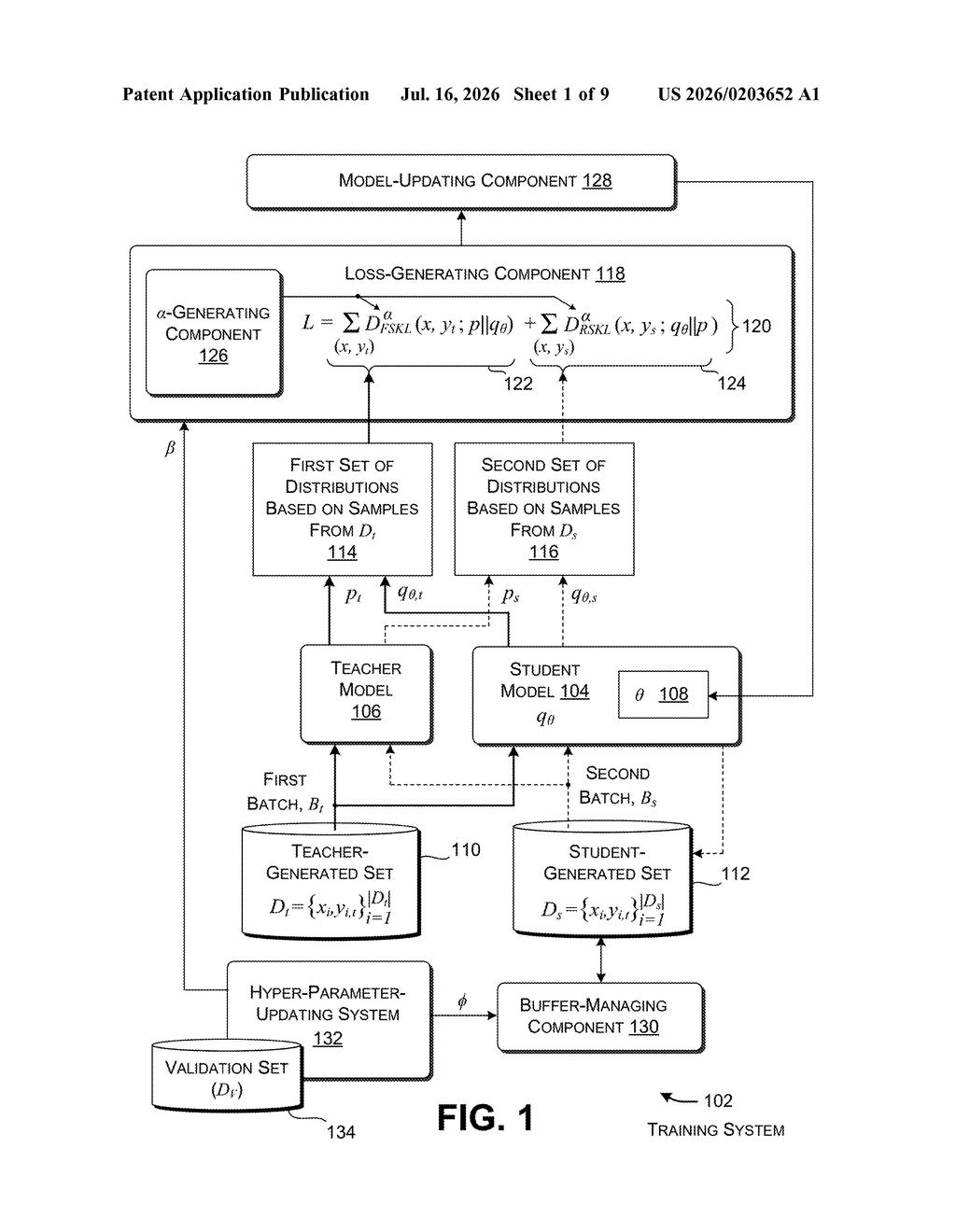
How Microsoft's teacher-student AI training actually works
Imagine a medical student learning from an experienced doctor. The standard approach: watch the expert handle real cases and try to copy them. But Microsoft's patent adds a twist: the trainee's own guesses, even the bad ones, get fed back into the lesson plan so the trainer can correct exactly where the student goes wrong.
That's essentially what this filing describes for AI. When you train a smaller, faster AI model using a larger, more capable one (a common technique called knowledge distillation), you normally just show the small model what the big model would say and tell it to match that. Microsoft's method also captures what the small model generates on its own, compares those outputs to the big model's expectations, and folds that comparison into the learning signal.
The result is a training process that corrects two kinds of errors at once: places where the student model misreads a known-good example, and places where its own independent guesses stray furthest from reality. The system also automatically adjusts the balance between those two corrections as training progresses.
How the hybrid loss function handles two sample types
The patent describes a training method built around a hybrid loss function (a mathematical score that tells the model how wrong it is, so it can correct itself). The loss has two parts that work together.
- Part one (forward divergence): The big "teacher" model generates examples that are considered correct. Both the teacher and the smaller "student" model then produce probability distributions (ranked guesses about what word, token, or answer comes next) based on those same examples. The difference between those distributions is measured using forward KL divergence (a standard formula for comparing two sets of probabilities, where the teacher's distribution leads). The student is penalized for covering possibilities the teacher thinks are important but the student ignores.
- Part two (reverse divergence): The student model generates its own examples, which may be imperfect. Both models again produce probability distributions based on those student-generated samples. This time, the comparison is flipped: reverse KL divergence measures how well the teacher's distribution aligns with the student's, penalizing the student for spreading probability mass over outputs the teacher considers unlikely.
The two penalties are combined into a single loss score. Crucially, the system uses dynamic hyper-parameter updates (automatic tuning of how much weight each part carries) across training iterations, rather than fixing those weights at the start.
What this means for deploying smaller, cheaper AI models
Smaller AI models are the path to running AI cheaply, on-device, or with lower energy costs. Knowledge distillation is already the main technique for building them, but it has known failure modes: the student can be overly conservative (missing creative outputs) or overconfident (hallucinating). Microsoft's two-part loss targets both failure modes in a single training pass.
For Microsoft's own products, this is directly relevant to Phi, the company's line of compact language models designed to run affordably or locally. A more principled distillation method could close the gap between a large model's quality and a small model's cost, which is the central tension in practical AI deployment right now.
This is a narrow, methodological patent on a well-studied problem, and the underlying math isn't new. What's notable is the specific combination: using the student's own generated samples as a training signal alongside teacher-generated ones is a meaningful design choice, and the dynamic hyper-parameter scheduling suggests Microsoft has run real experiments with it. Worth watching in the context of the Phi model line, less so as a standalone headline.
Get our take in your Top Stories
Liked this breakdown? Add Patentlyze as a preferred source on Google, and our plain-English take shows up more often in your Top Stories the next time Microsoft patent news breaks.
There are more where this came from
We read every patent application Big Tech publishes and send you the ones worth knowing. Plain English, free, every week.
Want this weekly breakdown for a company we don't cover? Patentlyze Pro →