
Microsoft Patents AI That Colors Heat-Detecting Footage Differently for Each Object Type
Thermal cameras show you heat — but they can't tell you what's hot. Microsoft's new patent describes a system that figures out whether it's looking at a person, a vehicle, or a piece of equipment, then colors each one differently, automatically.
What Microsoft's heat-signature colorizer actually does
Regular thermal cameras show everything as shades of orange and white — hot things glow, cold things don't, and it's up to a human to figure out what's what. That works fine when you're looking at one thing, but in a crowded scene it gets confusing fast.
Microsoft's patent describes a system that takes a more analytical approach. Instead of treating all heat the same, its sensor captures heat across multiple different slices of the infrared spectrum — think of it like splitting white light through a prism, but for heat. Each type of object (a person, a car engine, an electrical panel) leaves a slightly different pattern across those slices, a kind of heat fingerprint.
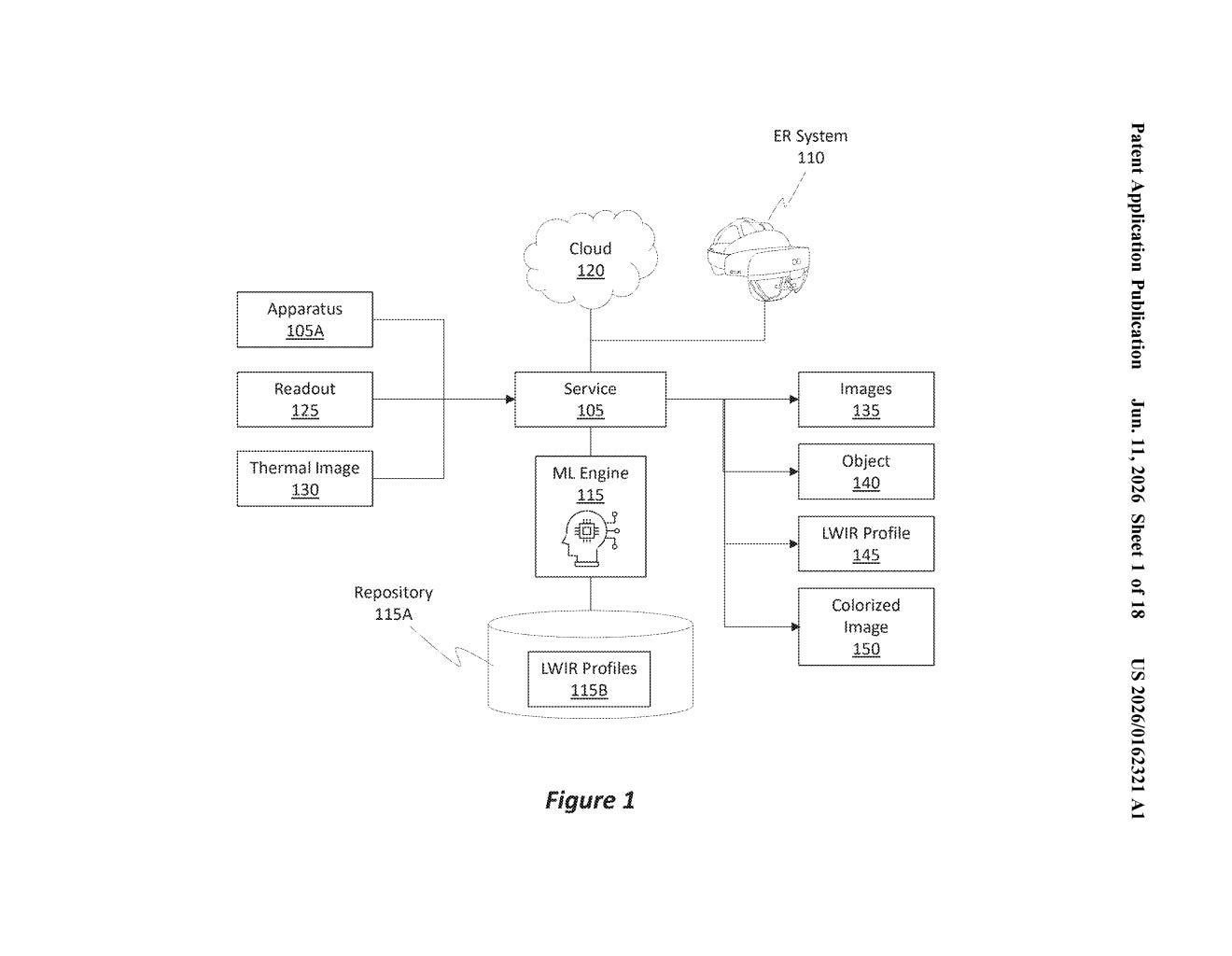
The system matches those fingerprints against a saved library, figures out what each object is, and then colorizes the thermal image based on type — painting people one color, vehicles another, and so on. The result is a thermal image that's far easier for a human (or another AI system) to read at a glance.
How the LWIR spectral profile matching works
The patent describes a multi-spectral thermal imaging pipeline built around a sensor that isn't just a single thermal detector. The sensor contains several distinct pixel arrays, each tuned to a different narrow band within the long-wave infrared (LWIR) spectrum — the portion of the electromagnetic spectrum (roughly 8–14 micrometers) where room-temperature objects naturally emit heat radiation.
When the system captures a scene, it generates a separate image for each spectral band. Because different materials absorb and emit infrared energy differently across those bands, the same object looks subtly different in each image. The system then identifies objects that appear across multiple band images and constructs an LWIR profile — essentially a multi-band heat signature unique to that object's material composition and temperature.
That profile is compared against a pre-built library of saved LWIR profiles for known object types (people, vehicles, machinery, etc.). When a match is found, the system knows what it's looking at. It then takes a separate thermal image of the same scene and colorizes each recognized object based on its identified type — giving human operators (or downstream AI) a visually coded map rather than a uniform heat blob.
- Multi-band LWIR sensor captures overlapping spectral slices
- Per-object profiles are extracted and matched against a reference library
- Object type drives the colorization of the final output image
What this means for security cameras and defense tech
The most immediate application is security and surveillance: thermal cameras are already common in perimeter monitoring and military contexts, but operators routinely struggle to distinguish humans from animals or warm machinery in a cluttered scene. Automated, color-coded type identification could dramatically reduce false alarms and operator fatigue.
There's also a broader signal here about where Microsoft is positioning itself in defense and government sensing markets. This isn't a consumer patent — it reads squarely as infrastructure for military, industrial, or law-enforcement thermal imaging platforms. If you use any Microsoft-connected security or facility-management software, the underlying sensing layer it talks to could eventually look something like this.
This is a genuinely interesting patent for anyone watching the thermal imaging or defense-tech space — it's not just 'AI makes cameras better' hand-waving, but a specific, well-described spectral-profiling approach. That said, the real-world value depends entirely on how good the saved LWIR profile libraries turn out to be, which the patent doesn't address. The concept is solid; the execution risk is in the data.
There are more where this came from
We read every patent application Big Tech publishes and send you the ones worth knowing. Plain English, free, every week.
Want this weekly breakdown for a company we don't cover? Patentlyze Pro →