
Microsoft Patents a Dense Context Engine That Primes AI With Company-Specific Knowledge
Before your AI assistant answers a question, what if it could automatically load up a compressed briefing of everything relevant about your company and industry? That's exactly what Microsoft is patenting here.
What Microsoft's dense context engine actually does for AI
Imagine asking your company's AI assistant a question like "What's our standard approach for handling supplier disputes?" A generic AI might give you a textbook answer. But what you really need is an answer grounded in your company's actual policies, past decisions, and industry norms.
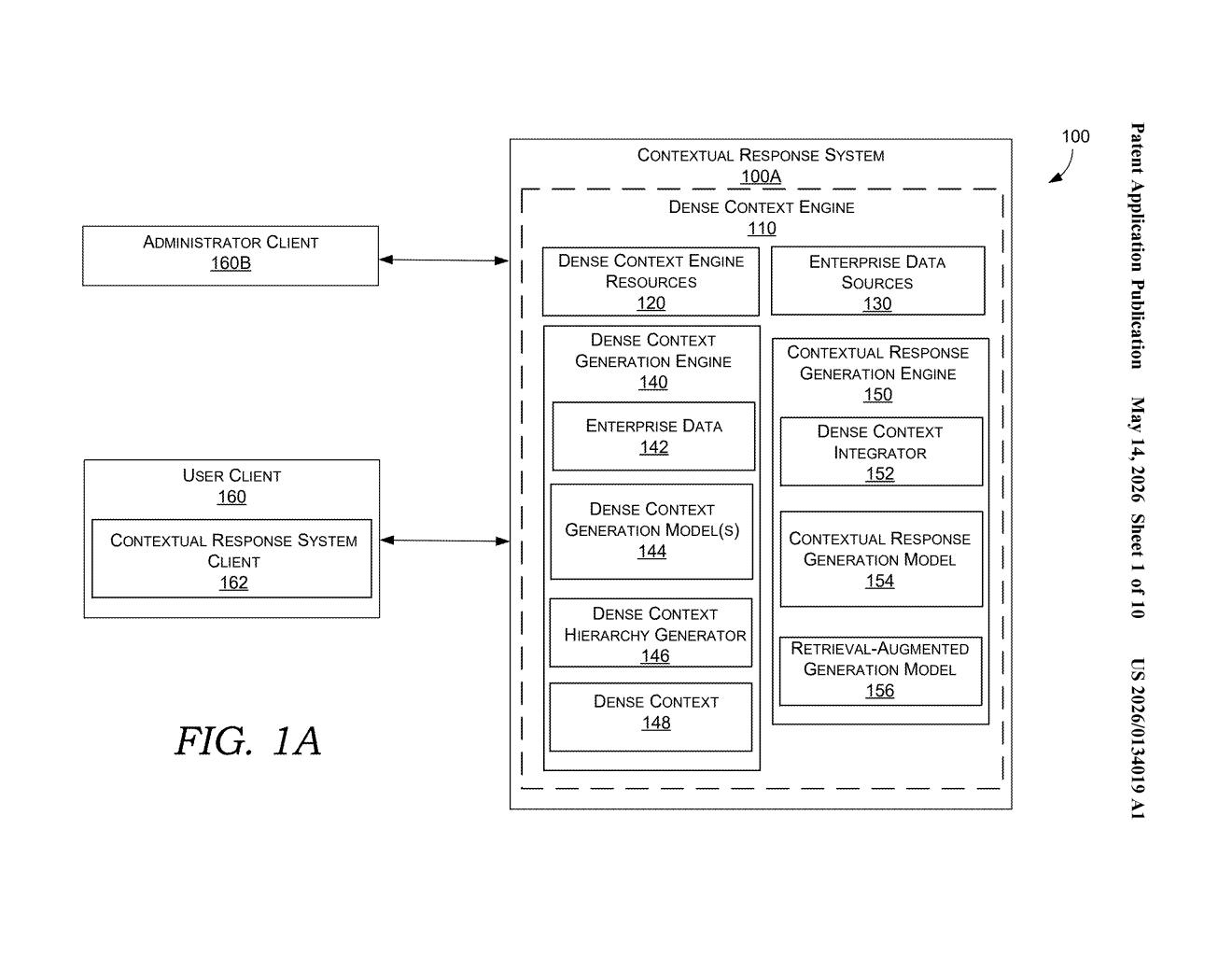
Microsoft's patent describes a system that solves this by automatically generating what it calls a dense context — a compact, programmatically-built summary of relevant enterprise data — and quietly stitching it into your query before the AI ever tries to answer. You ask a question, the engine enriches it behind the scenes, and the AI responds with something far more specific and useful.
Think of it like a research assistant who, before handing your question to the expert, quickly pulls the relevant files and whispers a summary into the expert's ear. You get a smarter answer without doing any extra work.
How the dense context integrator rewrites your query
The system revolves around three moving parts working in sequence:
- Dense context generation service: Pulls from enterprise data sources and produces a compressed, structured summary (the "dense context") relevant to the incoming query. This isn't a raw document dump — it's a synthesized representation designed specifically to help a language model respond accurately.
- Dense context integrator: Takes that summary and combines it with the original query to produce an updated query — essentially a richer, more contextualized version of what the user asked.
- Contextual response generation model: The actual language model that receives the updated query and generates the final answer.
The key insight is the separation of concerns. Rather than cramming enterprise knowledge directly into a model's training data or dumping raw documents into a prompt window (which gets expensive and slow), Microsoft's approach programmatically condenses the relevant context on demand and injects it at query time.
The patent also describes a dense context hierarchy — suggesting contexts can be layered or organized by specificity, from broad industry knowledge down to organization-specific or even project-specific detail. This hierarchy allows the system to serve the most relevant slice of context for each query rather than everything at once.
What this means for enterprise AI assistants
Enterprise AI deployments live or die on relevance. A Copilot or AI agent that gives generic answers quickly loses user trust, and the current standard fix — retrieval-augmented generation (RAG), where raw document chunks are fetched and stuffed into a prompt — is costly, inconsistent, and can overwhelm the model with noise. Microsoft's dense context approach looks like a more structured, scalable alternative: pre-digest the enterprise knowledge into clean summaries, then inject only what's needed.
For you as an end user inside a Microsoft 365 or Azure AI environment, this could mean your AI assistant stops sounding like Wikipedia and starts sounding like a colleague who actually knows your company. The broader signal here is that Microsoft is investing heavily in the infrastructure layer of enterprise AI — the plumbing that makes AI feel contextually aware, not just statistically fluent.
This is genuinely interesting infrastructure work, not a flashy consumer feature. The dense context framing is Microsoft's attempt to solve one of the most persistent complaints about enterprise AI: that it's smart but clueless about your specific world. Whether this ends up under the hood of Copilot for Microsoft 365 or Azure AI Foundry, it represents a real architectural bet on structured context management over brute-force retrieval.
Get our take in your Top Stories
Liked this breakdown? Add Patentlyze as a preferred source on Google, and our plain-English take shows up more often in your Top Stories the next time Microsoft patent news breaks.
There are more where this came from
We read every patent application Big Tech publishes and send you the ones worth knowing. Plain English, free, every week.
Want this weekly breakdown for a company we don't cover? Patentlyze Pro →