
Microsoft Patents a Diff-Based System for Auto-Tuning LLM Prompts
Writing good prompts for AI systems is more art than science — Microsoft is trying to automate the whole process by borrowing a trick from software version control: diffs.
What Microsoft's diff-format prompt tuner actually does
Imagine you're trying to get an AI assistant to write better customer support replies, but every tweak you make to your instructions feels like a guessing game. You change one sentence, test it, change another, and slowly iterate — except you have no systematic way to track what changed or why one version worked better than another.
Microsoft's patent describes a system that handles this iteration automatically. You give it a starting prompt, and it generates a bunch of variant prompts — but here's the clever part: each variant is expressed as a diff, the same compact "here's exactly what changed" format that programmers use when editing code. That means the system always knows precisely what it modified from your original.
Those variants get applied back to your original prompt to produce a set of candidate prompts, each of which is then scored against whatever goals you care about — accuracy, tone, conciseness, whatever. The best-performing candidate wins and gets handed back to you. It's basically A/B testing for prompts, but run automatically at scale.
How the variant generator and MOMAB module pick winners
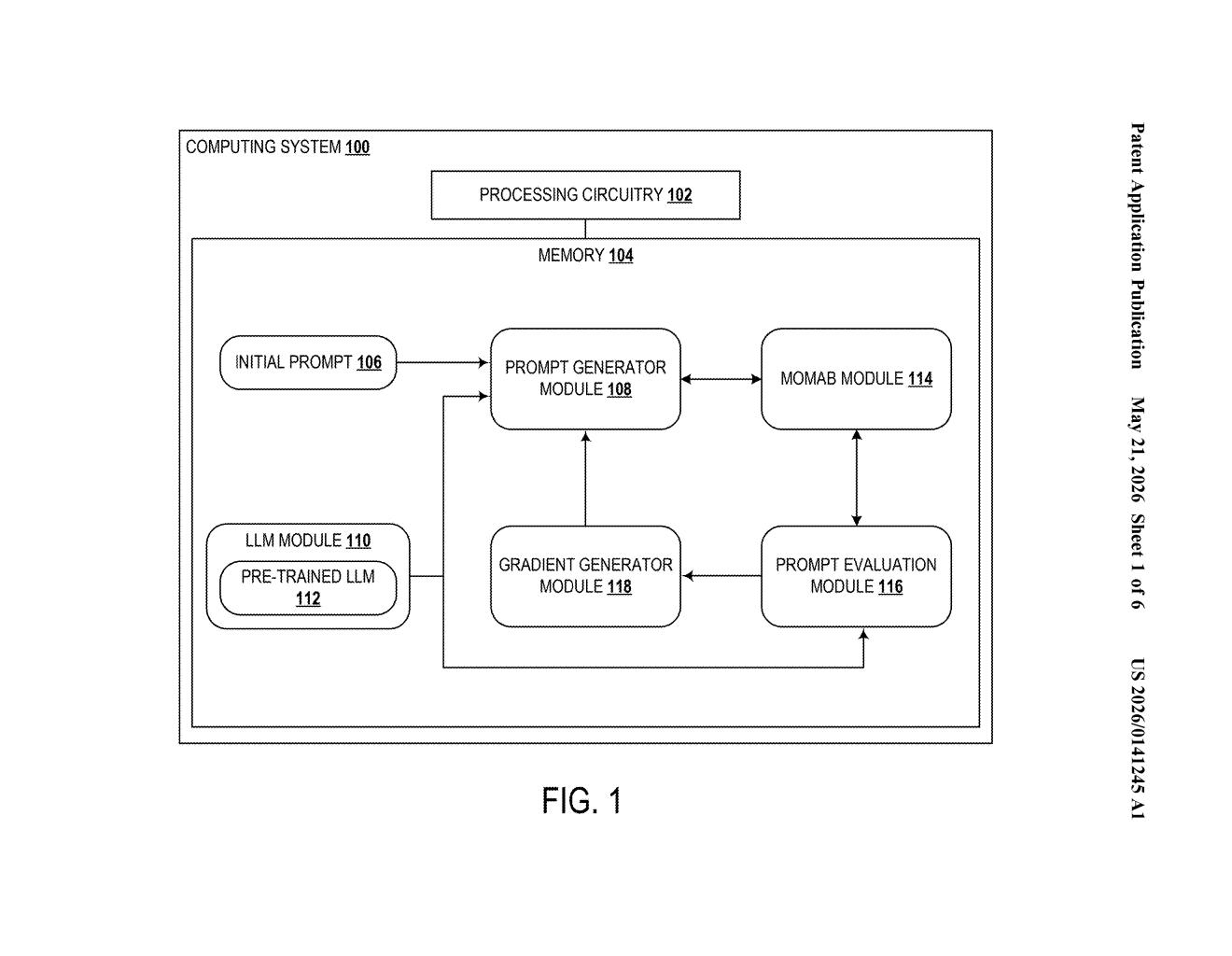
The system takes an initial prompt and feeds it to a prompt generator module that produces multiple prompt variants in diff format. A "diff" (short for difference) is a structured representation of changes — think of GitHub's line-by-line change view, where additions are marked in green and deletions in red. Using diffs rather than full rewritten prompts keeps each variant compact and interpretable, and makes it trivial to reconstruct the full candidate by patching the diff onto the original.
Once the prompt candidates are derived by applying each diff to the initial prompt, a prompt evaluation module scores them against one or more target metrics. The patent refers to multi-objective tuning, meaning the system can optimize for several goals simultaneously — not just a single quality score.
The architecture includes a MOMAB module — which likely stands for Multi-Objective Multi-Armed Bandit (a reinforcement-learning-style algorithm that balances exploring new options against exploiting known good ones). This suggests the system doesn't just do a one-shot evaluation; it can iteratively sample and learn which types of prompt edits tend to perform well across different objectives.
A gradient generator module is also referenced, hinting that the system may compute gradient signals (directional cues about which changes improve performance) to guide future variant generation — making the whole loop more efficient over time rather than purely random.
What this means for enterprise AI prompt engineering
Prompt engineering is currently a largely manual, expensive, and non-reproducible process — most teams rely on intuition and informal testing. A system that can automatically generate, track, and evaluate prompt edits in a structured diff format could make prompt optimization something you run as a pipeline rather than something a human labors over.
For Microsoft's enterprise customers building Copilot integrations or Azure OpenAI applications, this kind of automated tuning is a natural fit — it could slot into CI/CD-style workflows where prompts get optimized the same way code gets tested. The multi-objective angle is particularly useful: real-world deployments rarely optimize for just one thing, and balancing accuracy against safety or verbosity against helpfulness is exactly the kind of tradeoff this architecture is built for.
This is solid, unglamorous infrastructure work — the kind of thing that quietly makes AI products more reliable and cheaper to maintain. The diff-format framing is genuinely clever because it gives the system a precise, auditable record of what changed between prompt versions, which is something most prompt tooling today completely lacks. Whether this ends up inside Azure AI Studio or Copilot Studio tooling, it's the kind of patent that signals Microsoft is thinking seriously about the operational side of LLM deployment, not just the model side.
Get our take in your Top Stories
Liked this breakdown? Add Patentlyze as a preferred source on Google, and our plain-English take shows up more often in your Top Stories the next time Microsoft patent news breaks.
There are more where this came from
We read every patent application Big Tech publishes and send you the ones worth knowing. Plain English, free, every week.
Want this weekly breakdown for a company we don't cover? Patentlyze Pro →