
Microsoft Patents a Way to Hide Your Identity Inside Every Stylus Stroke
Every time you write or draw with a stylus, Microsoft's new patent could embed your identity invisibly into the ink itself. The stroke looks normal to you, but the pixels tell a different story.
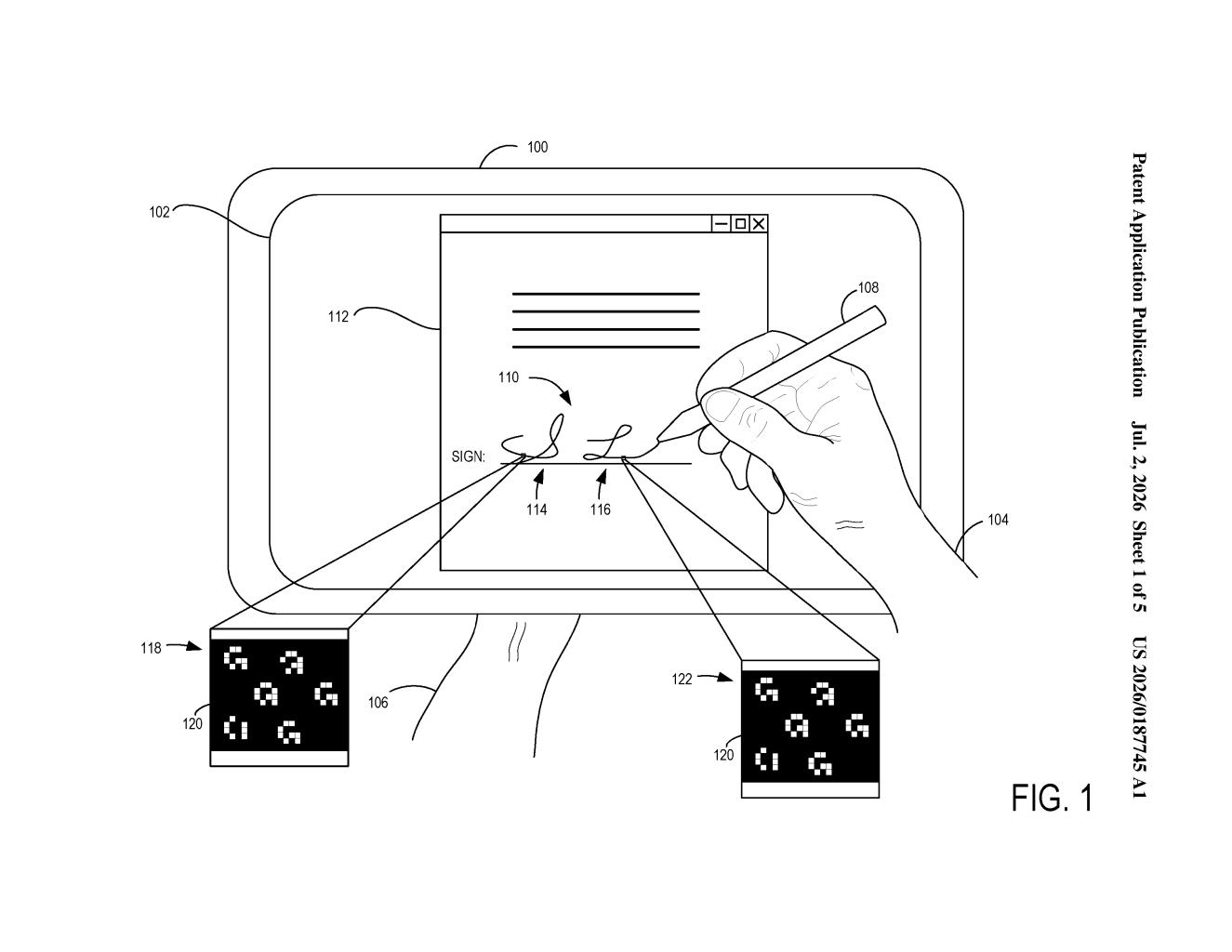
What Microsoft's stylus watermark actually does
Imagine signing a document or sketching a diagram on a tablet with a stylus pen. The line appears perfectly normal on screen, but hidden inside the pattern of pixels that makes up that stroke is a tiny, invisible signature tied to your account.
That's the core of this Microsoft patent. When you touch your stylus to the screen, the digitizer (the layer that reads your pen input) figures out who you are and weaves a watermark linked to your identity into the ink as it renders on screen. Nobody can see it, but it's there.
The idea is that any digital handwriting or drawing you produce would carry a traceable fingerprint. If a document or image were shared, leaked, or disputed, the watermark could potentially reveal who originally wrote or drew it.
How the pixel pattern carries the watermark
The system works at the level of the digitizer, the hardware-and-software layer inside tablets and touchscreens that interprets stylus input. Rather than recording a watermark as a separate, invisible layer on top of the ink, the patent embeds it directly into the rendered ink pixels themselves as a specific pattern.
The process has three steps:
- The digitizer detects contact from a stylus pen on the display.
- It looks up or determines a user identification linked to a digital watermark (think: your account ID mapped to a unique pixel signature).
- As the ink stroke is drawn on screen, the pixels that form that stroke are arranged to carry the watermark pattern invisibly.
The watermark isn't a separate overlay; it's baked into the visual rendering of the ink itself. That distinction matters because it makes the watermark much harder to strip out by simply removing a layer or converting the file format.
The patent doesn't spell out the exact encoding scheme, but the core claim is that the pattern of pixels used to render stylus strokes encodes the user's identity without visibly altering how the ink looks to the person writing.
What this means for digital ink and accountability
The practical use case is accountability in documents. In enterprise or legal settings, being able to prove who handwrote a note, signed a form, or annotated a contract is genuinely valuable. If the watermark survives export, screenshot, or printing, it becomes a kind of invisible chain-of-custody record embedded in the handwriting itself.
For everyday users, this raises obvious privacy questions. If every stylus stroke on a Surface device or Windows tablet tags your identity, that's a feature or a surveillance tool depending on who controls the data and how transparent the disclosure is. Microsoft hasn't said how or whether this would surface in any product, but the filing puts the intent on record.
This is a genuinely interesting idea for enterprise document workflows, where proving authorship of handwritten content is a real problem. The privacy angle is real too, and Microsoft would need to be very explicit about disclosure if this ever ships in a consumer product. Whether it does is the open question.
There are more where this came from
We read every patent application Big Tech publishes and send you the ones worth knowing. Plain English, free, every week.
Want this weekly breakdown for a company we don't cover? Patentlyze Pro →
Be the first to weigh in