
Microsoft Patents a System for Running AI Tasks From User-Written Config Files
Microsoft has patented a way to let users write simple configuration files that tell an AI model what to do, when to do it, and what to do with the results, turning complex multi-step AI workflows into something you can set up once and forget.
What Microsoft's config-file AI assistant actually does
Imagine you want an AI to automatically summarize every new document dropped into a shared folder, then email the summary to your team. Today, making that happen usually means writing code or cobbling together third-party tools. Microsoft's patent describes a system where you write a plain config file instead.
That file spells out three things: what event should kick things off (a new file arriving, a scheduled time, a button press), where the content to process is located, and what you want the AI to do with it, along with instructions for what to do with the AI's response, like saving it, sending it, or posting it somewhere.
A built-in assistant watches for your trigger event, grabs the right content, hands it to an AI language model with your instructions, and then handles the output however you specified. No coding required, just a structured text file that acts like a recipe for an AI-powered workflow.
How the trigger, config file, and language model connect
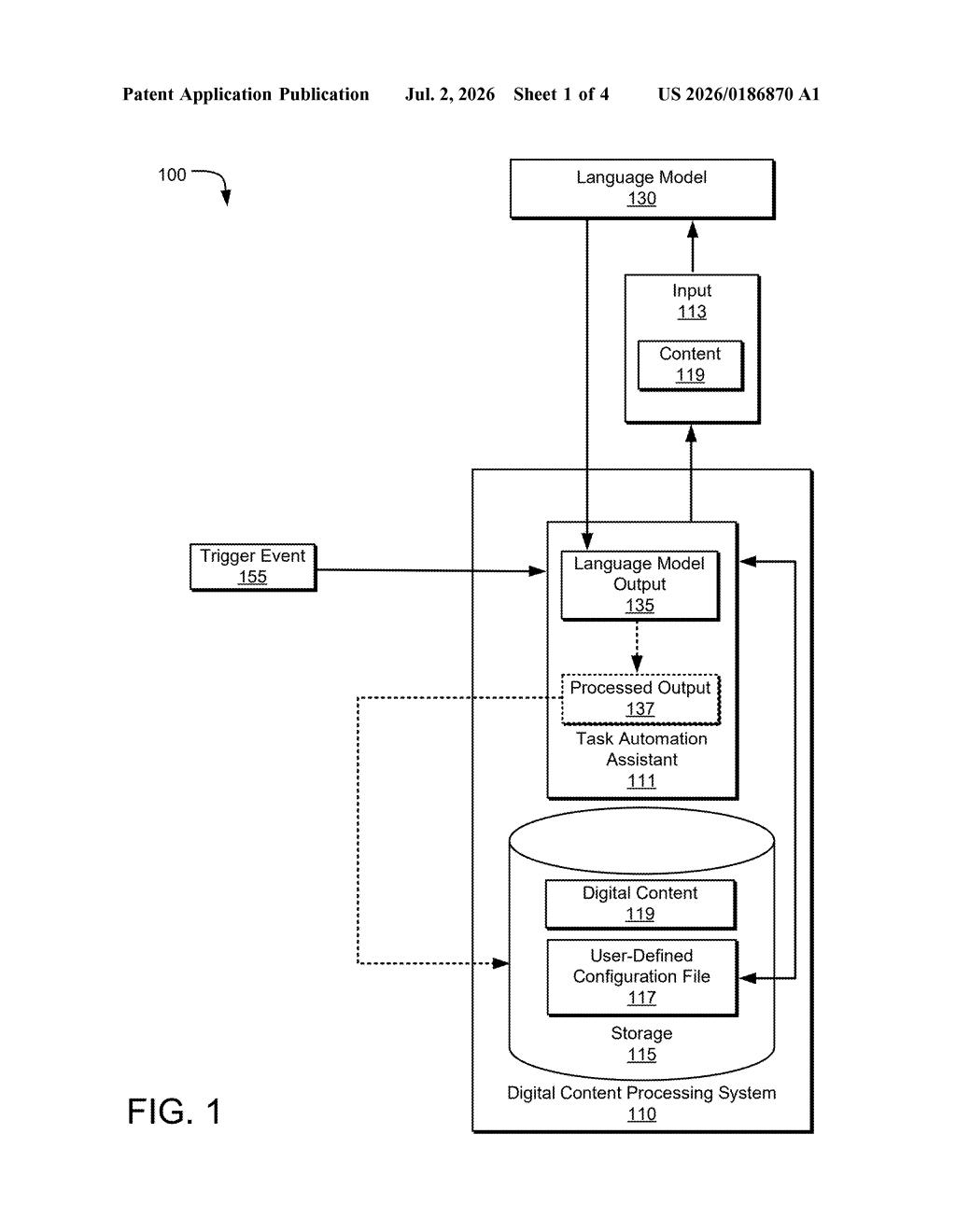
The patent describes a task automation assistant that reads a user-defined configuration file to orchestrate AI processing jobs from start to finish.
The config file does most of the heavy lifting. It defines:
- The trigger event, the condition that kicks off the whole workflow (for example, a file being added to a folder, or a calendar event firing)
- Content-identifying information, a pointer to wherever the digital content lives, so the assistant knows what to fetch
- User-defined instructions, the prompt or task description passed to the language model, including what inputs it should expect and what kind of output it should produce
- Output processing instructions, rules for what to do once the AI responds, such as saving the result to a specific location, forwarding it, or triggering a downstream action
When the trigger fires, the assistant retrieves the content from the specified location, bundles it with the user's instructions, and sends the whole package to a language model (an AI text-processing system, like the kind that powers chatbots). The model's response is then handled according to whatever the output rules say.
The key design choice here is that all of this logic lives in a declarative config file (a file that describes what should happen rather than spelling out programming steps), which means technically inclined users can build and share workflows without writing traditional software code.
What this means for AI automation in Microsoft products
For power users inside Microsoft's ecosystem (think SharePoint, OneDrive, or Copilot Studio), this kind of system could make it practical to build repeatable AI workflows without involving a developer. You'd write a config file the way you'd write a recipe, and the platform handles the execution. That's a meaningful shift from today's model, where AI automation usually requires either a low-code tool with a steep learning curve or actual programming.
The broader strategic angle is that Microsoft is clearly thinking about how to make Copilot-style AI programmable by non-engineers. If config-file-driven automation ships inside existing Microsoft products, it could give enterprise teams a way to build custom AI pipelines around their own data and workflows without waiting for Microsoft to build a specific feature for them.
This is a solid infrastructure patent for enterprise AI automation, not a flashy consumer feature. The interesting part isn't the AI itself, it's the idea that a plain config file becomes the control layer for an entire AI workflow. That's a developer-friendly abstraction that Microsoft is clearly betting will matter as companies try to embed AI into existing processes without rewriting everything.
There are more where this came from
We read every patent application Big Tech publishes and send you the ones worth knowing. Plain English, free, every week.
Want this weekly breakdown for a company we don't cover? Patentlyze Pro →