
Microsoft Patents a Laptop Hinge Whose Pivot Point Moves as You Open It
Most laptop hinges rotate around a fixed point. Microsoft is patenting one where the pivot itself slides as you open the screen, which changes the geometry of the whole opening motion.
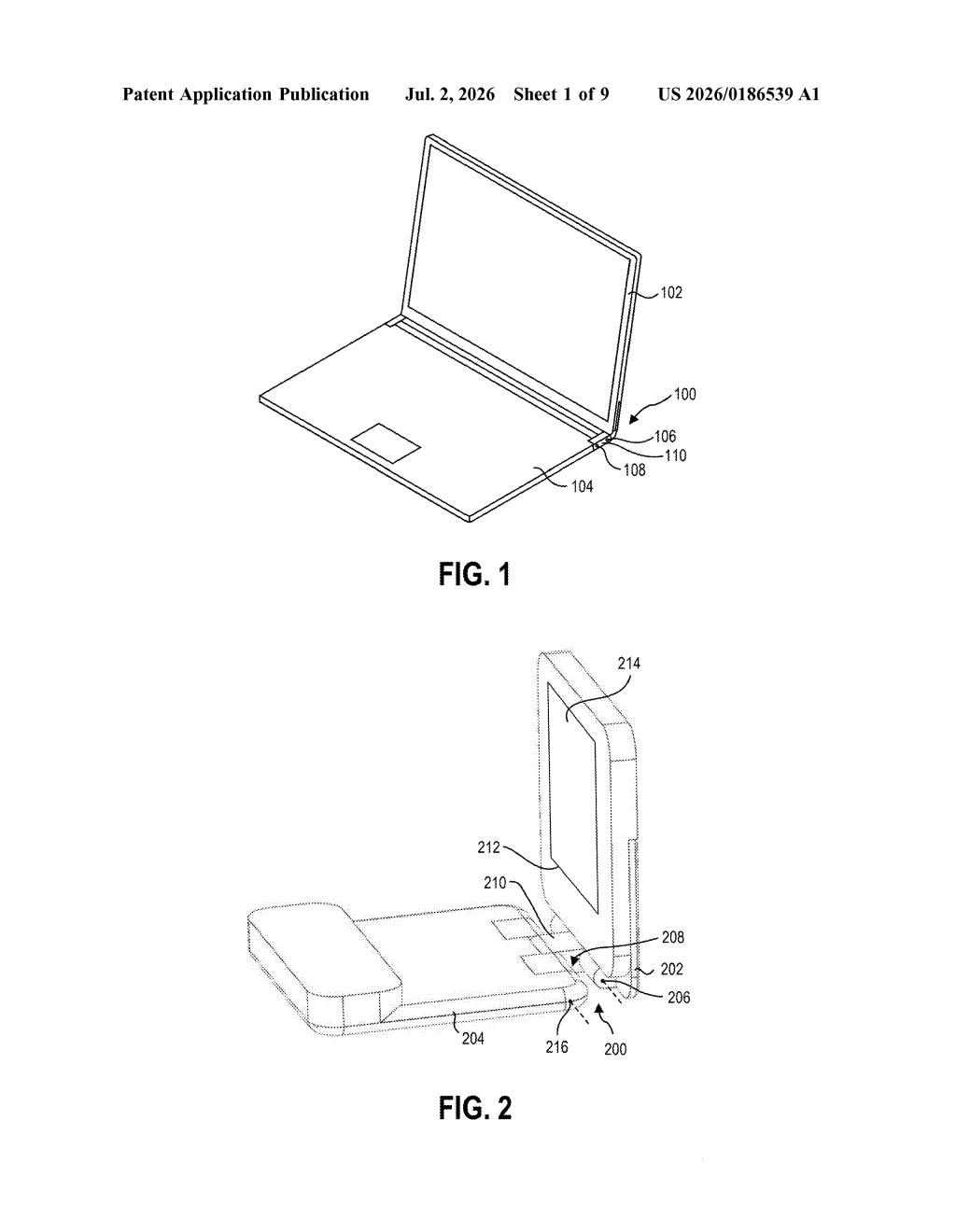
What Microsoft's shifting-pivot hinge actually does
Think about how a standard door hinge works: the pin in the middle stays perfectly still while the door swings around it. Every laptop hinge works the same way. The point the screen rotates around never moves.
Microsoft's patent describes a hinge where that center point does move. As you lift the lid, a small gear mechanism shifts the pivot up or down at the same time. The result is that the screen follows a slightly different arc than a normal hinge would allow.
Why would anyone want that? When you open a very thin laptop or a foldable device, the fixed-pivot approach can cause the bottom edge of the screen to dig into the keyboard deck or create a gap. A translating pivot lets engineers route the screen along a path that avoids those problems, which matters a lot as devices get thinner.
How the pinion gear shifts the hinge's center point
The patent describes a hinge system made of three main bodies. The first body attaches to one part of the device (say, the keyboard base), the second body attaches to another (the display), and a third body is supported by the first. The key addition is a translation mechanism that moves the pivot point itself during rotation.
The mechanism uses a pinion gear (a small rotating gear, the same type used in a rack-and-pinion car steering system) connected between the second body and the pivot point. When the gear rotates as you open or close the lid, it physically displaces the pivot in the vertical direction relative to the screen panel.
In practice, this means the screen doesn't just swing in a simple arc. Its path is a compound curve: rotating and translating at the same time. Engineers can tune the gear ratio and track geometry to control exactly how the pivot moves, letting them compensate for the thickness and shape constraints of a specific device chassis.
- First body: base/keyboard side of the device
- Second body: display panel side
- Third body: intermediate support connected to the first body
- Pinion gear: drives pivot translation during lid rotation
What a moving pivot means for thin laptops and tablets
For regular laptops, this is mostly a design-tolerance fix. But for foldable or ultra-thin devices, the geometry of a hinge is one of the hardest engineering problems to solve. A fixed pivot on a very thin screen can force the lid to scrape across the keyboard or leave an awkward gap at the top of the base. A translating pivot gives product engineers an extra degree of freedom to make the opening motion feel natural without adding bulk.
Microsoft has been iterating on hinge designs across its Surface line for years, and foldable form factors (like a dual-screen or book-style device) would benefit most from this kind of precision. If you've ever felt a laptop lid catch or noticed uneven gaps when the device is open, this is the class of problem Microsoft is trying to solve.
This is exactly the kind of quiet mechanical engineering patent that rarely gets attention but ends up in every premium thin laptop eventually. The pinion-gear approach is clever because it's compact and tunable. It's not a flashy AI feature, but it's the kind of detail that separates a device that feels refined from one that feels like a cost-cut.
Get our take in your Top Stories
Liked this breakdown? Add Patentlyze as a preferred source on Google, and our plain-English take shows up more often in your Top Stories the next time Microsoft patent news breaks.
There are more where this came from
We read every patent application Big Tech publishes and send you the ones worth knowing. Plain English, free, every week.
Want this weekly breakdown for a company we don't cover? Patentlyze Pro →