
Microsoft Patents a Camera That Moves Its Own Sensor in Six Directions
Most cameras stabilize a shot by moving the lens. Microsoft's new patent flips that idea and moves the image sensor instead, using a swarm of microscopic machines to nudge it in any direction imaginable.
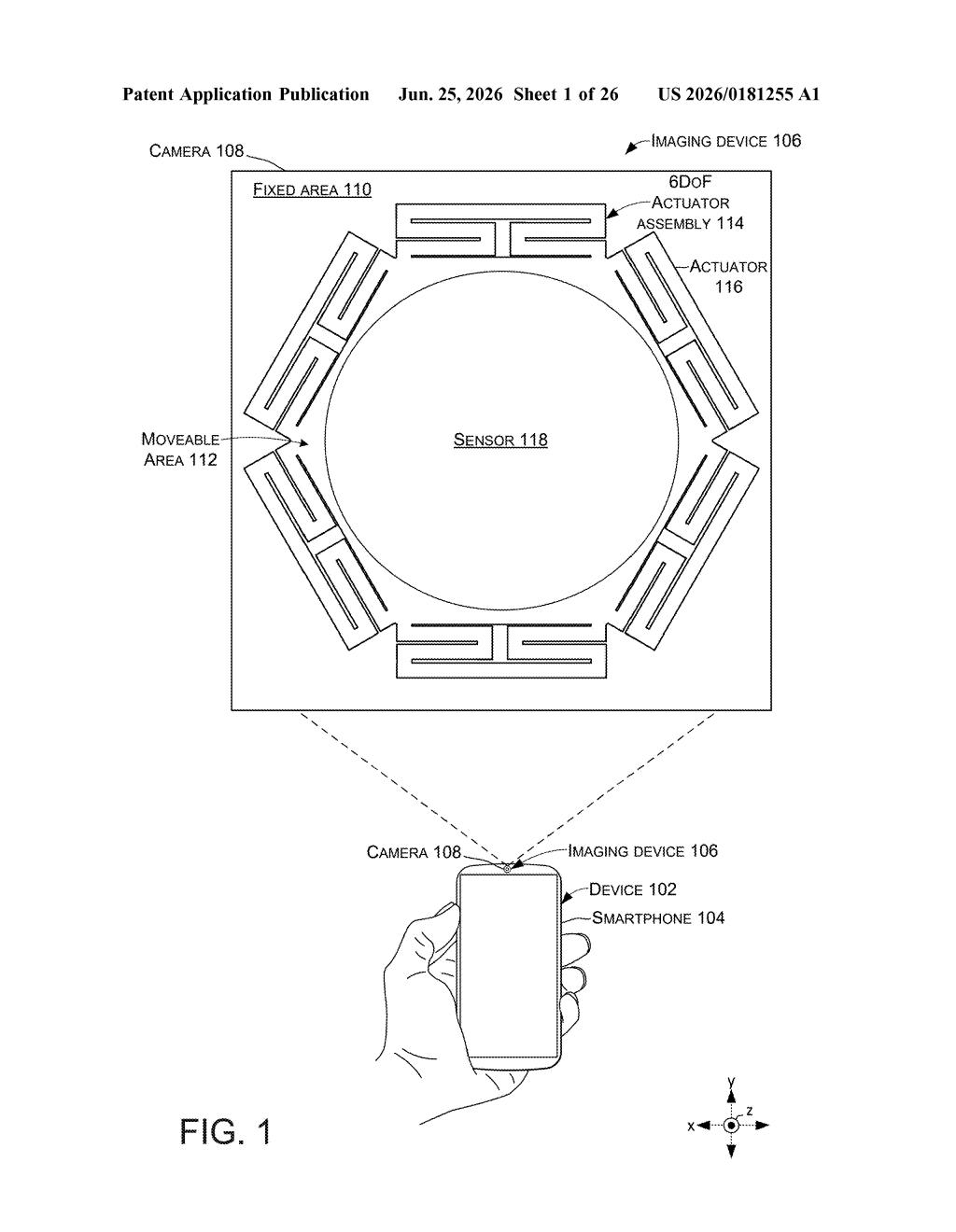
What Microsoft's moving-sensor camera actually does
Imagine trying to take a sharp photo while walking, and every tiny shake of your hand blurs the image. Cameras normally fight this by physically shifting the lens, but that requires bulky motors and a lot of space. Microsoft is patenting a different approach: move the sensor chip itself, not the lens.
To do that, the patent describes using MEMS actuators, which are microscopic mechanical parts etched onto silicon, smaller than a grain of sand, that can push and pull with surprising precision. A whole set of them work together to shift the sensor in any combination of six directions: up, down, left, right, forward, backward, and even tilting and rotating.
That six-direction freedom (called six degrees of freedom) is far more than the two-axis wobble correction you get in most phone cameras today. It could mean sharper photos in low light, better video stabilization, or entirely new tricks like synthetic zoom that doesn't lose detail.
How the MEMS actuators shift the sensor six ways
The patent describes a camera assembly where the image sensor (the chip that actually captures light) is suspended on a set of MEMS actuators (Micro-Electromechanical Systems, essentially tiny motors built from silicon at microscopic scale). Each actuator can be controlled independently, and together they can move the sensor in six degrees of freedom (6DoF), meaning translation along three axes (side to side, up and down, front to back) plus rotation around each of those same three axes.
The key claim is that the actuators don't just physically reposition the sensor; they also carry the data signal from the sensor back to the processor. That dual role (movement and data transmission) in a single mechanical connection is part of what makes the design compact enough to be practical.
- Optical element (lens or lens stack) stays fixed
- Sensing element (image chip) floats on MEMS actuators
- A processor receives image data through those same actuator connections
- Each actuator is individually addressable, so the system can dial in precise sub-pixel positioning
Conventional optical image stabilization moves a lens element, which is heavier and harder to control at speed. Moving only the lightweight sensor chip is faster to actuate and leaves the optical path undisturbed.
What this means for cameras in AR glasses and laptops
For compact devices like AR glasses, thin laptops, or headsets, every millimeter counts. A lens-shift stabilization system needs motors and guides around the lens barrel, which adds thickness. A sensor-shift system built from MEMS parts could be nearly as thin as the sensor itself, opening the door to cameras in form factors where good stabilization was previously impossible.
For you as a user, the practical upside is sharper photos and smoother video without a bigger camera bump. There's also a research angle: six-degree sensor movement can be used to capture multiple slightly offset frames and merge them into a higher-resolution image, a technique called pixel-shift super-resolution. Microsoft's filing doesn't call that out by name, but the hardware would support it.
This is a genuinely interesting engineering approach, not just a routine patent filing. Moving the sensor rather than the lens is a known concept in high-end mirrorless cameras, but doing it with MEMS at the scale needed for a device like HoloLens or a thin PC webcam is a real materials challenge. Whether Microsoft can manufacture it reliably at volume is the actual question, but the design thinking here is solid.
There are more where this came from
We read every patent application Big Tech publishes and send you the ones worth knowing. Plain English, free, every week.
Want this weekly breakdown for a company we don't cover? Patentlyze Pro →