
Microsoft Files Patent to Summarize Meetings and Conversations in Near Real Time
Most AI meeting summaries arrive after the call ends. Microsoft is patenting a way to keep one updating in near real-time, every few seconds, without sending the AI the entire conversation history each time.
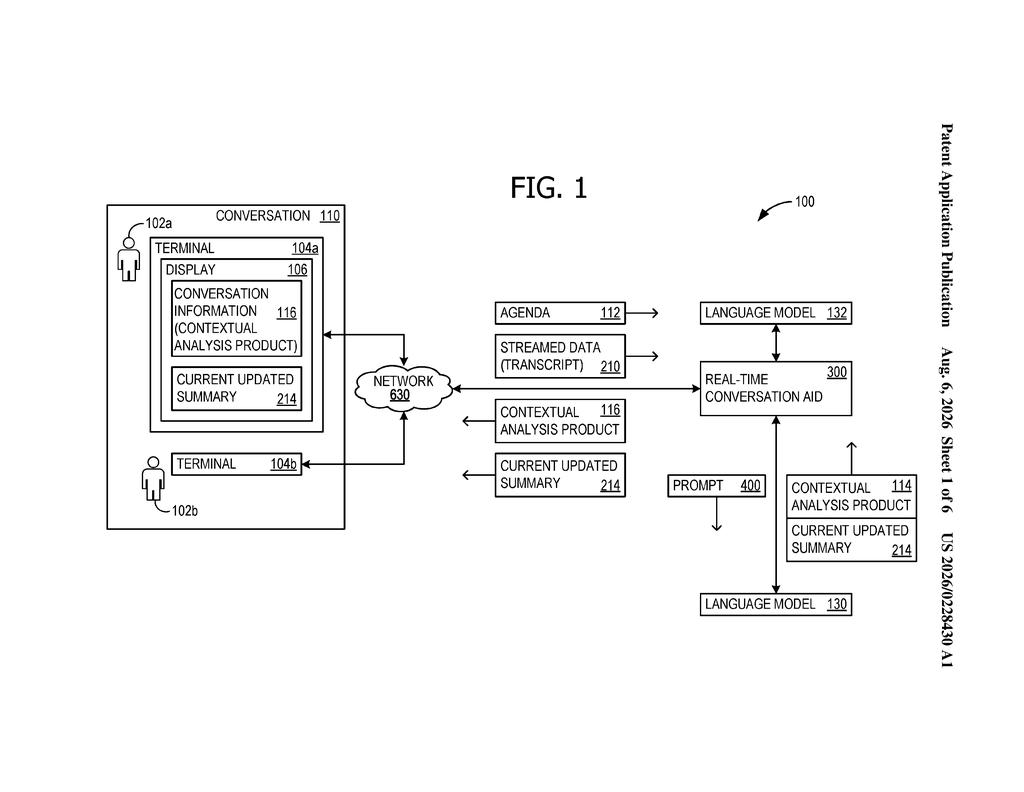
How Microsoft's live meeting AI stays up to date
Imagine you're in a two-hour strategy meeting and you want an AI to track the agenda, decisions, and action items as they happen, not just at the end. The problem is that AI language models have a limit on how much text they can read at once, and a long meeting transcript can blow right past it.
Microsoft's approach is a rolling compression trick. The system splits the transcript into two parts: everything said before a certain point gets collapsed into a short summary, and everything after that point is kept as full, word-for-word text. Only those two pieces get sent to the AI each cycle, keeping the total size small enough to process quickly.
Each time the system runs (on a scheduled timer, like every 30 seconds), the previous cycle's summary becomes the compressed "old" portion, and the newest speech becomes the fresh detail. The result is a continuously updated agenda or meeting summary that reflects what's being said right now, not what was said an hour ago.
… generate a language model prompt for a language model, wherein the language model prompt comprises: a current summary of the pre-segmentation portion, a copy of the post-segmentation portion, an instruction to return an update to a contextual analysis product …
Translation: The system feeds an existing summary and new conversation text into an AI prompt to get fresh meeting notes.
How the rolling summary cuts AI prompt size each cycle
The patent describes a system that runs on a repeating schedule to update what Microsoft calls a contextual analysis product (think: a live agenda, a running summary, or a list of action items) during an active conversation.
Each cycle, the system:
- Grabs the latest streamed transcript up to a current end point (the most recent words spoken)
- Designates a segmentation point that divides the transcript into an older chunk and a newer chunk
- Compresses the older chunk into a compact summary, and keeps the newer chunk as full text
- Bundles both into a language model prompt alongside instructions to update the agenda and produce a fresh summary
The key efficiency gain is that token count (the measure of how much text an AI model can process in one request) stays roughly constant across every cycle. Instead of the prompt growing longer with every new sentence spoken, the older material is always pre-compressed. The AI only ever sees a summary of the past plus the raw text of the recent past.
The prior cycle's end point becomes the new segmentation point, and the prior cycle's summary replaces the older one. This sliding window approach means each prompt is roughly the same size whether the meeting has been running for five minutes or five hours.
Efficient management of the historical state reduces token counts in prompts, enabling use of (near) real-time invocation of language models.
Translation: By keeping track of past conversation summaries, the system uses fewer computing resources to deliver fast updates.
What this means for AI tools in Teams and beyond
The practical ceiling for real-time AI in meetings today is cost and speed: the longer a meeting runs, the bigger the prompt, and the slower and more expensive each AI call becomes. This patent directly attacks that ceiling. By keeping prompt size flat across time, Microsoft could make per-second or per-minute AI updates financially and technically feasible at scale inside a product like Microsoft Teams.
For you as a meeting participant, this could mean an agenda panel that visibly shifts as the conversation moves, or an AI that flags when the discussion has drifted off-topic in the moment rather than flagging it in a recap email you read tomorrow. The underlying technique is general enough to apply to any live streaming scenario, customer support calls, courtroom transcripts, or medical consultations, not just corporate meetings.
This is solid infrastructure work, not a flashy demo feature. The rolling-summary approach is a genuinely practical fix for a real limitation that anyone who has tried to run AI on long transcripts has hit. Whether it shows up as a visible Teams feature or powers a back-end analytics service, the technique is worth watching.
There are more where this came from
We read every patent application Big Tech publishes and send you the ones worth knowing. Plain English, free, every week.
The drawings
6 drawing sheets from US 2026/0228430 A1 · click any drawing to enlarge


Want this weekly breakdown for a company we don't cover? Patentlyze Pro →
Be the first to weigh in