
A New Microsoft Patent Routes AI Requests Toward Data Centers With Wind and Sun to Spare
Microsoft describes sending your AI questions to wherever the wind is blowing, by building data centers beside wind and solar farms and routing around the lulls. The patent application is about the traffic control that makes that workable.
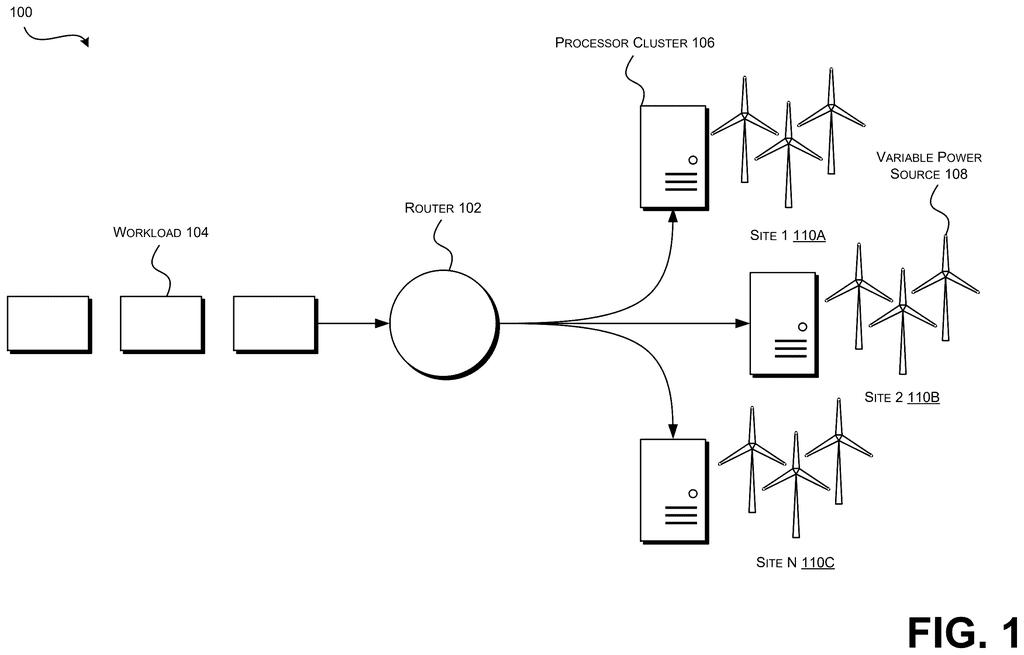
What Microsoft's wind-farm AI router actually does
A wind farm in Iceland slows to a trickle while another in northern Great Britain is making far more power than anyone is using. That is the example Microsoft's patent application uses to show what can go wrong.
Every time you ask a chatbot something, chips in a data center burn electricity to answer. Power grids are straining to keep up, so the filing describes putting those chips right beside wind and solar farms. The catch is that wind and sunshine come and go.
So Microsoft describes a traffic director for AI requests. It forecasts how much power each site will have, both over the long haul and over the next few seconds, then sends your question to a site that can handle it. When one farm's output sags, requests shift to another instead of getting dropped.
generating a first allocation plan based on one or more workload arrival patterns and long-term predicted power availability on a first, longer timescale from one or more distinct variable-power sources; …
Translation: The system plans ahead by looking at long-range weather and energy forecasts alongside expected AI traffic.
How the two planners decide where requests go
The system is a cross-site router. It receives AI requests (the questions you type into a chatbot, for example) and decides which site answers each one. Every site is a cluster of GPUs (the chips AI runs on) installed next to its own wind or solar source, so the power available there rises and falls with the weather.
The router has four parts:
- Long-term planner: uses expected request volume and long-range power forecasts to set how many chips team up on each type of request (tensor parallelism, meaning several chips splitting one job) and their top speed. A short question with a short answer might get 2 chips; a long one might get 8.
- Short-term planner: works in seconds instead of minutes and adjusts chip speeds and traffic as forecasts sharpen, such as raising a cap from 2.0 GHz to 2.2 GHz when extra power shows up.
- Configurator: pushes those settings to each site and holds the short-term planner back while chips are still being reconfigured.
- Request scheduler: sends each request to a site and chip group built for that size of job, using weighted round-robin (a rotating turn-taking scheme where some sites get more turns than others).
Both planners build their plans with integer linear programs (a standard math method for finding the best option under hard limits like power and chip counts). A separate predictor guesses how long each answer will be, so every request lands in the right size class.
The disclosure presents a technique for routing discrete AI inference workloads to processor clusters co-located with distinct variable-power sources.
Translation: Microsoft patented a method to send AI tasks directly to data centers powered by renewable energy sources like wind and solar.
Why power limits could send AI to wind farms
AI has a power problem. The filing says grids are straining, new power lines are costly and slow to approve, and electricity sent over long distances is partly lost. Putting chips beside wind and solar farms sidesteps that, and this routing layer is what would make the idea usable: when one site's wind drops, your request moves to another instead of failing.
For you, the best case is chatbot answers that stay fast while drawing on renewable power. The filing's own example shows a site in Iceland losing power while one in northern Great Britain had plenty to spare, so requests could have been redirected. It is a patent application, so it says nothing yet about whether Microsoft will build sites like this.
Microsoft's 24th filing we've tracked since July in the AI chip competition, it follows one on rounding numbers carefully and one removing a hardware bottleneck.
Claim 1 is wider than the headline example suggests. It asks for three steps: make a long-range plan from expected demand and expected power, make a short-range plan that refines it, then send work to computer clusters sitting beside power sources that rise and fall. The claim never names wind or solar, and it never mentions chatbots.
The chatbot details arrive in the dependent claims. They add AI requests, how many chips team up on each job, chip speed settings, a math method for building the plans, and a rotating assignment of requests. Each one narrows the claim, so the broad version carries most of the weight.
If granted as written, it would describe any two-speed scheduler that points work at computers sitting next to variable power, which is a lot of ground for one filing. Whether it pays off in practice depends on forecasts of power and demand being good enough.
Get our take in your Top Stories
Liked this breakdown? Add Patentlyze as a preferred source on Google, and our plain-English take shows up more often in your Top Stories the next time Microsoft patent news breaks.
There are more where this came from
We read every patent application Big Tech publishes and send you the ones worth knowing. Plain English, free, every week.
The drawings
15 drawing sheets from US 2026/0349824 A1 · click any drawing to enlarge


Show the other 7 sheets


Want this weekly breakdown for a company we don't cover? Patentlyze Pro →
Be the first to weigh in