
Nvidia Patents a System That Uses the GPU to Handle Network Sending Tasks
Nvidia is patenting a system that lets a GPU do the prep work for sending data over a network, a job that normally falls on a separate dedicated chip. The idea: flood that prep work across thousands of GPU cores in parallel instead of queuing it up one piece at a time.
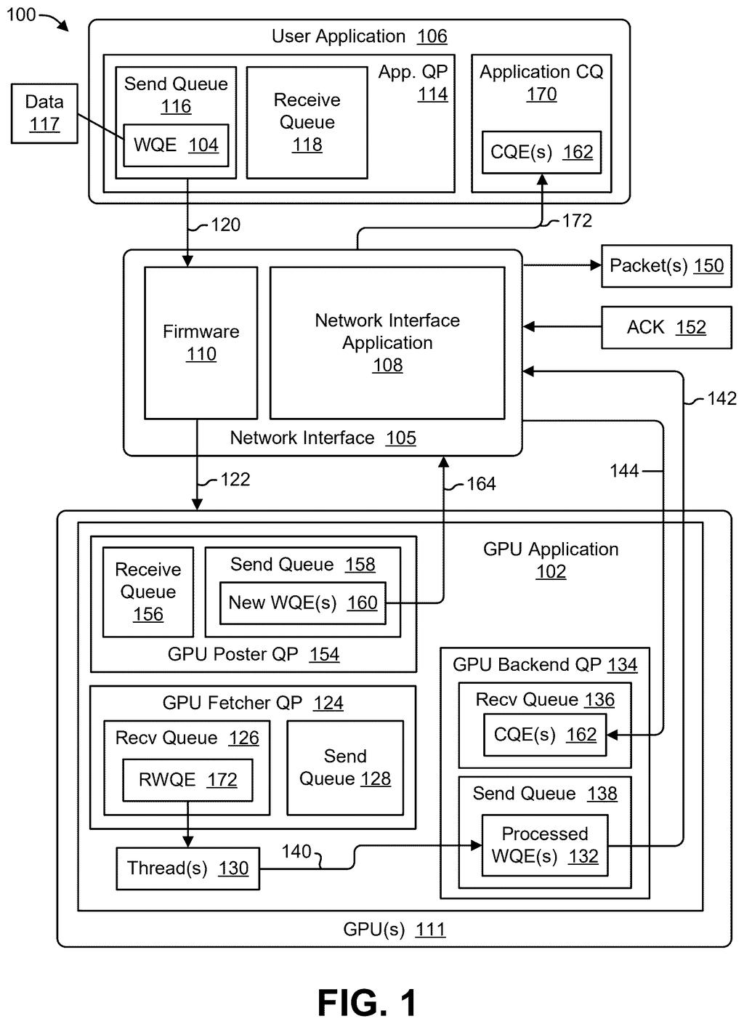
What Nvidia's GPU-as-network-helper actually does
A warehouse shipping dock has one person stamping and labeling every outgoing box before a fleet of trucks can leave. That bottleneck slows everything down, even when the trucks are sitting idle. Your computer's networking chip faces the same problem every time it has to prepare large chunks of data for transmission.
Nvidia's patent describes moving that stamping-and-labeling job onto the GPU. Instead of a single specialized chip preparing each data packet one after another, the GPU breaks the work into smaller pieces and handles all of them at the same time, using the same parallel computing muscles it normally flexes for AI or graphics.
Once the GPU finishes preparing those pieces, it hands them back to the network chip with a notification that they're ready to send. The network chip then just transmits, without having to do the slow prep work itself.
Apparatuses, systems, methods, and techniques to process a work request (e.g., a Work Queue Element (WQE)) using graphics processing unit (GPU) resources. In at least one embodiment, the GPU detects one or more work requests to be processed, retrieves the work request(s), and processes the work request(s) in parallel.
Translation: The system uses the graphics chip to handle network tasks simultaneously.
How the GPU splits and posts work queue elements
The patent centers on a structure called a Work Queue Element (WQE), which is essentially a set of instructions telling a network interface controller (NIC) what data to send and how. Normally the NIC, a chip separate from the GPU, processes these instructions itself, one job at a time or in limited batches.
Here, the GPU intercepts an incoming WQE before the NIC ever sees it. It then uses its many parallel processing cores to expand that single WQE into multiple smaller WQEs, each covering a slice of the original data. All of this splitting and preparation happens simultaneously across the GPU's cores, not sequentially.
The completed batch of WQEs is placed into a queue pair (QP), a two-way communication channel the NIC monitors. The GPU then sends the NIC a notification that the queue is loaded and ready. The NIC reads the queue and starts transmitting without having to do the heavy prep work.
The claim specifically covers:
- Obtaining the original WQE on the GPU side
- Generating multiple WQEs from it, in parallel
- Posting those WQEs to a queue pair the NIC can access
- Notifying the NIC that the work is ready
What this means for data centers and AI networking
In data centers and AI clusters, GPUs spend enormous amounts of time moving data between machines, and the networking chip that handles that movement can become a bottleneck. If the GPU can prepare network jobs in parallel rather than waiting for a single chip to do it sequentially, overall throughput could rise without adding more hardware.
This is particularly relevant as several Nvidia filings on GPU-network integration this year suggest the company is working to blur the line between compute and networking in its data center stack. For anyone running large AI training jobs, faster and more parallel data movement directly translates to shorter training times and lower costs.
Nvidia's 46th filing we've tracked in the AI chip wars since July adds to a run that includes one on skipping redundant video frames and one on catching circuit congestion early.
Claim 1 covers any chip that picks up a network preparation task, breaks it into parallel subtasks, and signals the network card when done. The claim puts no limits on which network standard applies, what data moves through it, or how the chip is built inside.
That breadth means the claim wraps around a behavior, not a specific design. Any processor handling networking tasks this way, regardless of how its hardware differs from Nvidia's, sits inside that boundary and would need to account for this patent before shipping.
The claim's future depends entirely on what existed before this filing. If breaking network preparation into parallel work was already a documented practice in high-speed computing, examiners have solid grounds to push back. If it was not, this is a wide legal claim over a useful and widely applicable idea.
There are more where this came from
We read every patent application Big Tech publishes and send you the ones worth knowing. Plain English, free, every week.
The drawings
17 drawing sheets from US 2026/0301109 A1 · click any drawing to enlarge


Want this weekly breakdown for a company we don't cover? Patentlyze Pro →
Be the first to weigh in