
Microsoft Patents a Way for Any Team to Build Its Own AI Support Bot
Microsoft is patenting a way for individual teams — say, your IT help desk or cloud ops group — to spin up their own AI support chatbot by pointing it at their own documents and incident history, no central AI team required.
What Microsoft's team-configurable AI support bot actually does
Imagine your company's IT help desk getting a chatbot that actually knows your team's specific tools, past incidents, and internal wikis — not just generic Microsoft docs. That's the problem this patent is trying to solve.
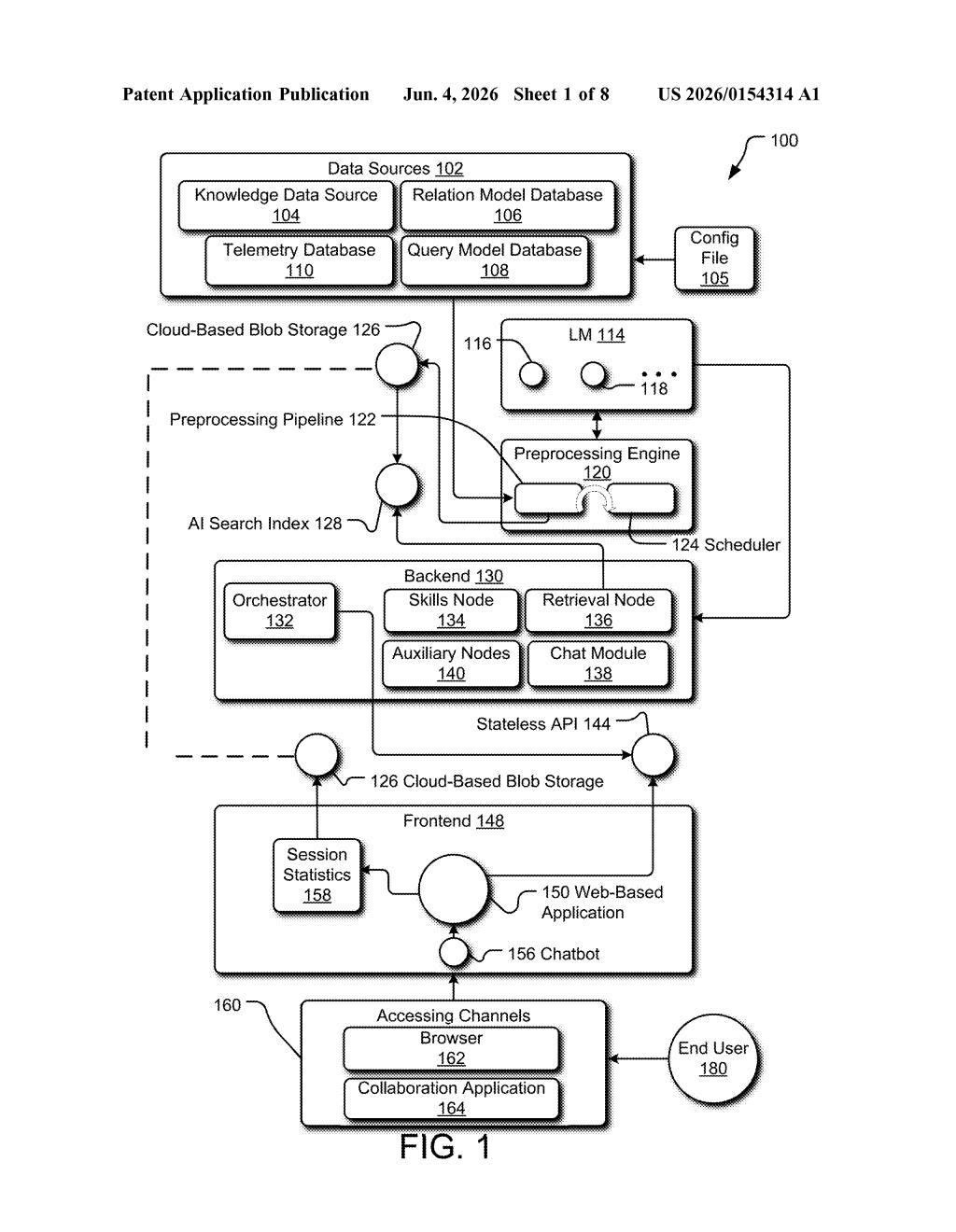
Right now, most enterprise AI chatbots are either one-size-fits-all or require significant engineering work to customize. Microsoft's approach here lets a team lead (or an IT admin) hand over a simple config file listing their team name, which document sites matter to them, and which past incident tickets to learn from. The system does the rest: pulling in those documents, tagging them, and making them searchable by an AI.
When someone on the team asks a question, the bot uses those tags to find the most relevant document chunks and hands them to a language model to form an answer. It's essentially a self-serve RAG pipeline — retrieval-augmented generation — packaged for teams that don't have a dedicated ML engineer on staff.
How the metadata embedding pipeline finds the right docs
The patent describes a retrieval-augmented generation (RAG) system (a technique where an AI looks up relevant documents before answering, rather than relying solely on what it was trained on) that's designed to be self-configurable by a non-expert team lead.
Here's how the pipeline works:
- A user submits a configuration file specifying their team name, document sites (think SharePoint pages, wikis, runbooks), and incident IDs from past support tickets.
- The system downloads and chunks those documents — splitting them into smaller, digestible pieces.
- Each chunk gets processed to generate metadata tags (labels describing what the chunk is about, who it's relevant to, what product it covers, etc.).
- Those tags are vectorized into embeddings — mathematical representations that let the system measure how closely a document chunk matches a user's question.
- At query time, the embeddings are used to retrieve the most relevant chunks, which are then passed alongside the question to a language model to generate an answer.
The key differentiator here is the metadata-driven retrieval step. Rather than doing a raw semantic search over all document text, the system uses structured tags to narrow the candidate pool first — which tends to improve answer precision, especially when a team's knowledge base has a lot of similar-looking documents.
What this means for enterprise IT support and Microsoft 365
Enterprise IT support is a massive, largely unsolved problem for large organizations. Most AI chat tools require either a centralized deployment team or a generic knowledge base that doesn't reflect how individual teams actually work. Microsoft's framing here is explicitly about letting teams own their own bot — which maps directly onto how Microsoft 365 and Teams are already structured around team-level workspaces.
If this ships in something like Microsoft Copilot Studio or Teams, it could meaningfully lower the barrier to deploying useful AI support tools across an organization. The real test will be how well the metadata tagging holds up at scale — garbage tags mean garbage retrieval, no matter how good the underlying language model is.
This is workmanlike enterprise infrastructure, not a headline-grabbing AI moment — but that's exactly what makes it worth paying attention to. Microsoft is clearly trying to democratize RAG pipeline setup so that IT teams can self-serve without needing an ML engineer. Given how much of Microsoft's revenue comes from enterprise M365 subscriptions, getting teams addicted to their own customized AI bots is a smart long-term lock-in play.
There are more where this came from
We read every patent application Big Tech publishes and send you the ones worth knowing. Plain English, free, every week.
Want this weekly breakdown for a company we don't cover? Patentlyze Pro →