
Microsoft Files Patent to Let Apps Swap in Better Predictions Without Being Rewritten
Microsoft has filed a patent for a way to add prediction features to an app, then keep improving them from afar without touching the app's code. The example in the filing is a computer that guesses whether you'll be away long enough to restart for updates.
What Microsoft's prediction toolkit does for apps
Imagine your laptop needs to restart to install an update. Restarting while you're in the middle of a spreadsheet would be rude, so the software tries to guess whether you'll touch the machine in the next 90 minutes. If the answer is no, it restarts. If yes, it waits.
Microsoft's patent describes a behind-the-scenes system for building guesses like that. A developer points to past moments in real device logs and marks what should have been predicted. Microsoft's servers train a model from those examples and ship it to devices, along with a small instruction sheet that says which signals to read and how to tidy them up.
The app just asks for a prediction and gets one, right on your device. Later, devices report whether the guesses were right, and Microsoft can send out a better model without changing the app at all.
receiving an application programming interface (API) call from a target application; locating machine learning (ML) assets based on the API call, the ML assets comprising an ML model and client configuration data; acquiring a value for a feature specified by the client configuration data; …
Translation: The client device intercepts an app request and loads the machine learning model and setup data needed to handle it.
How a settings sheet feeds data to the model
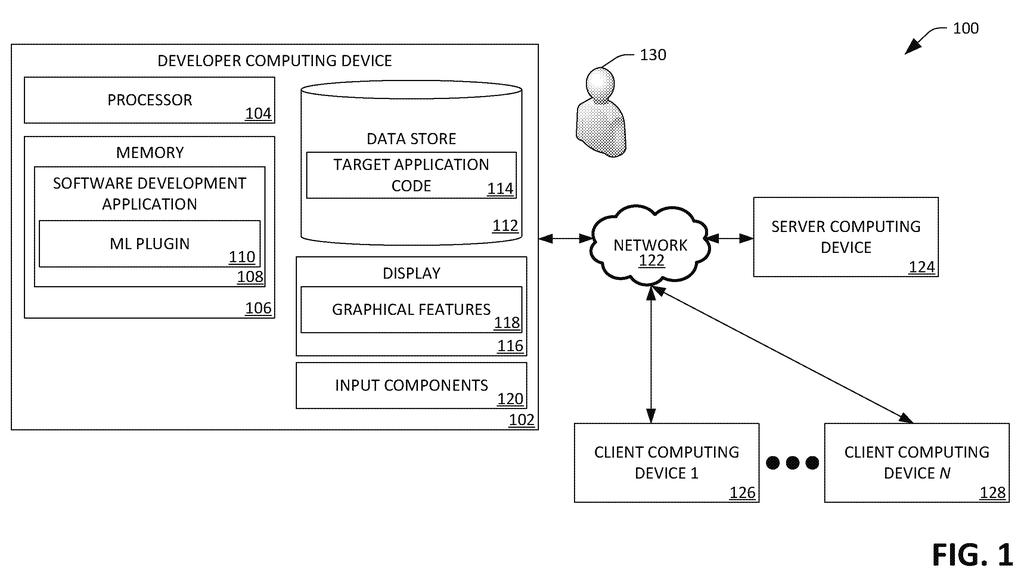
The system has two halves. On Microsoft's servers, a developer picks real moments from device logs (a particular device at a particular time) and attaches a label, meaning the correct answer that should have been predicted. The server trains a model on that data and packages it with client configuration data, a small instruction sheet. Together they are called the ML assets.
On your device, an app makes an API call (a standard request one piece of software sends another) asking for a prediction. Local code finds the assets and then:
- Reads the device signals the sheet asks for, such as keystrokes or whether the device is plugged in;
- Applies the listed transformations, like capping negative numbers at zero, adding values, dividing one count by another, or converting data types and renaming items;
- Feeds the results to the model and hands the prediction back to the app.
The sheet also lists the model type and the minimum app version it works with. The device checks that its transformations match the ones used in training. Everything can run locally, so no internet connection is needed.
Devices can send back telemetry (reports on whether each prediction was right). The server uses it to retrain the model and push updated assets, and the filing describes trying a new model on some devices first.
What this means for apps that learn your habits
For you, the payoff is apps that adapt without waiting for a full software update. A restart that waits until you've stepped away, or a feature that gets more accurate over time, can improve on the server side while the app on your device stays the same. Because predictions run on your own device, they can work offline.
For developers, the pitch is that they don't need to be machine learning experts. The system picks up the data prep, the model packaging and the update delivery. The filing also says some data can be left out of telemetry based on a device's privacy settings, which matters because this setup learns from how people use their devices.
Microsoft has filed its 49th patent in the enterprise AI work we cover since May, adding to a set that includes one tracing email inspiration sources and one reading your screenshot history.
You would probably never see this patent at work, and that is the point. What you would notice is fewer annoyances: the restart that waits until you've walked away, or a feature that gets a little more accurate each month without a download. The benefit depends on developers picking up the tool and using it well.
The part that helps you most is the feedback loop. Devices report whether each guess landed, and the model improves from that. Done carefully, an app learns your habits from signals already on your device, and the filing says some data can be held back based on privacy settings.
As a product idea it is developer plumbing, so expect the gains to show up as small irritations that simply stop happening.
Get our take in your Top Stories
Liked this breakdown? Add Patentlyze as a preferred source on Google, and our plain-English take shows up more often in your Top Stories the next time Microsoft patent news breaks.
There are more where this came from
We read every patent application Big Tech publishes and send you the ones worth knowing. Plain English, free, every week.
The drawings
9 drawing sheets from US 2026/0330322 A1 · click any drawing to enlarge


Show the other 1 sheets

Want this weekly breakdown for a company we don't cover? Patentlyze Pro →
Be the first to weigh in