
Qualcomm Patents ML-Driven RF Fingerprint Positioning for 5G Devices
GPS is useless indoors, and cell tower triangulation is often too coarse. Qualcomm's latest patent proposes using machine learning to read the unique 'fingerprint' of radio signals at a location — no satellites required.
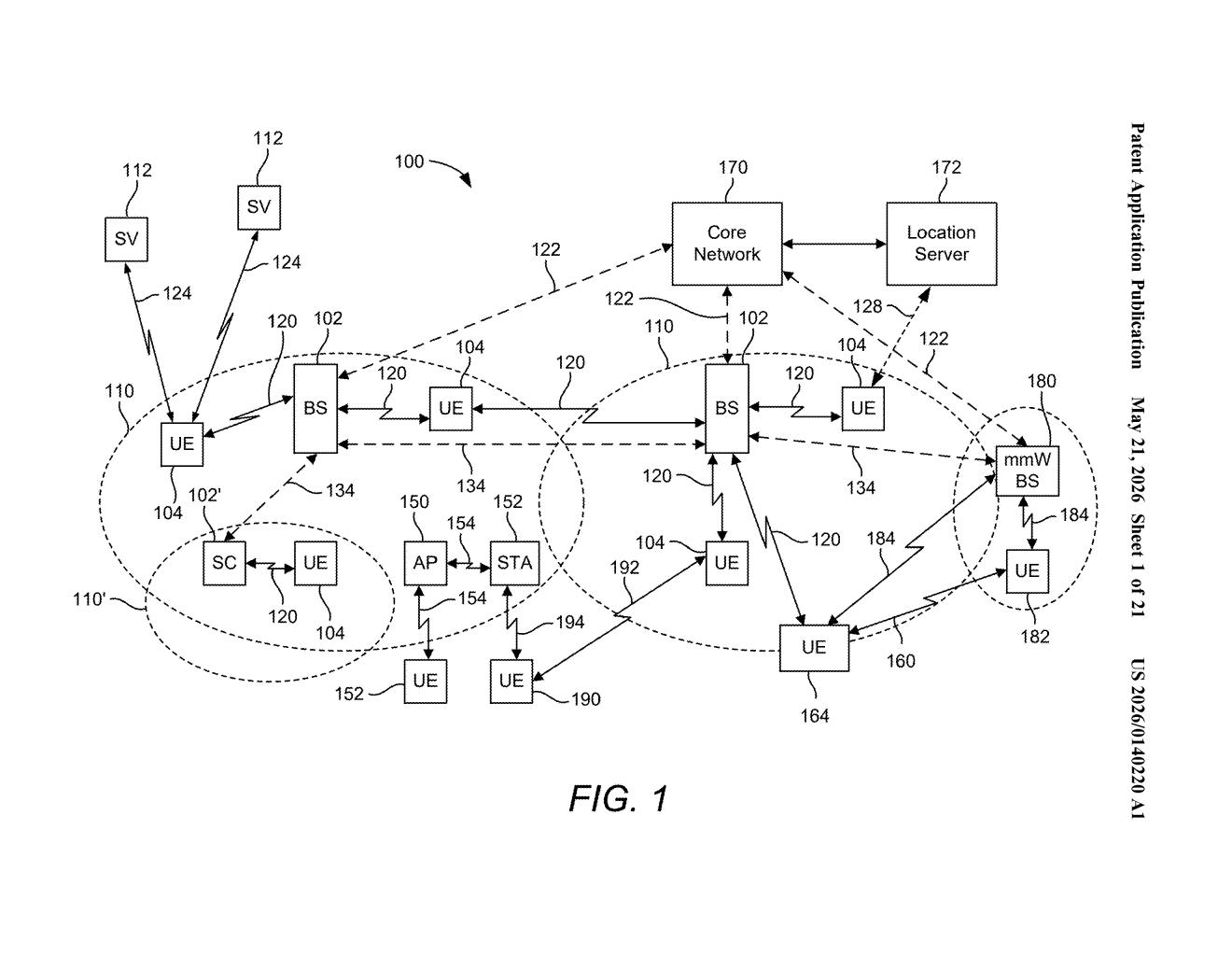
How Qualcomm's RF fingerprint positioning actually works
Imagine you're in a dense city block or a multi-story shopping mall where GPS can't get a fix. Your phone is still picking up radio signals from nearby cell towers — and those signals look slightly different depending on exactly where you're standing, because walls, furniture, and buildings scatter them in predictable ways. That pattern is called a radio frequency fingerprint.
Qualcomm's patent describes a system where a machine learning model runs on your phone and learns to recognize those signal patterns. A location server sends the phone the parameters it needs to run that model, the base station relays the setup instructions, and your phone does the heavy lifting of figuring out where it is from the signals it receives.
The key twist is that the whole pipeline — from the location server to the tower to your device — is standardized with specific message types, so carriers can deploy this across a network without every phone needing a custom setup.
How the base station, UE, and location server coordinate
The patent defines a three-party communication flow involving a location server, a base station, and a UE (user equipment — your phone or another wireless device).
Here's the sequence:
- The location server sends the base station an assistance information control message carrying parameters for a specific ML model the UE should use for DL-RFFP (Downlink Radio Frequency Fingerprint) positioning.
- The base station repackages those parameters into posSIBs — Positioning System Information Blocks, which are standardized broadcast messages used in 5G NR networks to distribute positioning-related config.
- The UE receives the posSIBs, applies the ML model to downlink positioning reference signals (known pilot signals transmitted by the network specifically so devices can measure them), and derives a location estimate.
- The UE then reports back location information to a second network entity, completing the loop.
The RF fingerprinting approach works by training an ML model on what signals look like at thousands of known positions, then having the device match live measurements against that learned map. It's conceptually similar to how Shazam matches audio — pattern recognition against a reference database, but for radio waves.
The patent's contribution is mostly in the signaling protocol: defining how ML model parameters are communicated through the existing 5G standards infrastructure, rather than requiring out-of-band coordination.
What this means for indoor and urban device location
Precise indoor positioning has been a stubborn problem for carriers and device makers for over a decade. RF fingerprinting has been researched in academia for years, but standardizing how ML model parameters flow through a live 5G network is a real engineering step toward making it deployable at scale. If this lands in a 3GPP standard, every compliant base station and UE would support it without custom firmware.
For you as a user, the payoff could be sub-meter positioning in airports, warehouses, hospitals, or dense urban canyons where GPS fails. For carriers and enterprises, it opens up location-aware services — think asset tracking or emergency dispatch — that don't depend on external satellite infrastructure.
This is a solid, focused standards-infrastructure patent rather than a flashy AI play. Qualcomm isn't inventing RF fingerprinting here — that's well-established — but nailing down the signaling messages that make ML-based positioning interoperable across a 5G network is the unglamorous work that actually gets technology deployed. Worth watching if you follow 5G positioning standards like 3GPP Release 17/18.
There are more where this came from
We read every patent application Big Tech publishes and send you the ones worth knowing. Plain English, free, every week.
Want this weekly breakdown for a company we don't cover? Patentlyze Pro →