
Sony Patents a Multi-Analog-Stick Input System That Picks a Lead Stick When All Are Idle
Sony is exploring controllers with more than two analog sticks — and this patent solves a surprisingly thorny problem: what should the game do when none of them are being touched?
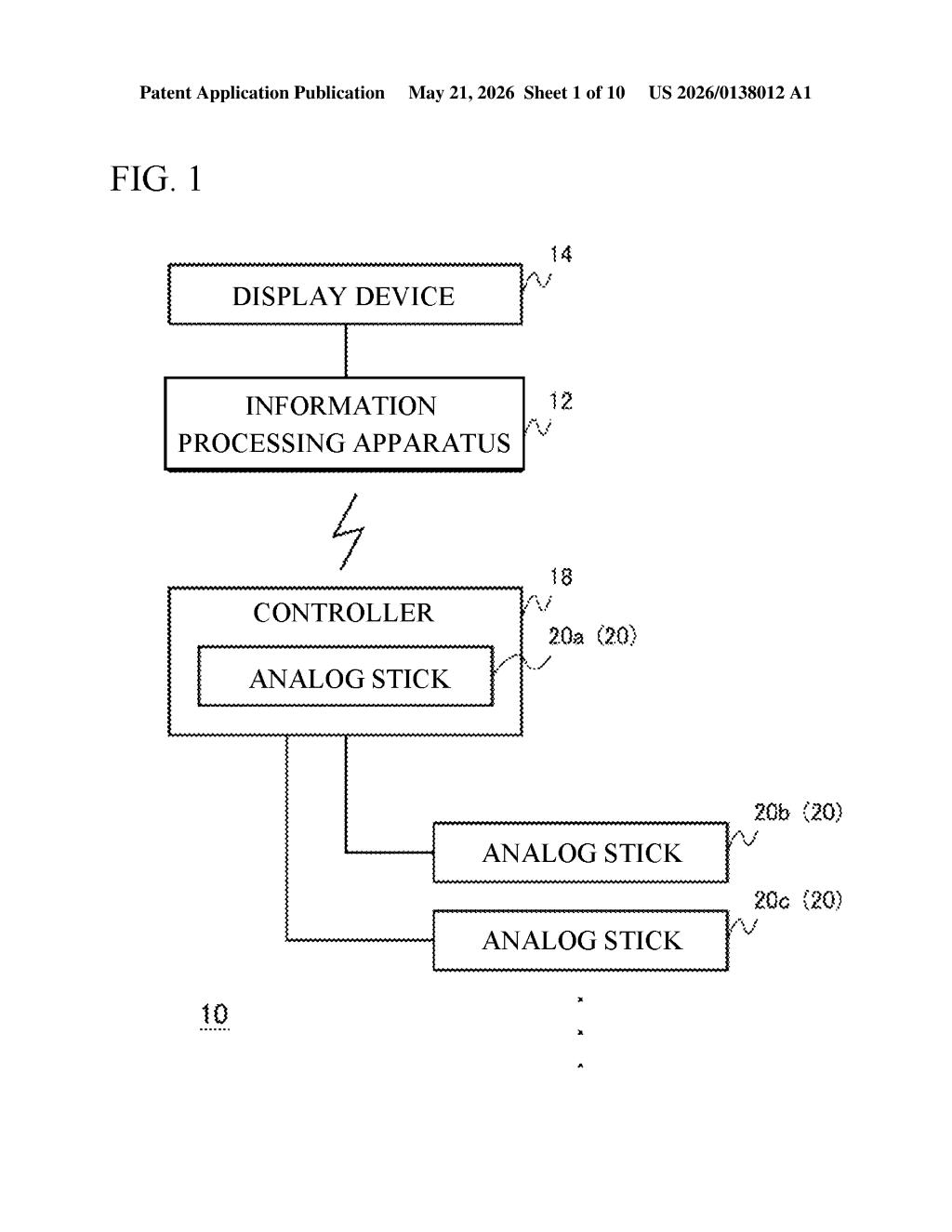
What Sony's representative analog stick system actually does
Imagine a future PlayStation controller with three or more analog sticks. Most of the time that's fine — you move one, the game responds. But what happens when you let go of all of them at once? Every stick sits at its resting position, and the console has to decide which one to treat as the 'active' input. Without a rule for that, you could get conflicting or ambiguous signals sent to the game.
Sony's patent describes a system that watches all the analog sticks simultaneously. When every stick is detected as stationary — sitting in that dead-center idle zone — the system uses a predetermined rule to quietly crown one stick as the representative. Only that stick's value gets passed along as the official input.
It's a bit like a group of musicians all pausing at once: instead of silence being interpreted as noise, the conductor points to one player and says, 'you hold the note.' The result is cleaner, more predictable input data sent to whatever game or application is running.
How Sony's controller picks the representative stick
The patent describes three core components working together inside an operation processing apparatus (think: a game console or the controller's onboard processor).
- Acquisition unit: Continuously reads the 2D positional values from each analog stick — essentially the X/Y coordinates of where each stick is pointing at any moment.
- Determination unit: Monitors whether each stick's value falls within a stationary range (the dead zone around the center position). When all sticks are simultaneously idle, it applies a predetermined rule to select one as the representative operation member.
- Generation unit: Takes the representative stick's value and packages it into the operation information that gets sent downstream to the game or OS.
The 'predetermined rule' is deliberately left abstract in the patent — it could be priority-based (stick A always wins), context-based (whichever stick was touched most recently), or even application-defined. The patent's abstract refers to three analog sticks (20a, 20b, 20c), strongly implying Sony is designing hardware with more than the standard two.
The key insight is that this is a stationary-state disambiguation system — it only kicks in when no sticks are actively being moved, avoiding any conflict with normal gameplay input.
What this means for future PlayStation controllers
Standard DualSense controllers have two analog sticks, and input routing is straightforward. But if Sony is prototyping controllers with three or more sticks — for accessibility, for new control schemes, or for specialized peripherals — the software layer needs to handle ambiguity gracefully. This patent addresses exactly that edge case, and the fact that it names three specific sticks in the abstract suggests the hardware concept is further along than pure speculation.
For you as a player, this is mostly invisible plumbing. But it matters for developers: predictable idle-state behavior means games can safely assume which stick is 'active' without writing custom disambiguation logic for every multi-stick peripheral Sony might ship.
This is quiet but deliberate infrastructure work. Sony wouldn't be patenting multi-stick idle-state logic unless hardware with more than two analog sticks was at least on a drawing board — you don't solve problems you don't have. It's a narrow, unglamorous patent, but it's the kind of detail that only shows up when a product is getting real.
There are more where this came from
We read every patent application Big Tech publishes and send you the ones worth knowing. Plain English, free, every week.
Want this weekly breakdown for a company we don't cover? Patentlyze Pro →