
Red Hat Patents a Nested Container System for Cross-Platform Workloads
Red Hat has patented a way to spin up a container inside another container — sharing the outer container's network identity — so workloads built for a different platform can run without touching the host machine's configuration.
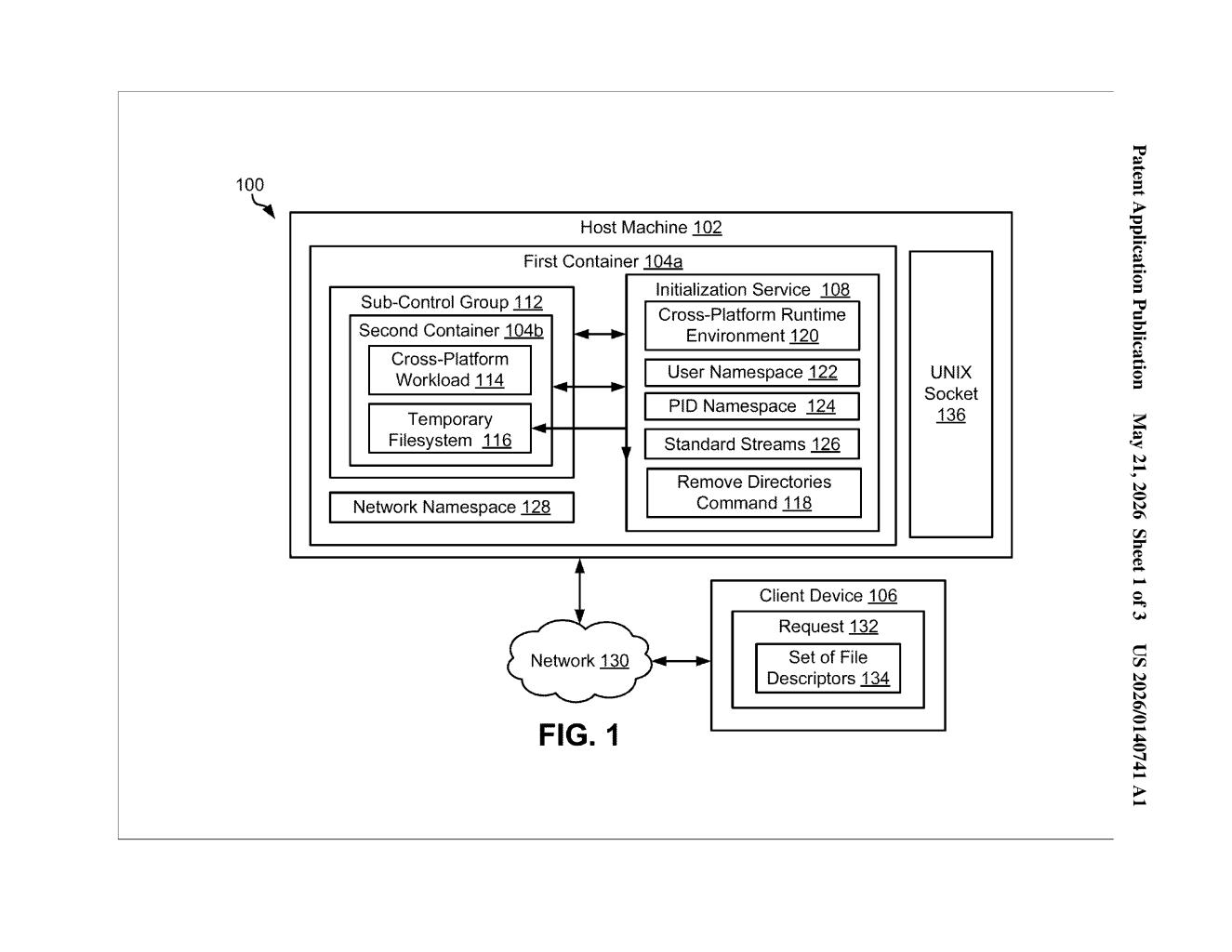
What Red Hat's nested container trick actually does
Imagine you're running a Linux server, and a piece of software shows up that was built for a slightly different environment — different CPU architecture, different OS assumptions. Normally you'd either reject it or reconfigure your whole setup. Red Hat's patent describes a cleaner escape hatch.
The idea is that a container (think of it like a lightweight, isolated box your app runs inside) can spawn a second, inner container specifically tailored for that foreign workload. The inner box borrows the outer box's network identity, so from the outside world nothing looks different — it's still the same IP address, the same connection.
The whole process is managed by an "initialization service" living inside the first container. You send it a request, it builds the right inner environment, and your cross-platform workload runs there. No host-level changes, no new network setup — just a container within a container doing the translation work.
How the init service spawns and wires up the inner container
The patent describes a system where an initialization service running inside a first container acts as a kind of on-demand container factory. When it receives a request flagged as a cross-platform workload, it programmatically generates a second (nested) container and executes the workload inside it.
The key technical detail is namespace sharing. Linux namespaces are the kernel-level mechanism that gives containers their isolation — separate process trees, network interfaces, user IDs, and filesystems. The patent specifies that the inner container reuses the outer container's network namespace (meaning it inherits the same network interfaces and IP address), while other namespaces — user, PID, and mount — can be configured independently for the inner workload.
The filing also mentions several supporting primitives wired up during inner container creation:
- UNIX sockets — for inter-process communication between the init service and the inner container
- Standard streams (stdin/stdout/stderr) — passed through so the inner workload behaves like a normal process
- Sub-control groups (cgroups) — Linux's resource-accounting layer, used to track and limit the inner container's CPU and memory use
- Temporary filesystem and file descriptors — scratch space and open file handles set up for the workload's runtime
The cross-platform runtime component inside the inner container handles any architecture or ABI translation needed for the foreign workload. The outer container's init service orchestrates all of this without requiring the host machine or its container runtime to know anything special.
What this means for multi-platform container deployments
For platform engineers running mixed workloads — say, x86 and ARM binaries on the same cluster, or OCI containers from different base images — this approach keeps complexity inside the container boundary rather than leaking it out to the host or the orchestrator. You don't need to reconfigure Kubernetes node selectors, register a new runtime class, or rebuild the workload image. The outer container just quietly handles it.
This also has security implications worth noting. By keeping the cross-platform runtime isolated in a nested container with its own user and PID namespaces, the foreign workload gets fewer privileges and less visibility into the host. Red Hat — as the company behind RHEL, OpenShift, and significant upstream contributions to Podman and CRI-O — is clearly thinking about how to make multi-architecture container deployments less painful at the infrastructure level.
This is solid, unsexy infrastructure work — the kind of thing that matters enormously to platform teams running heterogeneous clusters but generates zero consumer headlines. Red Hat filing this under a single inventor (Giuseppe Scrivano, a well-known Podman/containers contributor) suggests it grew out of real upstream engineering rather than a patent strategy sweep. Whether it surfaces in Podman, OpenShift, or RHEL's container stack is worth watching.
There are more where this came from
We read every patent application Big Tech publishes and send you the ones worth knowing. Plain English, free, every week.
Want this weekly breakdown for a company we don't cover? Patentlyze Pro →