
IBM Wins Patent for Least Privilege Security in AI Workflow Orchestration
When an AI agent runs a multi-step business workflow, it often gets handed a master key to everything. IBM's new patent proposes a gatekeeper that hands out only the smallest key possible for each individual step.
How IBM's trust companion limits what AI agents can touch
Imagine a contractor who shows up at your office building with a single keycard that unlocks every room, every floor, every server closet. That's a security nightmare, even if the contractor is trustworthy, because one mistake exposes everything.
IBM's patent describes a system called a trust companion that solves this for AI-driven workflows. When an AI system is running a series of automated tasks, like pulling a customer record, updating a database, and sending a report, the trust companion figures out exactly what permissions each individual step needs and issues a temporary pass (token) covering only that. Nothing extra.
Every token used is also recorded for auditing, so if something goes wrong, you can trace exactly what the AI touched and when. Think of it as a detailed sign-in log at a secure facility, but for software permissions.
How the trust companion assigns and tracks per-tool tokens
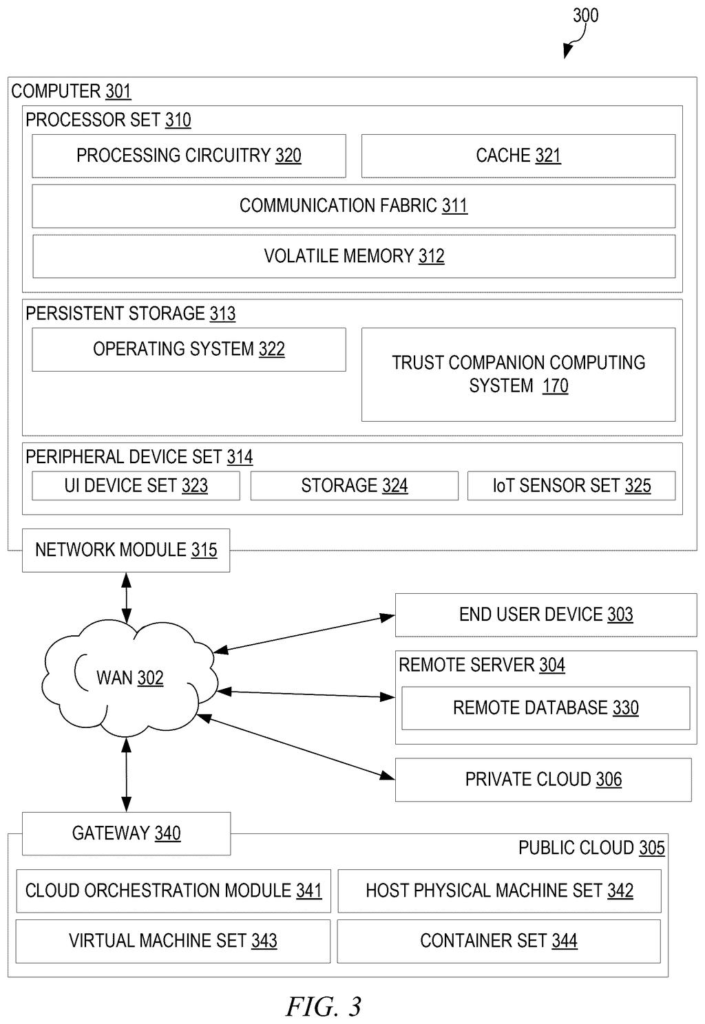
The patent describes a layered architecture built around a trust companion computing system that sits between an AI orchestration platform (the engine coordinating multi-step tasks) and the backend systems those tasks need to access.
When the orchestration platform is about to run a workflow, it sends the workflow steps to the trust companion. For each tool involved in those steps, the trust companion does two things:
- Determines the minimum credential needed for that specific action (for example, read-only access to a database row rather than full admin rights).
- Requests a short-lived token from an identity provider (a service like Okta or Microsoft Entra that issues digital credentials), scoped to only those reduced privileges.
Those narrow tokens are then handed to the AI agents or tools actually doing the work. The claim calls the narrowed permission set a reduced size set of privileges, explicitly smaller than the full set (superset) that might be available.
Finally, a secure backend records every token used during execution, creating an immutable audit trail for compliance and forensic review. This is the provenance angle: you can prove, after the fact, exactly which permissions were used at each step.
What this means for companies running AI automation at scale
As companies plug AI agents into real business systems, those agents often need credentials to do useful work. The easiest approach is to give the AI a high-privilege account and let it sort things out. That's also the approach that turns a compromised or buggy agent into a serious breach.
This patent addresses that directly by automating what security teams call least-privilege enforcement. Instead of relying on developers to manually scope permissions correctly for every tool in every workflow (which rarely happens), a dedicated system does it automatically at runtime. For regulated industries like finance, healthcare, or government, the built-in audit trail is just as important as the access control itself.
This is solid, practical security engineering rather than a flashy AI feature. The problem it solves is real and growing: as agentic AI systems get deployed in enterprise environments, credential sprawl is a genuine risk that most companies are handling poorly right now. IBM's approach of automating least-privilege at the orchestration layer is the right instinct, and the audit trail component makes it genuinely useful for compliance teams, not just security architects.
There are more where this came from
We read every patent application Big Tech publishes and send you the ones worth knowing. Plain English, free, every week.
The drawings
5 drawing sheets from US 2026/0211996 A1 · click any drawing to enlarge


Want this weekly breakdown for a company we don't cover? Patentlyze Pro →