
Intel Patents an AI Filter That Stops Your Speakers from Haunting Your Microphone
Every time your laptop plays audio while you're on a call, a ghost of that sound creeps back into your microphone. Intel wants to kill that ghost with a small neural network running inside the audio pipeline.
What Intel's speaker-leakage fix actually does
Imagine you're on a video call and your laptop is also playing a notification sound, or you forgot to mute before a YouTube clip auto-played. The microphone doesn't just pick up your voice; it also picks up whatever the speakers are pumping out. That bleed-through is called loudspeaker leakage, and it's the reason callers sometimes hear a tinny echo of themselves, or why background audio muddies a recording.
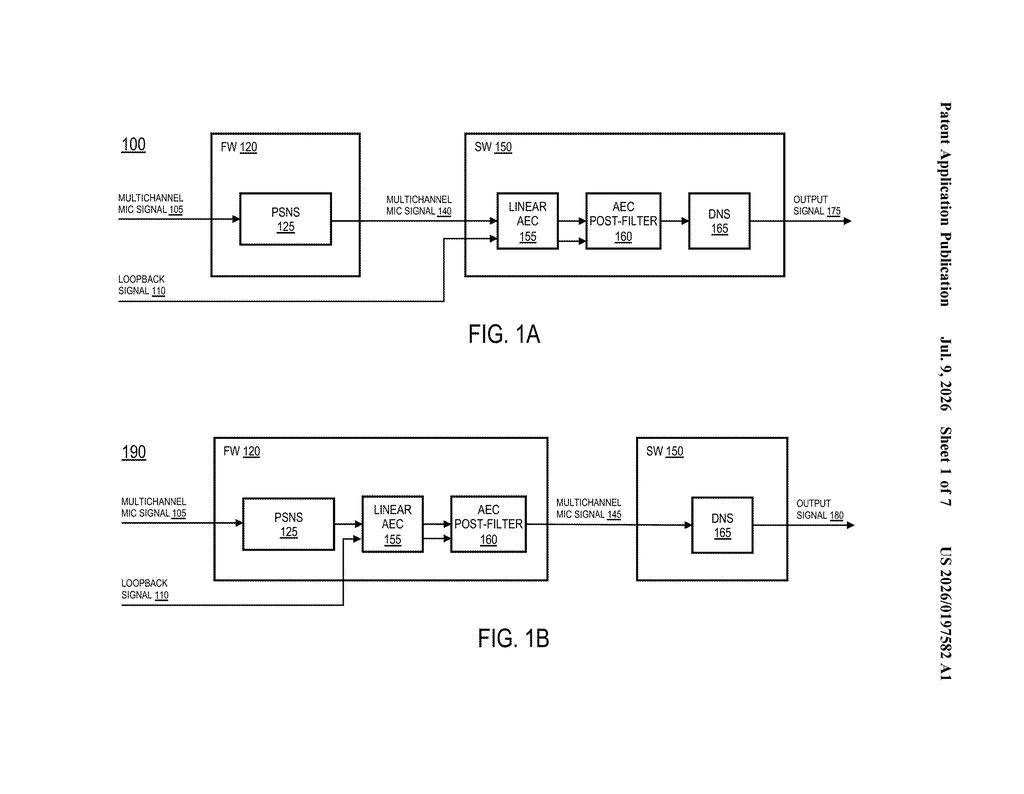
Intel's patent describes a small AI module, called the Loudspeaker Leakage Silencer, that listens to both your microphone and a copy of whatever the speakers are playing. By comparing the two, it figures out which parts of your mic signal are just echoes of the speaker output and then builds a filter to erase them in real time.
The result is a cleaner audio stream sent to whoever you're talking to. The system can work on its own or as a second layer on top of traditional echo-cancellation software already built into most devices, and Intel says it can cut speaker bleed by at least 9 decibels, which is roughly the difference between clearly audible and nearly inaudible.
How the RNN-Mixer generates its suppression mask
The patent describes a software module that sits inside a device's audio processing pipeline (the chain of software steps that handles microphone input before it reaches a call app or recording tool).
The module takes two inputs:
- The raw microphone signal (your voice, plus any unwanted speaker bleed)
- A loopback signal (a direct copy of whatever the device is playing through its speakers, used as a reference)
Those two streams are fed into a neural network built around what Intel calls an RNN-Mixer architecture. RNN stands for Recurrent Neural Network, a type of AI that processes sequences over time, making it well-suited for audio, where sounds unfold moment by moment. The Mixer part refers to how the network blends information across time steps to recognize patterns. This architecture is intentionally lightweight so it can run on-device without hogging CPU resources.
The network doesn't try to reconstruct your voice from scratch. Instead it produces an attenuation mask (essentially a frame-by-frame map of which frequencies to quiet down) and applies that mask to the microphone signal. What comes out is a cleaned-up audio stream with the speaker bleed suppressed. Intel also designed the system to work in cascade mode, meaning it can run after a conventional acoustic echo cancellation (AEC) module to catch the non-linear echo artifacts that traditional AEC tends to miss.
What this means for voice calls on Intel-powered devices
Traditional echo cancellation has been in laptops and phones for years, but it works best on linear echo (clean, predictable reflections of the speaker signal). When speakers distort, clip, or interact with a room in complicated ways, the echo becomes non-linear and much harder to filter out. Intel's system is specifically aimed at that harder problem, which is why it pairs a neural network with a conventional AEC rather than replacing it.
For you as a user, this is about call quality on PCs and other Intel-powered devices. If this module ships inside Intel's audio processing stack, your video calls could sound cleaner without any app-level changes, because the fix lives below the app layer, in the hardware platform's own audio pipeline. That's a meaningful place to fix a problem that every conferencing app currently tries to solve independently, and often inconsistently.
This is a focused, practical patent for a real and annoying problem. It's not a moonshot; it's the kind of infrastructure-level audio work that makes conference calls less miserable. The 9 dB suppression target is a concrete claim, and the lightweight RNN design suggests Intel actually wants to ship this rather than just stake out IP territory.
Get our take in your Top Stories
Liked this breakdown? Add Patentlyze as a preferred source on Google, and our plain-English take shows up more often in your Top Stories the next time Intel patent news breaks.
There are more where this came from
We read every patent application Big Tech publishes and send you the ones worth knowing. Plain English, free, every week.
Want this weekly breakdown for a company we don't cover? Patentlyze Pro →