
Nvidia Files Patent to Keep AI-Built 3D Scenes From Having Floating, Overlapping Objects
AI image tools are good at pretty pictures and bad at physics, so beach chairs sink into towels and umbrellas hover over sand. Nvidia's patent application describes a two-AI team that builds a scene and then fixes where everything sits.
What Nvidia's 3D scene patent actually does
Imagine you type a peaceful beach during sunset into an AI image tool. You get a pretty picture, but the beach chair is sunk halfway into the towel and the umbrella hovers an inch above the sand. For a postcard, that is fine. For a robot or a self-driving car learning from that scene, it teaches the wrong lessons.
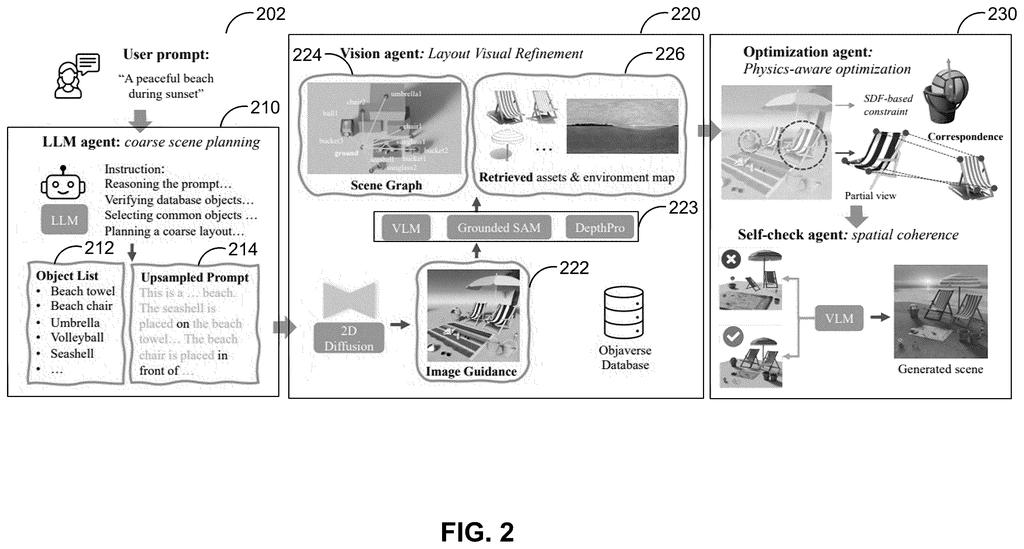
Nvidia's new patent application describes a way to fix that by using two AIs as a team. The first one thinks like a set designer: it lists what a beach scene usually contains (a towel, a chair, an umbrella, a volleyball, a seashell) and decides where each item goes relative to the others. The second one draws a rough guide picture from that plan.
Then comes the cleanup. The system treats each object as a separate piece it can slide and turn, and keeps nudging the pieces until nothing overlaps and everything rests on something solid.
… generating a description of the three-dimensional scene using a first generative AI model of the plurality of generative AI models, the description including at least an enumeration of objects and an arrangement of the objects to be included in the scene; …
Translation: The first AI lists all the items needed and plans out where they go.
How Nvidia's AI nudges objects until they fit
The patent covers a pipeline with two AI models working in sequence. A language model (the same type of AI behind chatbots) takes a short prompt and expands it. It first lists the objects that commonly belong in the scene, then writes a longer description of how they relate, such as one thing sitting on another. One object can be marked as an anchor, and everything else is placed relative to it.
A second, image-making model uses that description to produce a guide picture. Other tools then cut the picture into objects and estimate depth to build a scene graph (a map of every object and how they connect). Each object gets a box that can move in five ways: three directions plus two kinds of rotation. Instead of leaving the scene as one flat picture, the system can pull matching 3D models from a database and drop them in over a background chosen for the scene.
The system then adjusts positions again and again. In the filing's more detailed version, it uses a signed distance field (a measurement of how far any point is from an object's surface, where negative numbers mean the point is inside the object):
- A collision rule pushes overlapping objects apart, toward the scene's center.
- A stability rule keeps the bottom of an object touching the surface it rests on.
… iteratively adjusting positioning of one or more objects in the generated image; …
Translation: The system keeps shifting the items around until they fit together correctly.
Why practice scenes matter for robots and cars
If you ever ride in a self-driving car or share a warehouse with a robot, the software behind it learned somewhere, and often that somewhere is a simulated world. The filing says building those worlds by hand takes a lot of time and money, and earlier automatic methods produced scenes that were too tidy, with everything lined up at right angles. Nvidia's pitch is more varied, physically sensible scenes made from a short text prompt.
The claims also list uses well beyond training, including digital twins (virtual copies of real places), augmented and virtual reality content, and shared 3D asset creation. That fits a company that sells the chips and software for all of it. Any benefit to you would be indirect: if it works, the machines around you have practiced on a wider mix of messy, realistic rooms.
Nvidia's 16th filing we've tracked since July in our teams of AI models list follows earlier applications on a data-to-model translator and selective model loading.
Every design choice here costs something. Chaining a language model, an image model, a cutting-out tool and a depth tool means each step can hand its mistakes to the next, and the filing itself says the first layout is only a rough estimate because objects hide behind each other and the cutting-out step can get things wrong.
The cleanup stage is the smartest part, since floating and overlapping are things a computer can measure and fix. The price is that those rules only catch physical mistakes. A beach chair can rest perfectly on the sand and still face away from the towel, which is why the filing adds common-sense layout rules on top.
Pulling ready-made 3D models from a database also limits variety to whatever is in the library. Still, that trade reads as worth it, because separate movable pieces beat one flat picture. The filing offers no test results, so how well any of this works is unproven.
Get our take in your Top Stories
Liked this breakdown? Add Patentlyze as a preferred source on Google, and our plain-English take shows up more often in your Top Stories the next time Nvidia patent news breaks.
There are more where this came from
We read every patent application Big Tech publishes and send you the ones worth knowing. Plain English, free, every week.
The drawings
5 drawing sheets from US 2026/0330789 A1 · click any drawing to enlarge


Want this weekly breakdown for a company we don't cover? Patentlyze Pro →
Be the first to weigh in