
Adobe Files Patent to Turn a Photo of a Surface Into an Editable 3D Material
Adobe's patent application describes software that looks at a photo of a surface, say a faded chessboard, and builds an editable recipe that paints the same look in 3D. It also tries several versions and keeps the one that looks closest to your photo.
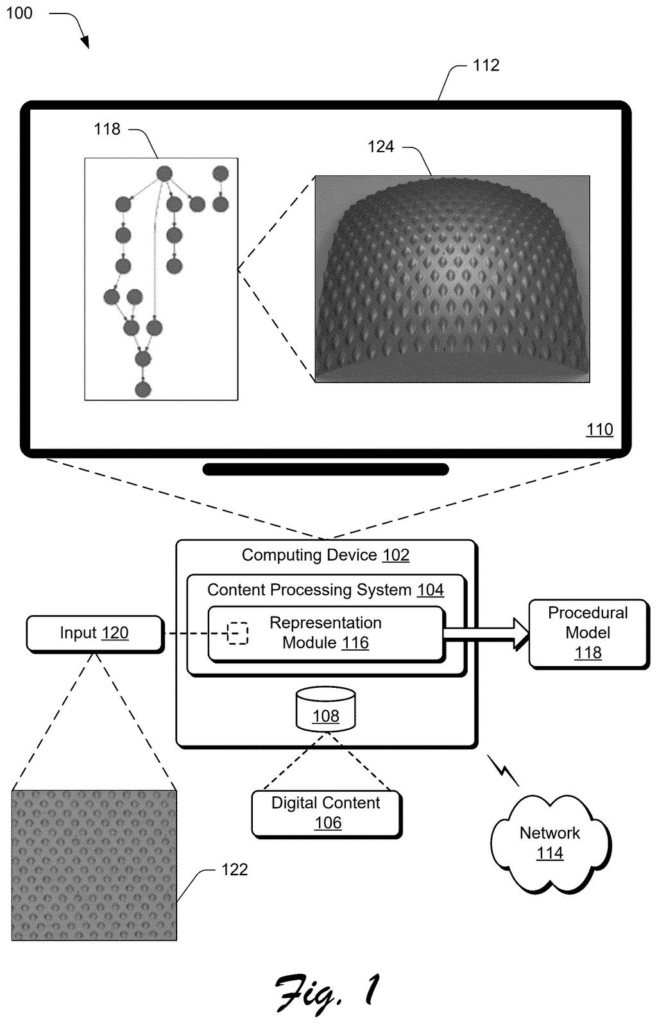
What Adobe's photo-to-texture tool actually does
A game artist spots a faded black-and-white chessboard on a desk and wants the same worn look on a wall in a digital room. Today, getting there usually means building the texture by hand, adjusting dials and connections until it looks right, which takes time and a lot of experience.
Adobe's patent application describes software that does the first draft for you. You give it a photo, and it builds a recipe for that look: a chain of steps that can paint the surface from scratch. A recipe can be stretched to any size, repeated across a big surface, and relit as the lighting changes in a game or scene, which a pasted photo cannot do.
The system also doesn't settle for its first try. It makes several versions, renders each one, and keeps whichever looks closest to your photo.
Conditional procedural model generation techniques are described that enable generation of procedural models that are usable to recreate a visual appearance of an input image.
Translation: New methods allow software to build adjustable digital materials that match the look of any photograph.
How three AI models build a texture recipe
The filing covers a method for turning a single image into a procedural model. In this patent, that is a node graph: a set of boxes (nodes) that each do one image operation, such as blur, sharpen or blend, joined by lines (edges) showing where one box sends its result next. Every node also has settings (parameters) that control how strongly it acts.
Three AI components, called transformers (a type of model that writes out a sequence one piece at a time, the same family behind many chatbots), split the work. One picks the nodes, one wires them together, and one sets the dials. The photo is first boiled down to a list of numbers (a feature vector) that captures its overall content, fine texture and color, and all three components are steered by that list. The dial-setting component also sees the wiring, so each node's settings can account for its neighbors.
The selection step is the core of the first claim:
- Generate several candidate recipes for the same photo.
- Render each recipe into an image.
- Score how visually close each image is to the original photo. The claims name two scoring methods, sliced Wasserstein distance and CLIP cosine distance, which are both ways of measuring visual likeness.
- Keep the best match.
Another claim covers how the training data is cleaned up. The system learns from pairs of a recipe and the image it produces. Recipes containing switch nodes (nodes that choose between alternate branches) are removed, and the description says each branch can become its own recipe, which adds more training pairs.
Why 3D artists could skip hours of hand-tuning
If you work in 3D, the practical change is a faster starting point. Instead of rebuilding a real-world surface step by step, you could feed in a photo of a brick wall, a metal plate or a chessboard and get an editable texture back. Because the result is a recipe, it can be resized without blur, repeated across a large surface, and it reacts to lighting the way a real material would.
The filing points to video games, animation, virtual reality and augmented reality as places where these textures get used. It also describes a second mode that invents fresh textures with no photo at all, trained to produce a wider mix than random generators, which the filing says lean heavily toward wood. Adobe names its own Substance Source library as training material for the system.
Adobe files its 17th patent in the AI simulation work we cover since May, building on ideas like turning text into 3D worlds and new camera angles from one photo.
If you have ever tried to make a digital wall look like the real one in front of you, you know the pain: lots of fiddling with dials for a result that is close but off. This filing aims at that exact chore, and the fix fits it well. You hand over a photo and get back something you can still edit.
The editable part matters most. A texture made from a pasted photo goes blurry when enlarged and looks flat under new lighting, while a recipe holds up at any size. The try-several-and-pick-the-closest step is a sensible safeguard too, since the artist starts from the best of multiple attempts.
Most people will never open a 3D modeling program, so the direct benefit lands on a small group of artists. For them, it could shrink the tweaking to a quick polish, and that is a clear, practical win.
Get our take in your Top Stories
Liked this breakdown? Add Patentlyze as a preferred source on Google, and our plain-English take shows up more often in your Top Stories the next time Adobe patent news breaks.
There are more where this came from
We read every patent application Big Tech publishes and send you the ones worth knowing. Plain English, free, every week.
The drawings
12 drawing sheets from US 2026/0330803 A1 · click any drawing to enlarge


Show the other 4 sheets


Want this weekly breakdown for a company we don't cover? Patentlyze Pro →
Be the first to weigh in