
Nvidia Patents a More Efficient Way to Store 3D Object Shapes
Storing the precise shape of a 3D object digitally takes up a lot of space — Nvidia's new patent describes a clever trick to squeeze that data down while preserving the details that actually matter.
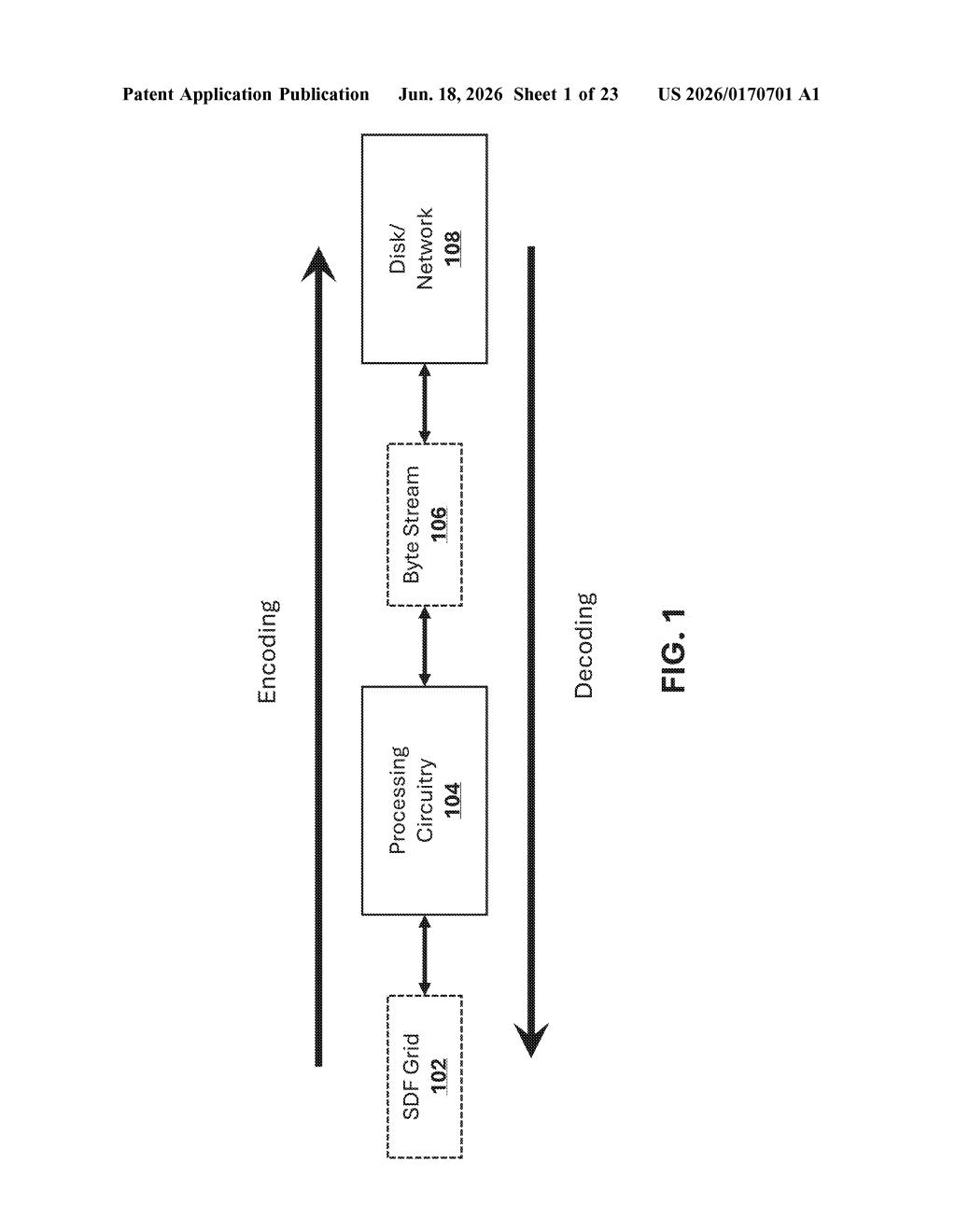
How Nvidia shrinks 3D shape data without losing detail
Imagine you're trying to describe the exact shape of a teacup to a computer. One common method is a signed distance function grid — basically a huge 3D grid where every point stores a number telling the computer how far it is from the surface of the teacup. Useful, but those grids can get enormous.
Nvidia's patent describes a way to compress that grid dramatically. Instead of storing every number, the system starts with a blurry, low-resolution version of the shape, then predicts what the finer details should look like. It only stores a small correction wherever its prediction was wrong — and only near the actual surface of the object, where it counts.
The result is a much smaller file that can still reconstruct the original shape accurately. That kind of compression matters any time a computer needs to work with complex 3D objects quickly — whether it's generating images in a game, training an AI model, or running physics simulations.
How the predictor-corrector scheme trims SDF grid size
The patent describes a multi-resolution predictor-corrector compression scheme for signed distance function (SDF) grids. An SDF grid is a 3D data structure where each point encodes the distance to the nearest surface of an object — positive values outside the surface, negative inside.
The compression process works in stages:
- Start with a coarse, low-resolution SDF grid of the object.
- Repeatedly upsample (mathematically expand) the grid to a higher resolution, generating predicted distance values for the new, finer grid points.
- Compare those predictions against the true values and compute a residual — a small correction number — but only for grid points that are close enough to the object's surface (the distance-based condition).
- Store only those residuals, not the full grid, discarding corrections for points far from the surface where the prediction is already accurate enough.
The final compressed output is a stream of these residuals across all resolution levels. To reconstruct the shape, a decoder reverses the process, applying corrections layer by layer. Points far from any surface get no correction at all, which is where most of the storage savings come from.
What this means for real-time 3D graphics and AI training
SDF grids are increasingly important in AI-generated 3D content and real-time graphics. Neural rendering systems, physics engines, and robotic simulation tools all lean on them heavily. Compressing them efficiently means less memory, faster loading, and the ability to work with higher-fidelity geometry without blowing up storage budgets.
For Nvidia specifically, this fits squarely into its push to power AI workloads that involve 3D environments — from autonomous vehicle simulation to generative 3D models. If you've ever seen a game or simulation stutter as it loads detailed geometry, this kind of work is why engineers spend years on it. Smaller, faster data means smoother experiences on the same hardware.
This is a solid, focused engineering patent — not the kind of thing that ends up in a press release, but exactly the kind of foundational work that makes ambitious 3D AI applications practical. Nvidia clearly sees SDF-based geometry as a long-term infrastructure bet, and filing compression patents around it is a logical way to protect that turf.
There are more where this came from
We read every patent application Big Tech publishes and send you the ones worth knowing. Plain English, free, every week.
Want this weekly breakdown for a company we don't cover? Patentlyze Pro →