
Nvidia Patents a Fix for the Visible Seams That Appear in Multi-Camera Photos
When two cameras capture adjacent parts of a scene, they almost never agree on how bright or saturated the scene is. Nvidia's new patent tackles the ugly seam that mismatch creates before the images are even joined.
What Nvidia's camera-stitching color fix actually does
You're looking at a 360-degree photo or a car's surround-view display, and there's an obvious line where two camera feeds meet. One side looks slightly warmer, the other cooler, and the join looks like a bad photo collage rather than a single picture. That line is called a stitching artifact, and it's caused by each camera processing its image slightly differently.
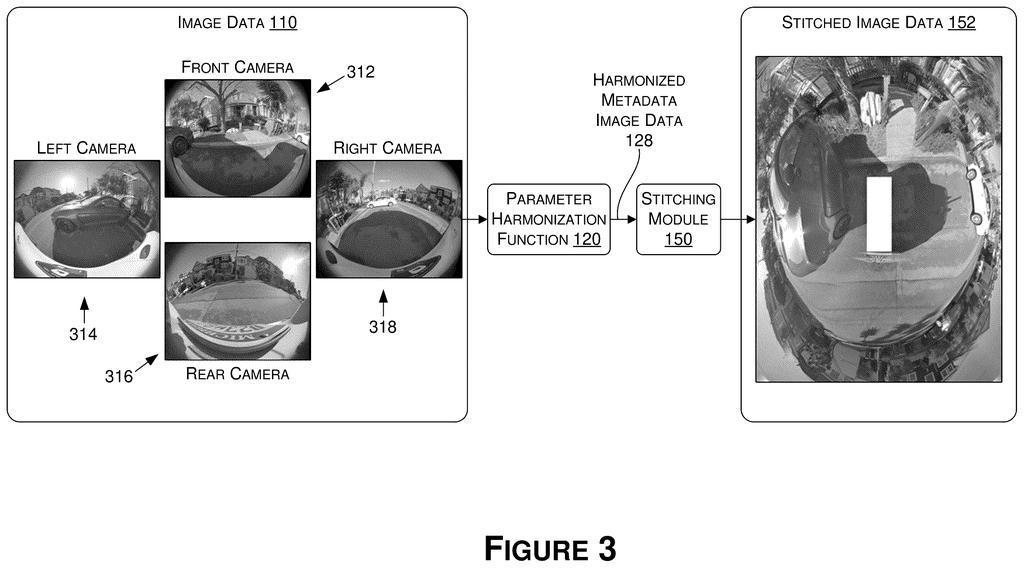
Nvidia's patent describes a way to fix this before stitching happens. Instead of blending the pixels themselves after the fact, it looks at the processing settings each camera used (things like brightness scaling and tone mapping), then gradually nudges both cameras' settings toward a shared middle value right at the seam. The result is that by the time the two images are joined, they already agree on what the border should look like.
The fix is handled in software on the chip that processes the camera signal, so no new camera hardware is needed. Both images are adjusted independently, each sliding toward a shared target at the edge, which means the rest of each image stays largely untouched.
… apply a first parameter gain function that adjusts the first parameter value in at least a portion of the first image directionally toward the boundary parameter value at the image border; apply a second parameter gain function that adjusts the second parameter value in at least a portion of the second image directionally toward the boundary parameter value at the image border …
Translation: It smoothly shifts the camera settings of both photos toward a shared value near the edge where they meet.
How the gain function smooths brightness at the image border
The patent focuses on a specific step in image processing called ISP (image signal processor) parameter harmonization. An ISP is the chip logic that converts raw sensor data into the color, brightness, and contrast values you actually see. When two cameras feed into a stitching system, each ISP may have settled on different values for those rendering parameters, producing a visible discontinuity at the border.
The system works in three steps:
- It reads the metadata parameters (brightness gain, white balance, tone curve settings) attached to each of the two images.
- It calculates a boundary parameter value, a shared target at the seam, derived from both images' settings.
- It applies a parameter gain function to each image separately, gradually adjusting pixel values in the border region toward that shared target without touching the rest of the image.
The gain function is essentially a ramp: pixels far from the seam keep their original processing settings, while pixels near the seam are progressively shifted toward the boundary value. This avoids a hard jump in rendering at the join line.
Critically, the harmonization happens before the stitching algorithm runs, not after. Post-hoc blending can smear detail; pre-processing the metadata means the images already agree at the border before they are composited, which preserves edge sharpness.
Pixels in both images located along the border are adjusted to the same boundary metadata parameter value, and smoothed based on the parameter gain function. A discontinuity in rendering parameters is avoided, substantially avoiding corresponding artifacts in the resulting stitched image.
Translation: This removes harsh lighting changes so you do not see ugly lines where separate camera frames join.
What this means for panoramic and surround-view cameras
For consumers, the most visible use case is surround-view cameras in cars. Multi-camera rigs that stitch a bird's-eye view around a vehicle are now common on mid-range cars, and the seam between cameras is a persistent annoyance. A software-only fix in the ISP pipeline could clean those up without a hardware redesign.
The same problem exists in security cameras, drones, and content-creation rigs where multiple lenses are combined into a wide panorama. Because the fix lives in the parameter metadata rather than the pixel data itself, it can adapt dynamically as lighting conditions change, which matters a lot in moving vehicles or outdoor cameras that face shifting sun angles. Nvidia's track record in imaging pipeline patents suggests this fits a broader push into vision processing for autonomous and robotic systems.
Nvidia's 26th filing we've tracked in our AI photo editing race since May follows one on aging objects and one on blending by certainty.
The core change described here is software, not hardware. It adjusts how a camera system processes metadata before handing images to a stitching algorithm, which means no new chips or lenses are required to make it work.
The fix is deliberately narrow: it targets the specific problem of mismatched brightness or color settings at the seam between two camera images. Geometric gaps or motion blur at that seam are separate problems this patent does not claim to solve.
For a multi-camera platform that already runs this kind of image processing, the shortest path to shipping this is likely a driver or firmware update rather than a new product line.
There are more where this came from
We read every patent application Big Tech publishes and send you the ones worth knowing. Plain English, free, every week.
The drawings
12 drawing sheets from US 2026/0301355 A1 · click any drawing to enlarge


Want this weekly breakdown for a company we don't cover? Patentlyze Pro →
Be the first to weigh in