
Nvidia Patents Hardware Ray Tracing for Curved 3D Geometry
Rendering realistic hair, fur, or cables in real time has always forced GPUs to cheat. Nvidia's new patent moves curve geometry — the kind used for every strand of hair in a game — directly into hardware ray tracing, potentially eliminating a major software workaround.
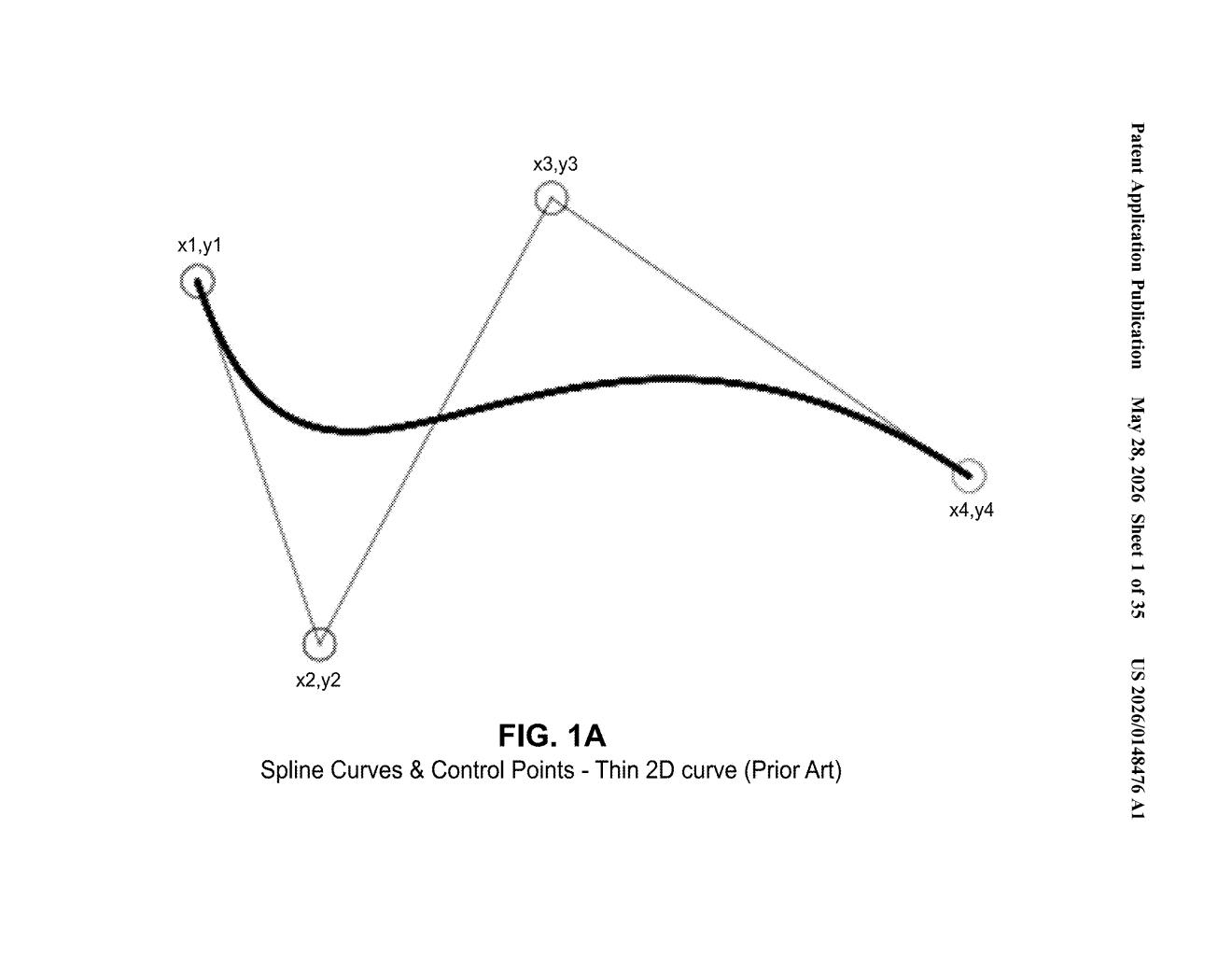
What Nvidia's Linear-Swept Sphere ray tracing actually does
Imagine every strand of hair on a game character, every blade of grass, or every fiber-optic cable in a data-center visualization. Each of those is a curve primitive — a thin, tube-like shape that ray tracers historically struggle with because their hardware was designed around triangles and simple spheres.
Right now, rendering curves in a ray tracer typically requires a software detour: the GPU hands control off to a small shader program to figure out whether a light ray actually hits a strand. That's slower and burns valuable compute resources. Nvidia's patent describes dedicated hardware logic that handles this math directly on the chip — no software shader required.
The key trick is something called a Linear-Swept Sphere (LSS): picture a capsule shape defined by dragging a sphere from one point to another. Chain those capsules together and you can approximate any curve. Nvidia's new circuit tests whether a ray intersects those capsules entirely in silicon, which is much faster than delegating to software.
How the LSS intersector circuit handles curve traversal
The patent describes a multi-pass ray-primitive intersector circuit — a dedicated block of hardware inside a ray tracing engine — that handles Linear-Swept Sphere (LSS) primitives. An LSS is essentially a capsule: a cylinder with hemispherical end caps, defined by two endpoints and a radius at each end. Curve geometry (hair, fur, tubes, cables) can be approximated by chaining LSS segments together.
Traditionally, ray tracers use a structure called a Bounding Volume Hierarchy (BVH) — think of it as a nested set of boxes that lets the GPU quickly skip geometry a ray can't possibly hit. For curves, the current approach uses software "intersection shaders" to do the final hit test, which adds latency. This patent moves that test into fixed-function hardware with a loopback connection on the intersector circuit — meaning the circuit can run multiple passes on a single LSS segment when needed (for example, when the geometry is degenerate or when an exit hit point, not just an entry hit, is required).
Notable capabilities the patent specifically enables:
- Single end-cap LSS — a half-capped tube, useful for open-ended segments that connect to the next piece of a curve
- Exit hit point queries — returning where a ray leaves a primitive, not just where it enters, which matters for translucency and subsurface scattering
- Degenerate-shell intersection testing — handling edge cases where the sphere collapses to a flat disk or a line segment without crashing the pipeline
The variable-pass loopback is the architectural key: rather than provisioning worst-case circuitry for every possible curve configuration, the hardware iterates only as many times as the specific primitive requires.
What this means for real-time hair and fur rendering
For game developers and VFX artists, hair and fur rendering is one of the most expensive effects in real-time graphics. The fact that Nvidia is patenting dedicated hardware for it suggests the next generation of GeForce or professional RTX hardware could handle strand-based geometry with meaningfully less overhead. You'd see the benefit in games with realistic characters or dense vegetation without the frame-rate penalty that currently comes with those effects.
More broadly, this reflects Nvidia's ongoing strategy of moving more rendering math into fixed-function hardware — the same approach that made triangle rasterization fast decades ago. If LSS intersection becomes a hardware primitive the way triangles did, it could reshape how real-time rendering pipelines are built across gaming, simulation, and scientific visualization.
This is real, substantive silicon-level work — not a software trick dressed up in a patent filing. Curve geometry has been a known pain point in real-time ray tracing for years, and if Nvidia ships this in hardware, developers won't need to maintain separate software fallback paths for hair and fur. It's the kind of plumbing improvement that quietly makes a generation of games look noticeably better.
There are more where this came from
We read every patent application Big Tech publishes and send you the ones worth knowing. Plain English, free, every week.
Want this weekly breakdown for a company we don't cover? Patentlyze Pro →