
Nvidia Patents Software That Calculates How Far Away Objects Are
Figuring out exactly how far away something is from a camera is one of the hardest problems in computer vision — and Nvidia is betting a neural network can solve it by thinking in probabilities rather than hard answers.
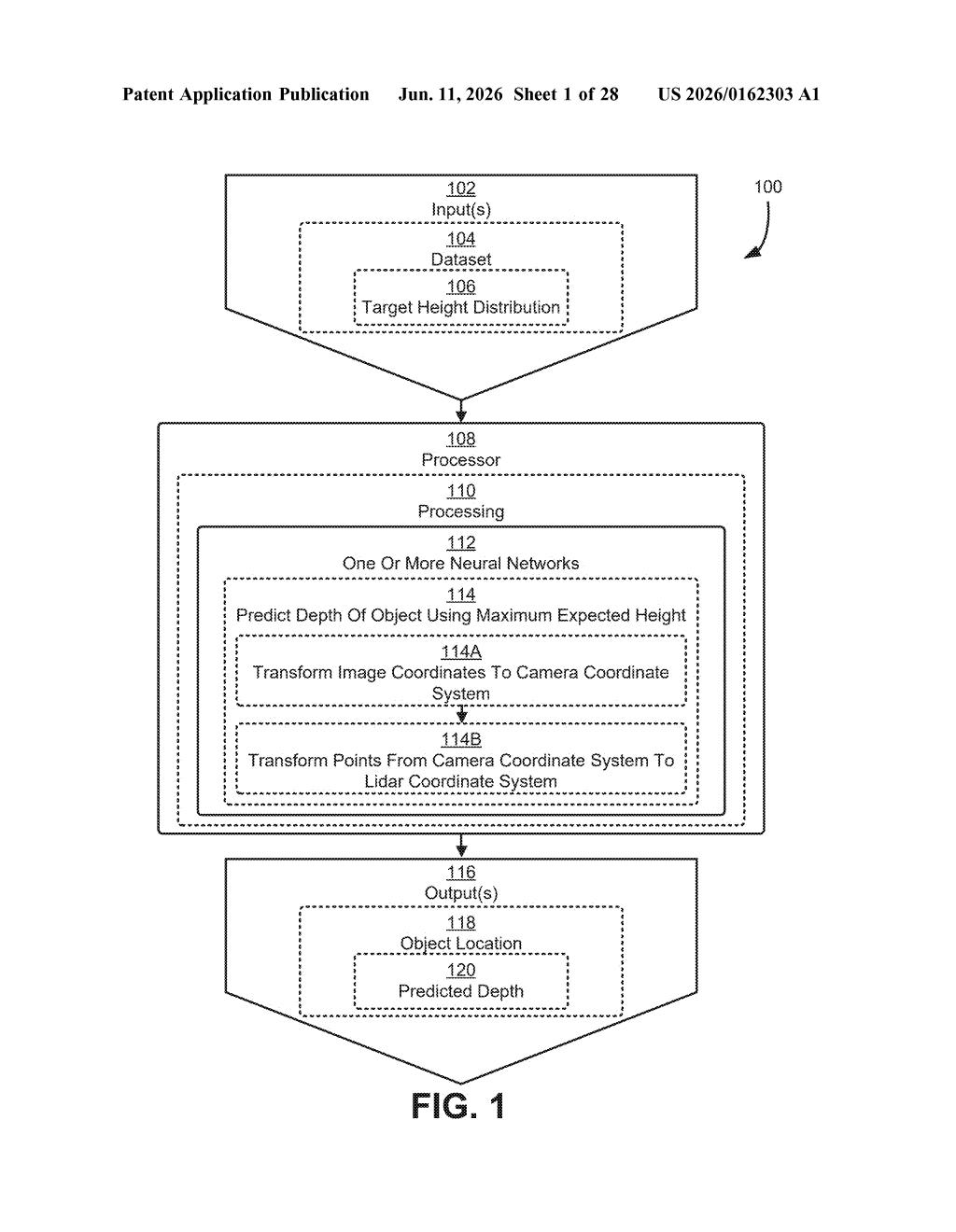
How Nvidia's depth-guessing neural network actually works
Imagine you're backing out of your driveway and your car's camera spots a kid on a bike. Knowing whether that kid is 5 feet away or 15 feet away is the difference between braking in time and not. That distance judgment — called depth estimation — is surprisingly hard for a regular camera to get right.
Nvidia's patent describes a neural network (a type of AI that learns from examples) that looks at a camera image and, for each tiny dot of color in that image, estimates how likely it is that the object sits within different distance ranges. Instead of committing to one single distance, it hedges across a range of possibilities — which turns out to be a more honest and accurate way to handle the uncertainty.
This kind of technology is foundational for self-driving cars, warehouse robots, and any machine that needs to understand the physical world from a flat camera image. Nvidia, which makes the chips that power most of those systems, is filing to own a piece of that core capability.
How the network assigns probability ranges to pixel depth
At its core, this patent covers a processor — or more specifically, the circuits inside it — that runs one or more neural networks to determine the distance of objects captured in a camera image.
The key idea is probabilistic depth estimation: rather than outputting a single distance number per pixel, the network produces a set of probabilities across multiple depth ranges. Think of it like a weather forecast that says "40% chance of rain between 2–4pm, 30% between 4–6pm" instead of just picking one time. Each pixel in the image gets its own probability distribution across possible distances.
This matters because:
- Single-value depth guesses break down in tricky lighting or ambiguous textures
- Probability distributions let downstream systems (like a robot's decision engine) know how confident the network actually is
- Multiple cameras can be used together, with the network reconciling their overlapping views
The patent is written broadly — covering any processor with circuits that perform this function — which suggests Nvidia wants foundational IP covering the general approach, not just one specific implementation.
What this means for Nvidia's robotics and self-driving push
Depth perception is table stakes for autonomous systems. Self-driving cars, delivery robots, industrial arms, and augmented-reality headsets all need to know where objects are in three-dimensional space, and cameras are the cheapest and most common sensor available. Nvidia's chips — the Drive platform for vehicles and Jetson for robotics — sit at the center of most serious deployments of this technology.
By filing broad IP on the probabilistic neural-network approach to depth estimation, Nvidia is planting a flag in a technique the field is actively converging on. For you as a consumer, better depth estimation means safer driver-assistance features and more reliable robots in warehouses that stock the shelves you order from.
This is a foundational, broadly written patent on a technique that is genuinely important — probabilistic depth estimation is a real improvement over deterministic approaches, and Nvidia filing on it makes strategic sense given how central their hardware is to autonomous systems. That said, the claim as written is so wide that it will face scrutiny; there's a lot of prior art in this space, and the grant likelihood reflects that.
There are more where this came from
We read every patent application Big Tech publishes and send you the ones worth knowing. Plain English, free, every week.
Want this weekly breakdown for a company we don't cover? Patentlyze Pro →