
Nvidia Patents an AI Decision-Making System That Ignores Environmental Noise
AI models are notoriously sensitive to conditions they weren't trained on, producing wildly different answers from nearly identical inputs. Nvidia's latest patent targets that exact problem.
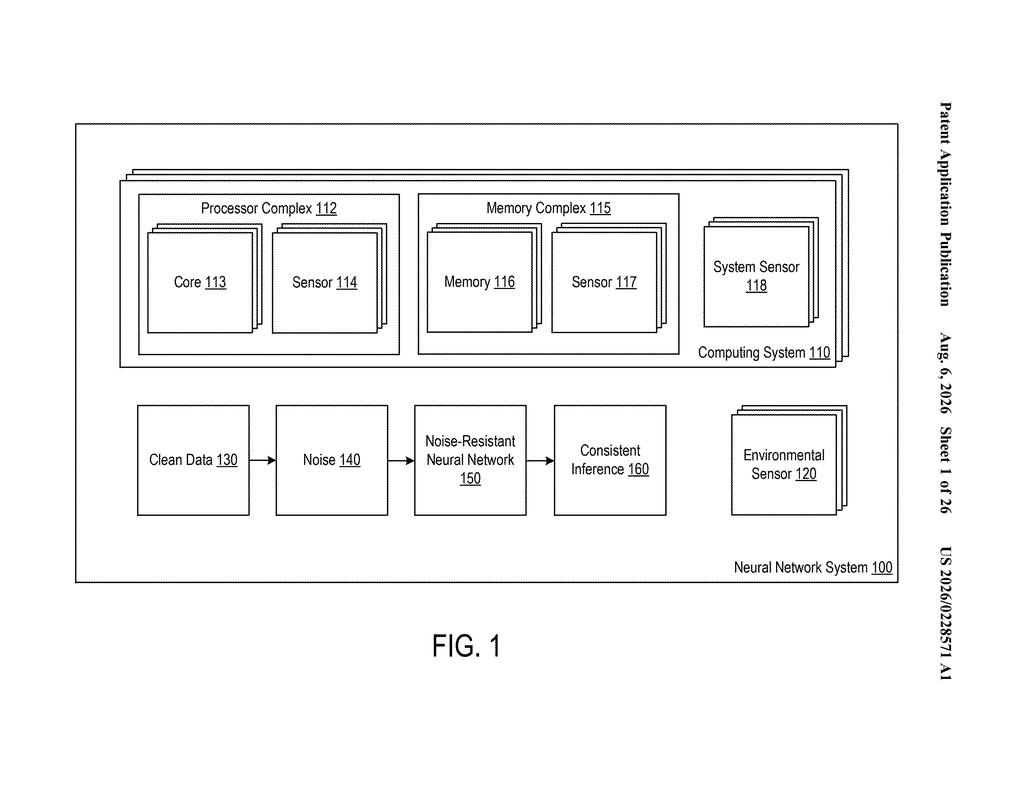
How Nvidia wants AI to stay consistent under messy conditions
Imagine asking an AI assistant the same question twice, once in a quiet room and once in a noisy café, and getting completely different answers each time. That kind of inconsistency is a real problem when AI is making decisions in the physical world, like guiding a robot arm or reading a sensor on a factory floor.
Nvidia's patent describes a way to build AI systems that produce measurably consistent results from the same input data, no matter what environmental conditions surround the hardware at the time. Temperature shifts, electrical interference, and other physical variables can all subtly affect how a chip processes information, and this system is designed to filter that out.
The practical goal is an AI that you can trust to give the same answer whether the device running it is sitting in a cool server room or baking inside a car on a summer afternoon.
one or more circuits to use one or more neural networks to generate measurably consistent information from multiple inferences using same information to be inferenced irrespective of changes in environmental conditions.
Translation: Specialized hardware runs AI models to produce steady results despite messy surroundings.
How the neural network filters out environmental interference
The patent describes a processor architecture that runs one or more neural networks in a way that maintains consistent inference outputs even when environmental conditions, things like temperature, voltage fluctuation, or electromagnetic interference, change around the hardware.
The core claim is that the processor's circuits are designed to produce measurably consistent information across multiple inferences from the same input data. In other words, feed the system the same image or sensor reading twice under different conditions, and you get the same answer both times. That sounds basic, but it's genuinely difficult to guarantee on physical silicon.
The patent is light on implementation specifics, but the general approach in this class of invention typically involves:
- Redundant or fault-tolerant circuit paths that cross-check outputs
- Calibration logic that accounts for known sources of hardware variation
- Neural network architectures trained or fine-tuned to be resilient to input perturbations caused by hardware noise
The single inventor, Chong Yu, filed this in February 2025, and the abstract's emphasis on environmental conditions suggests the target is edge or embedded AI hardware, where conditions are far less controlled than a data center.
… one or more neural networks may generate inferences, where these inferences may include measurably consistent information from the same input data irrespective of changes in environmental conditions.
Translation: The system delivers reliable AI conclusions from identical inputs even when the environment fluctuates.
What stable AI output means for robotics and edge hardware
For AI running in a data center, environmental stability is largely a solved problem. But AI is increasingly running at the edge, inside vehicles, industrial robots, medical devices, and consumer gadgets, where temperature swings and electrical noise are facts of life. A self-driving system or a robotic assembly line that gives inconsistent outputs because the hardware got warm is a safety problem, not just a performance one.
If Nvidia can bake noise resistance directly into its AI chip architecture, that's a meaningful selling point for customers deploying Jetson-class or automotive-grade silicon in harsh environments. It also lines up with Nvidia's push into physical AI and robotics, where reliability under real-world conditions matters far more than benchmark scores.
This patent is narrow in scope and short on technical detail, which makes it hard to evaluate on its own. What's interesting is the context: Nvidia filing specifically for noise-resistant inference points squarely at edge and automotive deployments, where hardware reliability is a genuine competitive differentiator. Worth a second look if Nvidia announces new Jetson or DRIVE platform features later this year.
There are more where this came from
We read every patent application Big Tech publishes and send you the ones worth knowing. Plain English, free, every week.
The drawings
26 drawing sheets from US 2026/0228571 A1 · click any drawing to enlarge


Want this weekly breakdown for a company we don't cover? Patentlyze Pro →
Be the first to weigh in