
Sony Patent Merges Mismatched 3D Sensors Into One Precise Unified Frame
Different sensors see the world at different speeds, and that mismatch creates blurry or misaligned data. Sony's latest filing describes a way to stitch those mismatched readings together accurately, frame by frame.
How Sony's sensor-blending system actually works
Imagine you're trying to combine footage from two cameras: one shoots at 30 frames per second, the other at 120. If you just lay them on top of each other, the motion won't line up. Sony's patent tackles the exact same problem, but for the 3D sensors used in gaming and virtual reality rather than ordinary cameras.
The system takes data from two sensors that run at different speeds and a third, faster sensor acts like a referee, measuring how things in the scene actually moved between each reading. That movement information, called optical flow, is used to nudge the slower sensor's data into the right position before the two streams are combined.
The end result is a single, corrected snapshot of the scene that reflects what all three sensors saw, without the motion blur or positional errors you'd get from just averaging them together. For you as a player or developer, that means a more accurate, stable picture of the world around a console or headset.
perform fusion of first frame data and second frame data, the first frame data being generated at a first interval by a first sensor through space sensing, the second frame data including a plurality of pieces of subframe data each generated at an interval shorter than the first interval by a second sensor through the space sensing …
Translation: It combines data from two different sensors that capture details at different speeds.
How the optical flow step corrects the timing mismatch
The patent describes a computer system that ingests data from three distinct sensors, each operating at a different temporal resolution (how often it produces a fresh reading).
- First sensor: produces one complete frame at a moderate rate, for example every 100 milliseconds.
- Second sensor: works differently. It breaks its output into several smaller subframes, each captured quickly, but the full set takes even longer to collect than the first sensor's frame.
- Third sensor: runs faster than either of the other two and is used only as a motion reference, not as primary data.
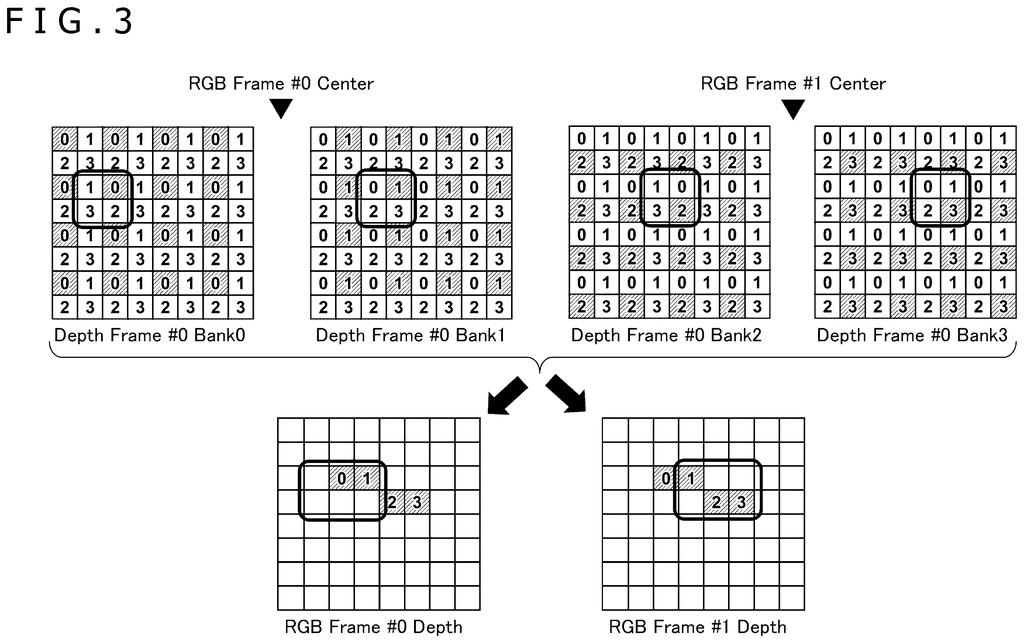
The key technical step is generating an optical flow map, a pixel-level description of how objects moved between the moment the second sensor's subframe was captured and the moment the first sensor captured its frame. Think of it like GPS waypoints that tell you exactly how far something shifted during the gap.
Using that map, the system shifts the position data inside the second sensor's reading so it aligns with where things actually were when the first sensor fired. Only then are the two data streams fused into a single output. The third sensor's job ends at the motion-estimation step; it doesn't contribute directly to the final combined result.
… generate an optical flow between a reference time for at least one subframe data in the second frame data and a reference time for the first frame data based on a result of sensing of the space by a third sensor of which temporal resolution is higher than those of the first and second sensors …
Translation: A third high speed sensor tracks movement to align the timing between the other two sensors.
What this means for PlayStation's next sensing hardware
Sony Interactive Entertainment makes PlayStation consoles and the PlayStation VR2 headset, both of which depend on multiple depth and motion sensors reading the environment simultaneously. When those sensors run at different speeds, any naive combination of their data introduces ghosting, depth errors, or tracking glitches. A reliable way to correct for timing mismatches would make tracking more accurate without requiring all sensors to run at the same expensive high frame rate.
For you as a player, more accurate sensor fusion translates to fewer moments where a VR headset loses track of your head position or a controller's depth reading jumps unexpectedly. It could also let Sony use a mix of cheaper, slower sensors alongside one faster reference sensor rather than making every sensor run at the highest speed, which would reduce cost and power draw.
This is quiet infrastructure work, but the kind that actually ships. Sensor fusion is one of the hardest unsolved problems in consumer VR, and patents that address the timing-mismatch angle specifically are worth tracking. If Sony is filing this now, it almost certainly reflects real engineering challenges they're working through for a future sensing platform.
There are more where this came from
We read every patent application Big Tech publishes and send you the ones worth knowing. Plain English, free, every week.
The drawings
12 drawing sheets from US 2026/0228919 A1 · click any drawing to enlarge


Want this weekly breakdown for a company we don't cover? Patentlyze Pro →
Be the first to weigh in